
G2 – Moderate geomagnetic storm watch, X1.5 flare erupts from departing Region 3697
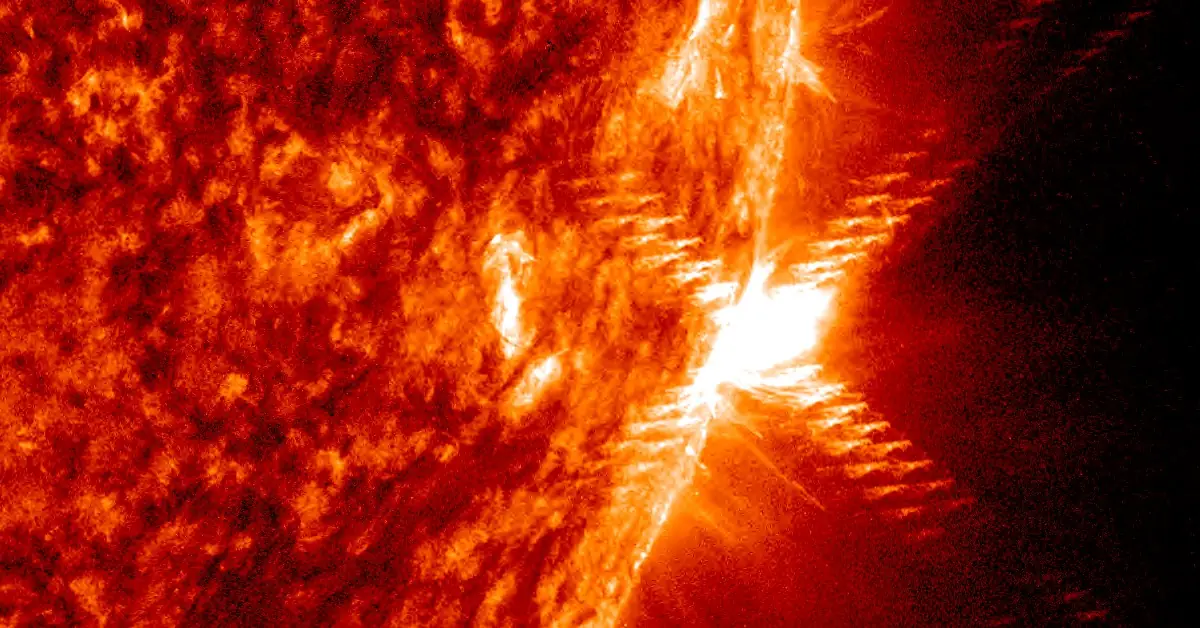
Featured image: X1.5 solar flare on June 10, 2024. Credit: NASA SDO/AIA 304, Helioviewer, The Watchers
A G2 – Moderate geomagnetic storm watch is in effect for June 10, 2024, due to the anticipated arrival of coronal mass ejection (CME) produced by a long-duration M9.7 solar flare on June 8.
Region 3697 is now located at or just behind the WSW limb of the Sun and is starting its farside rotation. Before departing, the region produced M1.0 at 20:17 UTC on June 9, M3.3 at 06:09 UTC on June 10, and X1.5 at 11:08 UTC today.
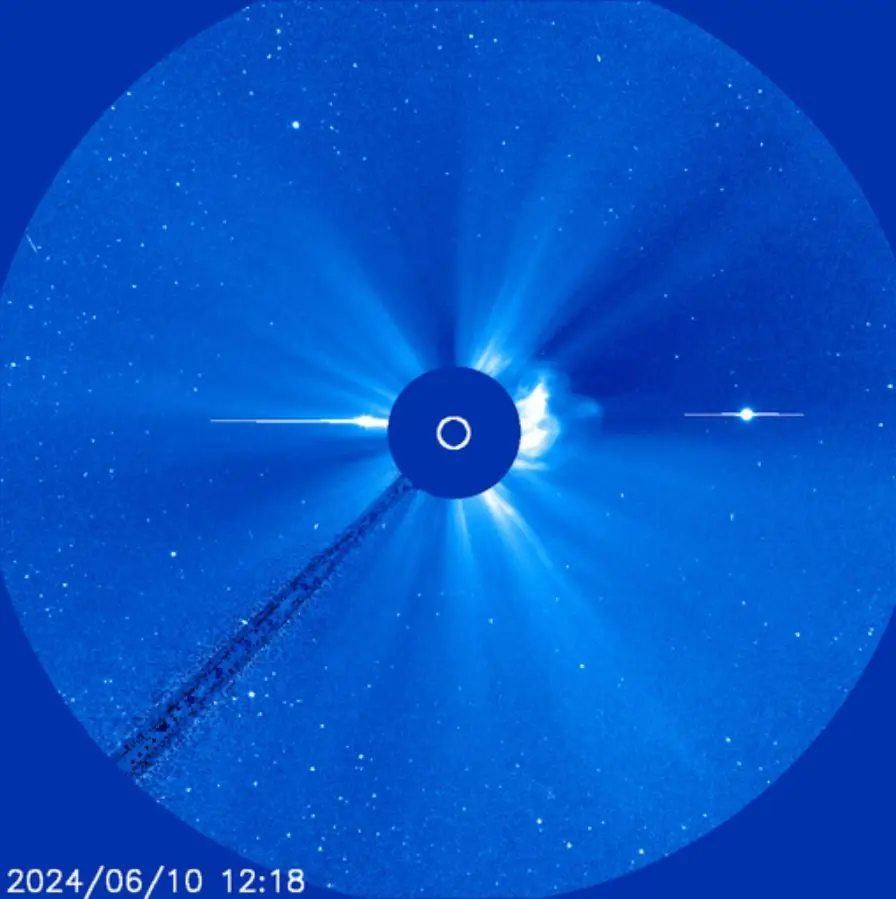
A CME was produced by today’s X1.5 flare but it’s directed away from Earth. Radio frequencies were forecast to be most degraded over Europe, the Middle East, and Africa at the time of the flare.


This region — previously numbered 3664 — produced around 100 M-class and over 10 X-class solar flares during its last rotation through the Earth side of the Sun in the first half of May. Multiple CMEs it produced at the time resulted in a G5 – Extreme geomagnetic storm — the strongest since 2003 — on May 10 and 11. On May 14, this region produced X8.7 solar flare — currently the strongest solar flare of Solar Cycle 25.
The region was still potent during its second Earth-side rotation but it didn’t exhibit such extreme activity.
Notable recent activity includes X2.8 on May 27, long-duration X1.4 on May 29, impulsive X1.1 on May 31, X1.4 on June 1, long-duration M7.3 on June 1, and long-duration M9.7 on June 8 which created a powerful CME with an Earth-directed component expected to impact Earth today — June 10.
As a result, active to G2 – Moderate geomagnetic storm levels are expected later on June 10. Active to G1 – Minor storm levels are likely on June 11 as CME impacts slowly decline followed by a return to quiet and unsettled levels is expected on June 12.
Solar activity is expected to be at R1 – Minor to R2 – Moderate levels through June 10 with a slight chance (25%) for isolated X-class flare activity. A chance for moderate levels and a slight chance for isolated X-class flare activity is forecasted for June 11 and 12.
Solar radiation storm produced by the M9.7 flare on June 8 reached S3 – Strong levels at around 07:50 UTC on June 8 and subsided below S1 – Minor threshold around 23:20 UTC on June 9.


Teo Blašković founded The Watchers in 2011 and edited it until 2026, covering seismic and volcanic activity, extreme weather, space weather and near-Earth objects. Articles on this page are his archive.
Earlier reporting
Nothing on Watchers was published in the last 24 hours. These are older articles.
- On October 22, 2017, a single flash of lightning stretched 515 miles from eastern Texas to near Kansas City, a distance that takes eight hours to drive, and nobody realized how far it had gone until scientists went back through the satellite data years later Epicenter
- CPC posts a slight risk of heavy rain from the Gulf Coast to the Northeast urban corridor November 25-29, and a moderate risk of West Coast wind and Sierra snow on November 25
- Florida's east coast faces a moderate flash flood risk Wednesday through Friday, with 4 to 8 inches of rain forecast and the St. Johns River near Cocoa already in major flood at 17.13 feet
- Cyclone Akvan to make landfall between Nellore and Visakhapatnam around noon on November 20, IMD forecasts 120-130 km/h winds gusting to 145
