
Amazing Earth-grazing fireball over the Mediterranean Sea

Image credit: TW
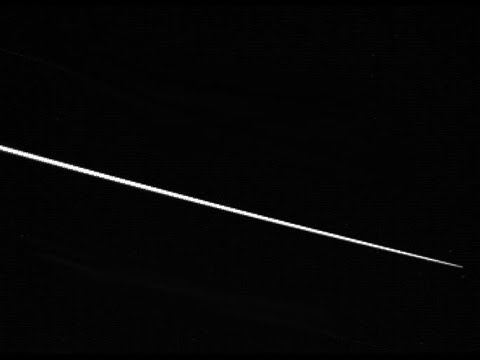
A stunning, slow-moving fireball crossed the night sky over the Mediterranean Sea at 04:08 UTC on December 4, 2021.
The bolide was generated by a rock (a meteoroid) from a comet that hit the atmosphere at about 83 000 km/h (51 600 mph), according to the principal investigator of the SMART project, Dr. Jose M. Madiedo, from the Institute of Astrophysics of Andalusia (IAA-CSIC).
The fireball began at an altitude of about 99 km (61 miles) over northern Morocco, moved northeast following an almost parallel trajectory with respect to the ground, and overflew the Mediterranean Sea.
It ended at a height of around 100 km (62 miles) over the sea, over a point located at around 85 km (53 miles) southeast of Ibiza, Balearic Islands, Spain.
The meteoroid that gave rise to this Earth-grazing bolide survived and left our atmosphere following a modified orbit around the Sun.
In total, the distance traveled in the atmosphere by this bolide was of about 760 km (472 miles).
The meteor was recorded in the framework of the SMART project, operated by the Southwestern Europe Meteor Network (SWEMN) from the meteor-observing stations located at Sevilla, La Hita (Toledo), La Sagra (Granada), Calar Alto (Almería), Sierra Nevada (Granada), Huelva, El Aljarafe (Sevilla), and Madrid (Universidad Complutense).
Featured image and video courtesy: Jm Madiedo

The Watchers team and our contributors bring the latest on extreme weather, earthquakes, volcanic eruptions, space weather, and all things science. We're all about making sense of the natural world and keeping you informed on what’s happening. Got a tip or a question? Hit us up using the form at newstips!
Published in the last 24 hours
- A Virginia park ranger was struck by lightning seven times and lived, even though three of the strikes set his hair on fire Epicenter
- The hole in the ozone layer over Antarctica was about twice the size of the US this year, and scientists say it would have been bigger still if ozone-eating chemicals were at their 2000 levels Epicenter

Mathew 24 knocking at the door!