
Unexpected large Perseid outburst detected on August 14
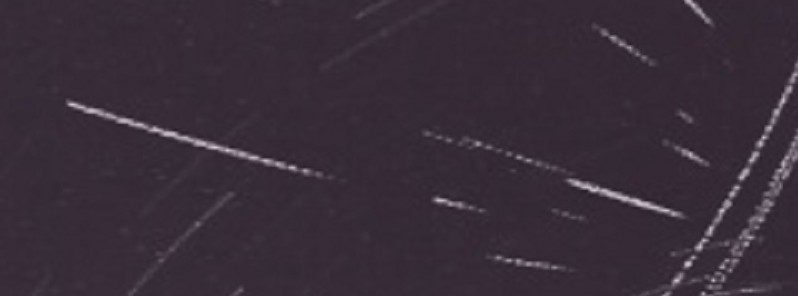
Image credit: This is a composite image of meteors captured from the San Diego area between 08:00 and 09:00 UTC on August 14, 2014. This camera faces overhead and the radiant lies outside the frame to the right. The long streaks are aircraft. Courtesy University of Arizona
The Perseid meteor shower displayed an unexpected outburst between 06:00 and 9:00 UTC on August 14, 2021, at a level of 3 times the Perseid peak level before it returned to normal levels by 13:00 UTC. This activity may be related to the earlier smaller enhancements observed in 2018 and 2019.
The outburst peaked at solar longitude 141.474 ± 0.005 degrees (equinox J2000.0) and the activity profile had a Full-Width-at-Half-Maximum of 0.08 degrees solar longitude and a peak rate of ZHR = 130 ± 20 per hour above the normal ~45 per hour annual Perseid activity, Peter Jenniskens and Koen Miskotte of MeteorNews report.1 2
The Perseids had a steeper magnitude size distribution index than the normal annual shower component. The activity profile is similar to that derived from visual and forward meteor scatter observations.
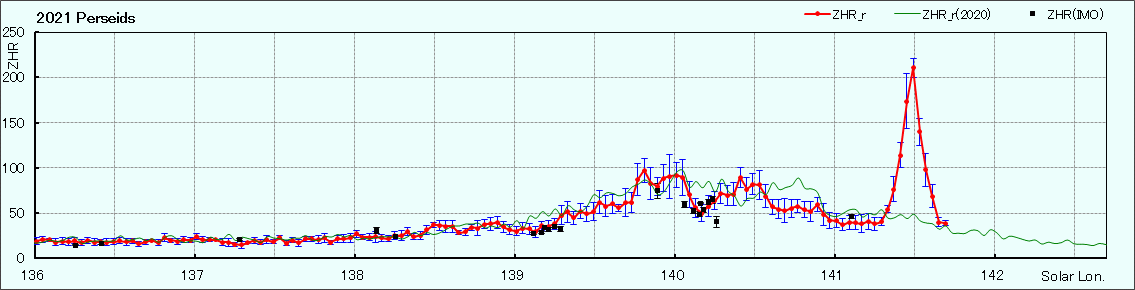
Image credit: MeteroNews
The 2021 outburst happened at a time best suited to the CAMS video-based meteoroid orbit survey networks in the United States.
The networks triangulated meteors using low-light video cameras and determined the meteor’s radiant and speed in continuous nighttime surveillance.
In 2018, visual observers reported a narrow peak of Perseid shower activity around solar longitude 140.95°, about ~30 hours after the traditional Perseid maximum, with a peak of about ZHR = 25 per hour above the normal Perseid activity of ZHR ~ 45 per hour at that time (Miskotte 2019).
In 2019, a similar peak was recorded by forward meteor scatter observations collected by the International Project for Radio Meteor Observation. That year, the outburst peaked at solar longitude 141.02° with a peak ZHR ~30 per hour above normal activity (Miskotte 2020a; 2020b).
"The cause of this outburst is currently unknown but is probably the result of an unknown filament of comet debris produced by comet 109P/Swift–Tuttle as it raced through the inner solar system many centuries ago," the International Meteor Organization (IMO) said.3
References
1 Strong outburst Perseids on August 14, 2021 ~ 06-09 UTC – MeteorNews
2 Perseid meteor outburst 2021 – MeteorNews
3 Unexpected Perseid Meteor Outburst on 14 August 2021 – IMO

I'm a dedicated researcher, journalist, and editor at The Watchers. With over 20 years of experience in the media industry, I specialize in hard science news, focusing on extreme weather, seismic and volcanic activity, space weather, and astronomy, including near-Earth objects and planetary defense strategies. You can reach me at teo /at/ watchers.news.

Commenting rules and guidelines
We value the thoughts and opinions of our readers and welcome healthy discussions on our website. In order to maintain a respectful and positive community, we ask that all commenters follow these rules.