
2019 Mercury transit across the Sun

Image credit: NASA/SDO

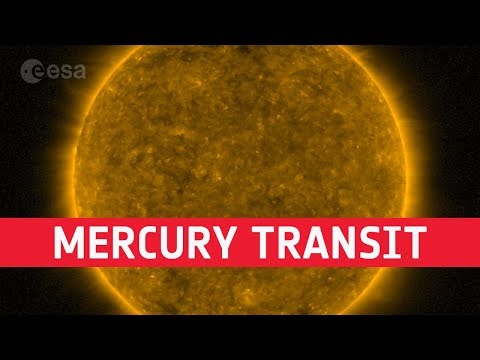

Skywatchers around the world witnessed a rare celestial event on November 11, 2019 – planet Mercury moving across the face of the Sun. From the perspective of humans on Earth, Mercury spent 5.5 hours crossing in front of the face of the Sun. This is the last Mercury transit until 2032.
European Space Agency's (ESA) Proba-2 and NASA's Solar Dynamics Observatory (SDO) had a "ring-side seat" for the rare transit, capturing planet Mercury as a small black disc, moving from left to right.
The planet's silhouette began to advance to the Sun's disk at 12:35 UTC – it was when the Sun was over the horizon for viewers in South America, eastern Central America, and the U.S. East Coast.
For viewers in the rest of the U.S., Mercury was already hovering across the Sun by sunrise.
For watchers in most of Africa and Europe, Mercury was still moving across the Sun as it dipped below the western horizon.
Our Solar Dynamics Observatory, in orbit around Earth, keeps a constant eye on the Sun to monitor and study the Sun’s changes, putting it in the front row for many eclipses and transits. Experience the Mercury transit through SDO's eyes. pic.twitter.com/AWA6AwL4Bl
— NASA Sun & Space (@NASASun) November 11, 2019
A solar transit is when a celestial body is seen passing across the solar disc from the Earth's perspective.
Mercury undergoes around 13 transits every 100 years, the last one being in 2016.
See other SDO views at 2019 Mercury Transit

Published in the last 24 hours
- On December 26, 2004, a 10-year-old British girl on a Phuket beach recognized the frothing sea from a recent geography lesson, and her warning helped clear the beach before the tsunami struck Epicenter
- A volcano in Tonga exploded so loudly in 2022 that people in Alaska, 6,000 miles away, were woken by the booms. Hawaii, at half that distance, heard nothing at all
