
Tropical Storm “Helene” forms near West Africa, Hurricane Watch issued for parts of Cabo Verde Islands
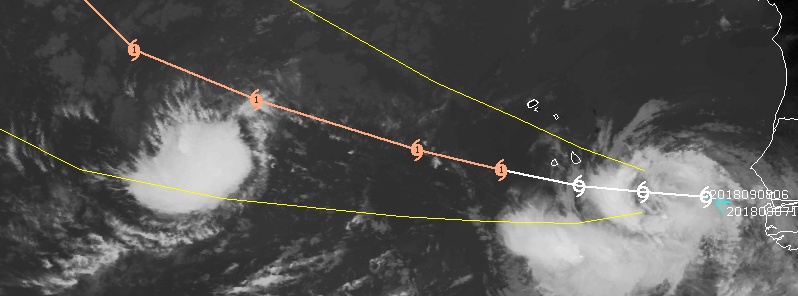
Image credit: UW-CIMSS
Tropical Storm "Helene" formed 03:00 UTC on September 8, 2018, near the coast of West Africa as the 8th named storm of the 2018 Atlantic hurricane season. The cyclone is moving westward toward the southern Cabo Verde Islands where tropical storm conditions are expected by the end of the day. The government of the Cabo Verde Islands has issued a Hurricane Watch for the southern islands of Santiago, Fogo and Brava.
At 12:00 UTC on September 8, the center of Tropical Storm "Helene" was located 465 km (290 miles) of the southernmost Cabo Verde Islands. The storm was moving W at 20 km/h (13 mph) and had maximum sustained winds of 75 km/h (45 mph) and minimum central pressure of 1 001 hPa.
On the forecast track, the center of Helene will pass very close to the southern Cabo Verde Islands late September 8 and early September 9 (AST).
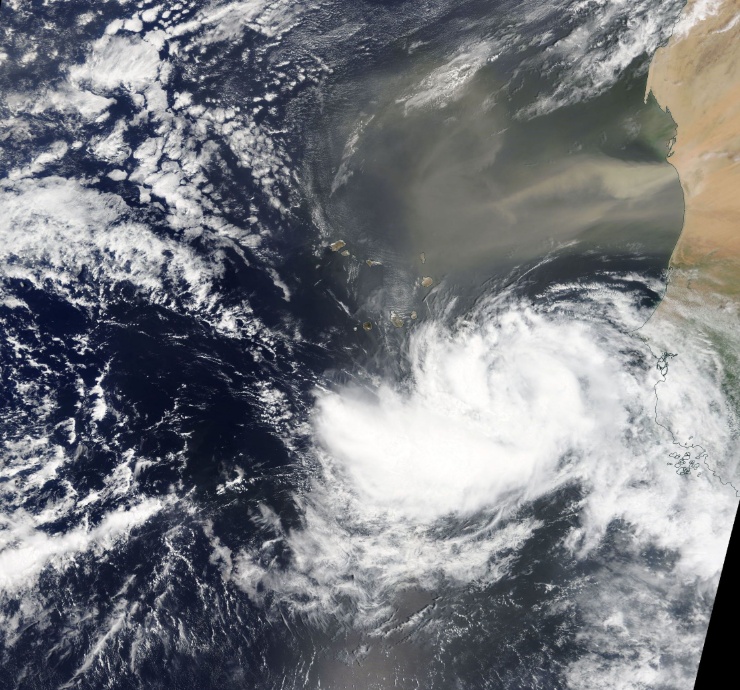
Tropical Storm "Helene" on September 8, 2018. Credit: NASA/NOAA Suomi NPP/VIIRS
A Hurricane Watch is in effect for the Cabo Verde islands of Santiago, Fogo, and Brava. A Hurricane Watch means that hurricane conditions are possible within the watch area in this case within the next 24 to 36 hours.
A Tropical Storm Warning is in effect for the Cabo Verde islands of Santiago, Fogo, and Brava. A Tropical Storm Warning means that tropical storm conditions are expected somewhere within the warning area in this case within the next 24 to 36 hours.
A general turn toward the WNW with an increase in forward speed is expected early next week.
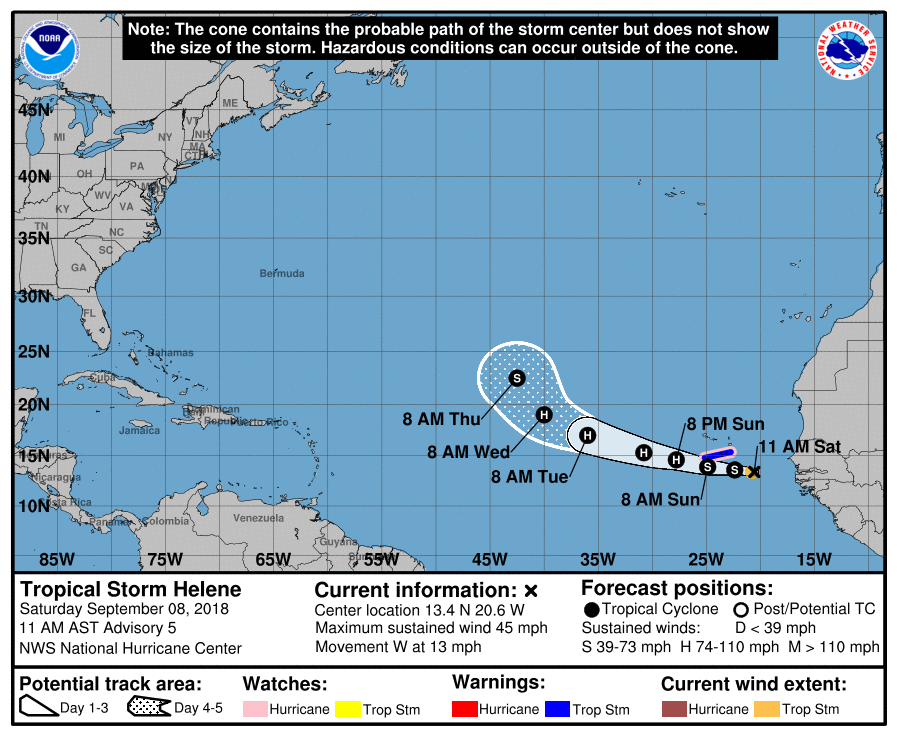
Tropical storm conditions are expected to first reach the warning area tonight or early Sunday (AST) while hurricane conditions are possible in the southernmost Cabo Verde Islands on Sunday, September 9.
Helene is expected to produce total rain accumulations of 76.2 to 127 mm (3 – 5 inches) over the southern Cabo Verde Islands through September 9, with isolated maximum amounts of 203.2 mm (8 inches). This rainfall may produce life-threatening flash floods, NWS warns.

Teo Blašković founded The Watchers in 2011 and edited it until 2026, covering seismic and volcanic activity, extreme weather, space weather and near-Earth objects. Articles on this page are his archive.
Published in the last 24 hours
- Strong El Niño reinforces above-normal winter precipitation outlook across southern and eastern U.S.
- Odisha evacuated 983,642 people before Phailin crossed near Gopalpur on 12 October 2013 with winds of 200-210 km/h gusting to 220, and 44 died, against 9,885 in the 1999 super cyclone. Cyclone Akvan crossed the same coast on 20 November 2026. Epicenter
- Lava fountains reached 1,900 feet (580 m) at Kīlauea Iki in 1959, the highest ever recorded at Kīlauea, as USGS forecasts episode 57 fountaining at Halemaʻumaʻu for November 22-26. Epicenter
- Novarupta in Alaska erupted about 3 cubic miles of magma in roughly 60 hours from 6 June 1912, 30 times Mount St. Helens in 1980, and strong northwesterly winds lifted that same loose ash on 16 November 2026, prompting an NWS SIGMET. Epicenter

may God be with you all