
Asteroid 2017 WW1 to flyby Earth at a distance of 0.37 LD
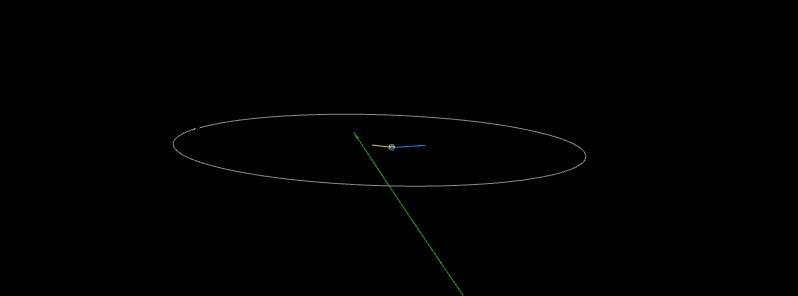
Featured image: The green line indicates the object's apparent motion relative to the Earth, and the bright green marks are the object's location at approximately one-hour intervals. The Moon's orbit is grey. The blue arrow points in the direction of Earth's motion and the yellow arrow points toward the Sun. Credit: Minor Planet Center.
A small asteroid designated 2017 WW1 will flyby Earth at a distance of 0.37 LD / 0.00094 AU (~140 621 km / 87 378 miles) at 19:18 UTC on November 21, 2017. This is 50th known asteroid to flyby Earth within 1 lunar distance since the start of the year.
2017 WW1 was first observed at Mt. Lemmon Survey at 08:41 UTC on November 20, 2017. It belongs to the Apollo group of asteroids and has an estimated diameter between 3 and 6.8 m (9.8 to 22.3 feet).
This object will flyby Earth at a speed (relative to the Earth) of 12.66 km/s at 19:18 UTC today.
[ Ephemeris | Orbit Diagram | Orbital Elements | Physical Parameters | Close-Approach Data ]
This is the 4th known asteroid to flyby Earth within 1 lunar distance this month, 15th since October 2 and 50th since the start of the year. It is also one of the smallest.
Reference
Asteroid 2017 WW1 at Minor Planet Center; CNEOS

Teo Blašković founded The Watchers in 2011 and edited it until 2026, covering seismic and volcanic activity, extreme weather, space weather and near-Earth objects. Articles on this page are his archive.
Published in the last 24 hours
- In September 1859, a solar storm lit up the night sky so brightly that gold miners in the Rocky Mountains woke up after midnight and started cooking breakfast, convinced the aurora glowing over their camp was the sunrise Epicenter
- A patch of warm Pacific water that could become the strongest El Niño in more than 70 years sits thousands of miles from any American town, yet it is already the main reason NOAA expects a wetter winter across the South and a milder one across the North
- A 19-year-old Nebraska teacher reportedly tied her pupils together with twine and led them to safety through a blizzard in January 1888 Epicenter
