
Hurricane “Jose” producing dangerous surf and rip currents along US east coast
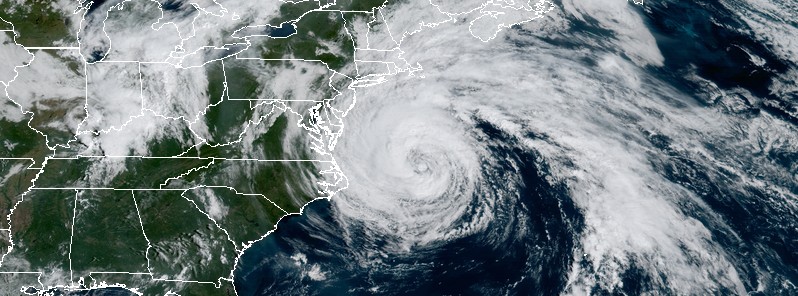
Featured image: Hurricane "Jose" at 14:45 UTC on September 19, 2017. Credit: NOAA/GOES-16 (preliminary and non-operational)
Hurricane "Jose" is a large tropical cyclone now swirling off the coast of the eastern United States, producing dangerous surf and rip conditions along the coast for several more days.
At 15:00 UTC (11:00 EDT) on September 19, 2017, the center of Hurricane "Jose" was located 370 km (230 miles) ENE of Cape Hatteras, North Carolina and 545 km (335 miles) SSW of Nantucket, Massachusets. The cyclone has maximum sustained winds of 120 km/h (75 mph), making it a Category 1 hurricane on the Saffir-Simpson scale. Jose is moving north at 11 km/h (7 mph) with the minimum central pressure of 976 hPa.
This general motion is expected to continue through today with a turn to the northeast anticipated today. On the forecast track, the center of Jose is expected to pass well offshore of Delmarva peninsula later today (local time), pass well to the east of New Jersey coast on Wednesday, and pass offshore of southeastern Massachusets by Thursday, September 21.
Little change in strength is expected today, but Jose should begin to gradually weaken on Wednesday.
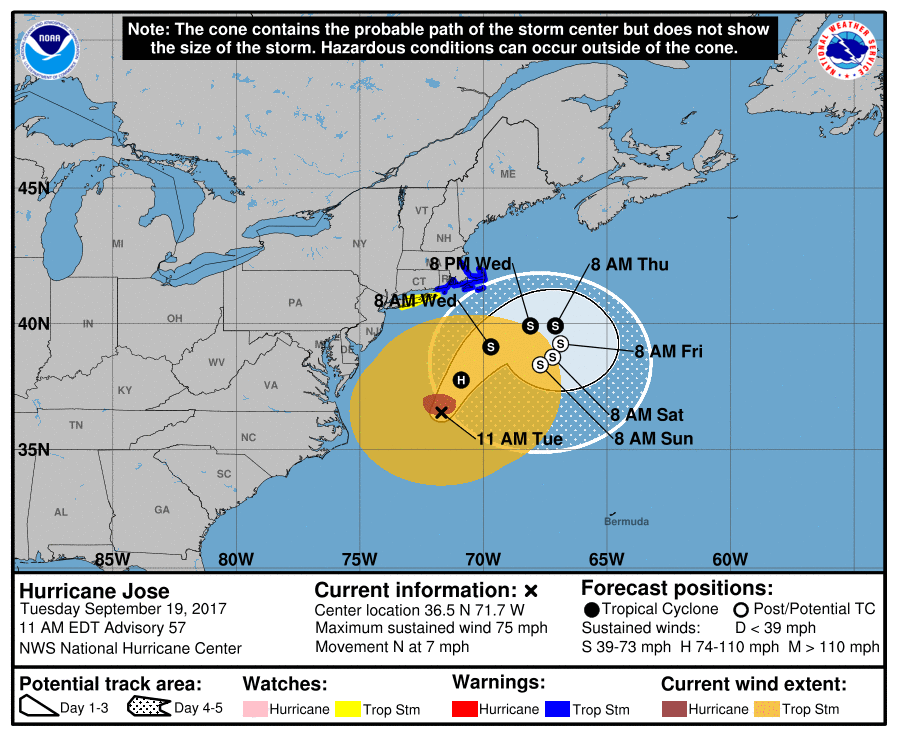
A Tropical Storm Warning is in effect for:
- Watch Hill to Hull
- Block Island
- Martha's Vineyard
- Nantucket
A Tropical Storm Warning means that tropical storm conditions are expected somewhere within the warning area within 36 hours.
Tropical Storm Watch is in effect for the coast of Long Island from Fire Island Inlet to Port Jefferson.
A Tropical Storm Watch means that tropical storm conditions are possible within the watch area, in this case within the next 24 to 36 hours.
Interests elsewhere along the U.S. east coast from North Carolina northward to New England should monitor the progress of Jose, NHC advised.
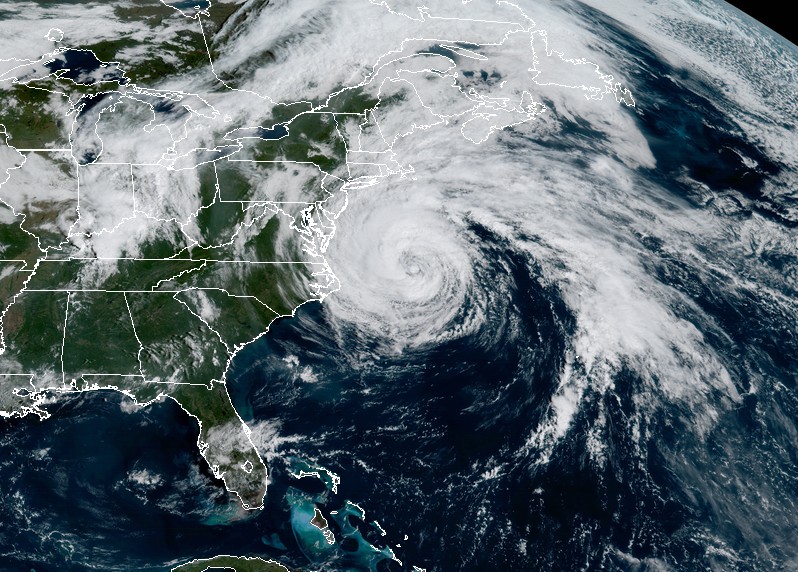
Hurricane "Jose" at 14:45 UTC on September 19, 2017. Credit: NOAA/GOES-16 (preliminary and non-operational)
Swells generated by Jose are affecting Bermuda, the Bahamas, and much of the U.S. east coast. These swells are likely to cause dangerous surf and rip current conditions for the next several days in these areas.
Jose is expected to produce total rain accumulations of 25.4 to 76.2 mm (1 to 3 inches) over eastern Long Island, southeast Connecticut, southern Rhode Island, and southeast Massachusetts. Rainfall amounts of 76.2 to 127 mm (3 to 5 inches) are expected for Martha's Vineyard, Nantucket, and Cape Cod through Wednesday. This rainfall could cause isolated flooding.
As of September 19, Jose has been a hurricane for 11.5 days, surpassing Irma as the longest-lived Atlantic hurricane of the 2017 season to date.

Teo Blašković founded The Watchers in 2011 and edited it until 2026, covering seismic and volcanic activity, extreme weather, space weather and near-Earth objects. Articles on this page are his archive.
Published in the last 24 hours
- Scientists directly observe how submarine landslides unfold in western Canada Epicenter
- Odisha evacuated 983,642 people before Phailin crossed near Gopalpur on 12 October 2013 with winds of 200-210 km/h gusting to 220, and 44 died, against 9,885 in the 1999 super cyclone. Cyclone Akvan crossed the same coast on 20 November 2026. Epicenter
- Lava fountains reached 1,900 feet (580 m) at Kīlauea Iki in 1959, the highest ever recorded at Kīlauea, as USGS forecasts episode 57 fountaining at Halemaʻumaʻu for November 22-26. Epicenter
- Novarupta in Alaska erupted about 3 cubic miles of magma in roughly 60 hours from 6 June 1912, 30 times Mount St. Helens in 1980, and strong northwesterly winds lifted that same loose ash on 16 November 2026, prompting an NWS SIGMET. Epicenter
