
What experts are saying about asteroid mining
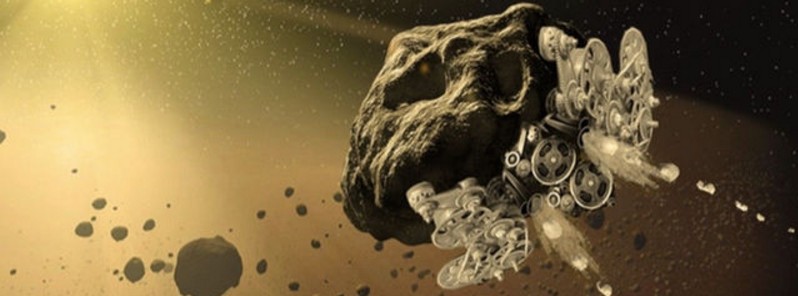
Featured image: Artist's illustration of an asteroid that has been turned into a giant mechanical spacecraft, which could fly itself to a mining outpost. Credit: Made In Space
Look into the heavens at night. You see twinkling stars, maybe the crescent moon. What else is out there that we can’t see with the naked eye? Other planets and moons, comets, meteors, asteroids, miners… wait, what?
Ok, there aren’t any miners in space — yet. However, big plans are in place and moving forward. Space mining companies see great potential in asteroids as sources of raw materials for both Earth and space exploration.
What’s it all about?
Nobody is sending miners with hardhats and jackhammers into space anytime soon. Right now the focus is on launching small spacecraft to test necessary technology.
Two companies, Deep Space Industries (DSI) and Made In Space, are at the cutting edge of space mining, securing contracts from NASA to start exploring the use of asteroids as spacecraft. DSI is also partnering with Luxembourg, the first European country to enter the arena.
Their initial project: a soon-to-launch low-orbit mission to work the kinks out. There’s little wiggle room for error in space exploration. Highly specialized technology that needs to work just right includes:
- Cold-formed components made from precious metals
- Camera-based navigation systems
- Modular avionics that is cost-effective but radiation resistant
- Water as propellant for electrothermal thrusters
As this program succeeds, more complex and far-reaching flights will take place. The ultimate goal is to dig up resources. A likely target is the asteroid belt that stretches between Mars and Jupiter. This will be a multi-step process that will include:
- Using resources such as space telescopes and satellites to locate asteroids with potential
- Sending probes to determine if water and metal content are sufficient
- Using robots to do the actual mining
- Transporting the mined materials to Earth or other locations
The Made In Space/NASA collaboration is taking a different path: to investigate whether an asteroid can be turned into a spacecraft. If so, traveling from one mining territory to the next becomes a lot easier. A traditional spacecraft isn’t necessary. Miners can just saddle up an asteroid and go where they’re needed.
Why bother?
Historically, when humans ventured into a new frontier, they determined how they take advantage of its resources. Space is no exception. Valuable and relatively rare materials, such as gold, iridium, silver and platinum, could be mined and exported to Earth. As humans deplete more and more of Earth’s natural resources, there might be power struggles to control what’s left. Humans have fought over Earth’s reserves before, so locating space sources of these materials might possibly prevent wars.
Space explorers will also find value in asteroids. Water is an essential compound. It’s necessary for life, but it weighs a ton — well, not a ton. It weighs little over eight pounds per gallon, actually, and it’s plentiful on some asteroids. If you’re sending humans into space for an extended period, though, they’ll need enormous amounts of water. It’ll take a lot less energy to refill a water tank than try to carry all the H20 needed.
And speaking of tanks — astronauts can pull up to an asteroid to top off their fuel supplies. They can recharge power cells with hydrogen or combine it with oxygen to create propellant.
Additionally, if you want to build something — like a space station — it is simpler to make it in space than to put it together on Earth and haul it out. Since many of the raw materials are already present in asteroids, the process is even easier as well.
Exploration won’t be tied to Earth anymore. Residents of the space station can then become consumers of mined resources. For example, nitrogen and ammonia make great fertilizers for astronauts growing their own food.
Are there any rules?
Legal issues involving asteroid mining are interesting. On earth, mining companies typically own the land they work. But who owns an asteroid? No one, according to 1967’s international Outer Space Treaty. The agreement banned military bases and weapons of mass destruction in the cosmos. It also prohibited anyone from declaring ownership of any heavenly body. That flag that American astronauts placed on the Moon? It wasn’t an annexation; it was just a sign that “we were here first.”
But what about mined resources? Who claims those? Space miners can heave a collective sigh of relief. President Obama signed the Space Act of 2015, which grants ownership of celestial materials to the mining companies that uncover them. However, Luxembourg isn’t letting everyone else handle the legalities. The country has plans to develop a legal framework that addresses ownership issues.
Space mining seems far more of a reality now than it did when it was featured in an episode of the 1960s TV series “Star Trek.” Currently, it’s a wide-open field. Some participants are motivated by profit, while others anticipate that asteroid resources will open up the cosmos for exploration.
Written by Megan Ray Nichols
Megan Ray Nichols is a science writer and editor of Schooled By Science. When she isn’t writing, Megan enjoys camping, hiking and stargazing. She invites you to follow her on Twitter @nicholsrmegan.

The Watchers team and our contributors bring the latest on extreme weather, earthquakes, volcanic eruptions, space weather, and all things science. We're all about making sense of the natural world and keeping you informed on what’s happening. Got a tip or a question? Hit us up using the form at newstips!

Commenting rules and guidelines
We value the thoughts and opinions of our readers and welcome healthy discussions on our website. In order to maintain a respectful and positive community, we ask that all commenters follow these rules.