
Moderately strong M1.8 solar flare erupts from Region 2497
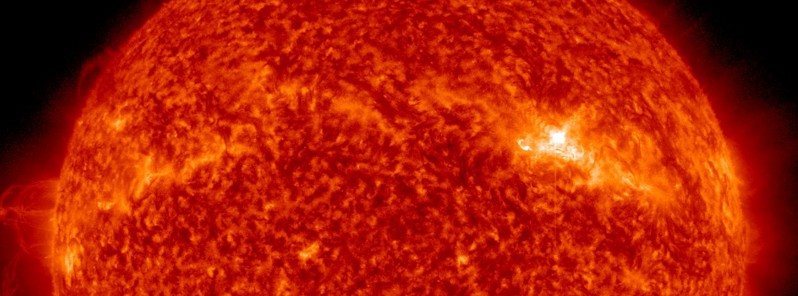
Featured image: M1.8 peaks on February 13, 2016. Credit: NASA SDO/AIA 304
A moderately strong solar flare measuring M1.8 at its peak time erupted from 'Beta-Gamma-Delta' classified Region 2497 at 15:24 UTC on February 13, 2016. The event started at 15:16 and ended at 15:24 UTC.
There were no radio signatures that would suggest a Coronal Mass Ejection (CME) was produced by the event.
This is a second M-class solar flare from this region; M1.0 erupted at 10:47 UTC on February 12, also without a CME. However, on February 12, the region was responsible for a long duration C8.9 solar flare that generated an asymmetric partial-halo CME with an Earth-directed component. The CME is expected to arrive early February 15, causing G1 – Minor geomagnetic storming.


D-RAP on February 13, 2016 at 15:25 UTC – M1.8 peak. Credit: NOAA/SWPC

M1.8 solar flare peaks on February 13, 2016. Image credit: NASA SDO/AIA 131

Sunspots on February 13, 2016. Credit: NASA SDO/HMI
2492 – Alpha
2494 – Alpha
2497 – Beta-Gamma-Delta
2498 – Alpha
2499 – Alpha

Teo Blašković founded The Watchers in 2011 and edited it until 2026, covering seismic and volcanic activity, extreme weather, space weather and near-Earth objects. Articles on this page are his archive.
Published in the last 24 hours
- High Risk of excessive rainfall covers Florida’s Space Coast as St. Johns River near Cocoa reaches 5.67 m
- Asteroid 2026 WJ to pass Earth at 1.7 lunar distances at 04:20 UTC on November 22, with 2026 WD following at 4.4 lunar distances on November 23
- Cyclone Akvan crossed the north Andhra Pradesh and south Odisha coasts close to Gopalpur on November 20 with 70-80 km/h winds gusting to 90, and has weakened into a deep depression
- A broad low over southeastern Florida and the northwestern Bahamas has a 30 percent chance of subtropical or tropical development within 48 hours and a 50 percent chance within 7 days, the National Hurricane Center says
