
Southern crown coronal hole stirring up geomagnetic storms
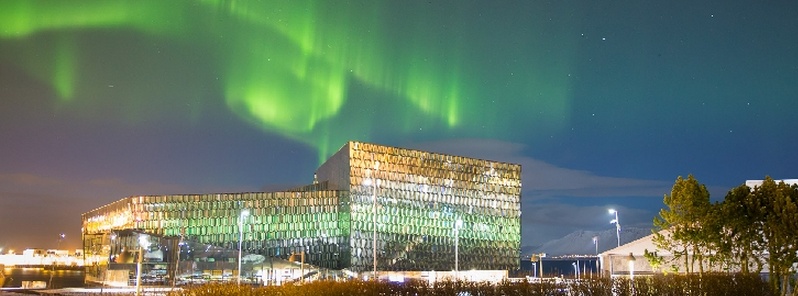
Image credit: Aurora over Reykjavik. Taken by Magnus (ReykjavikPhoto.com) on February 2, 2015 @ Reykjavik, Iceland (via SpaceWeather.com)
Earth is currently under the influence of a high speed solar wind speed, originating in negative polarity southern crown coronal hole, which is causing periods of geomagnetic storming on our planet.
Solar wind readings indicated a co-rotating interaction region (CIR) which came in advance of a negative polarity southern crown coronal hole high speed stream (CH HSS) yesterday. Enhanced density readings along with a rise in total field was followed by increased Bz variability.


Wind speed gradually increased from near 400 km/s to about 550 km/s through 18:15 UTC on February 1 when wind speeds sharply increased to a peak of 748 km/s at 20:06 UTC.
Afterwards, wind speed averaged close to 675 km/s.
Wind speed increased again, from near 540 km/s to a maximum of 783 km/s at 05:46 UTC on February 2 before leveling off near 660 km/s. Total field increased to a maximum of 15 nT by 01:38 UTC, but dropped to around 6 nT after 04:26 UTC. The Bz component was variable between +10 nT and -12 nT during last 12 hours.
Solar wind parameters are expected to continue to be enhanced under CH HSS influence for the next three days (February 2 – 4).

The geomagnetic field was at quiet to minor storm (G1-Minor) levels due to aforementioned CIR and CH HSS effects during last 24 hours. Minor storming periods were observed from 21:00 UTC yesterday until 06:00 UTC today.
Unsettled to minor storm (G1) levels are expected to continue today due to CH HSS activity. Quiet to active conditions are expected by February 3 and 4.
Space Weather Message Code: WARK05
Serial Number: 961
Issue Time: 2015 Feb 02 1227 UTC
EXTENDED WARNING: Geomagnetic K-index of 5 expected
Extension to Serial Number: 960
Valid From: 2015 Feb 01 2105 UTC
Now Valid Until: 2015 Feb 03 0000 UTC
Warning Condition: Persistence
NOAA Space Weather Scale descriptions can be found at
www.swpc.noaa.gov/noaa-scales-

Teo Blašković founded The Watchers in 2011 and edited it until 2026, covering seismic and volcanic activity, extreme weather, space weather and near-Earth objects. Articles on this page are his archive.
Published in the last 24 hours
- High Risk of excessive rainfall covers Florida’s Space Coast as St. Johns River near Cocoa reaches 5.67 m
- Asteroid 2026 WJ to pass Earth at 1.7 lunar distances at 04:20 UTC on November 22, with 2026 WD following at 4.4 lunar distances on November 23
- Cyclone Akvan crossed the north Andhra Pradesh and south Odisha coasts close to Gopalpur on November 20 with 70-80 km/h winds gusting to 90, and has weakened into a deep depression
- A broad low over southeastern Florida and the northwestern Bahamas has a 30 percent chance of subtropical or tropical development within 48 hours and a 50 percent chance within 7 days, the National Hurricane Center says

