
M2.0 solar flare erupts from Region 2130
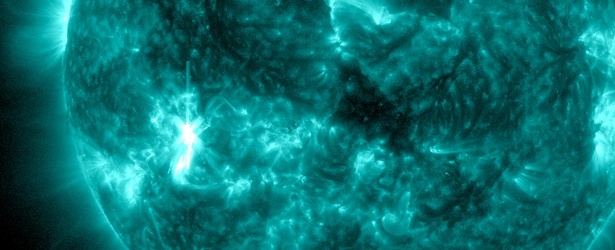
Image credit: SDO AIA 131 on August 1, 2014 @ 14:51 UTC
Moderately strong solar flare measuring M2.0 erupted from Active Region 2130 on August 1, 2014, at 14:48 UTC. The event started at 14:43, peaked at 14:48 and ended at 14:57 UTC. After almost 3 weeks without solar flares of this magnitude, this is now the second M-class solar flare in last 27 hours. Both of them erupted from Region 2130.
A 10cm Radio Burst lasting 1 minute, with peak flux of 340 sfu, was associated with the event. A 10cm radio burst indicates that the electromagnetic burst associated with a solar flare at the 10cm wavelength was double or greater than the initial 10cm radio background. This can be indicative of significant radio noise in association with a solar flare. This noise is generally short-lived but can cause interference for sensitive receivers including radar, GPS, and satellite communications.
Region 2130 has 'beta-gamma' magnetic configuration and it is capable of producing strong eruption on the Sun. The region is still rotating toward the center of the disk, a glancing blow to Earth's magnetic field is possible.
More information on today's M2.0 flare will be available after the analysis is complete.
NOAA SWPC forecasters estimate 40% chance for M-class, and 5% chance for X-class solar flare in the next 2 days.

Space Weather Message Code: SUM10R
Serial Number: 623
Issue Time: 2014 Aug 01 1506 UTC
SUMMARY: 10cm Radio Burst
Begin Time: 2014 Aug 01 1447 UTC
Maximum Time: 2014 Aug 01 1447 UTC
End Time: 2014 Aug 01 1448 UTC
Duration: 1 minutes
Peak Flux: 340 sfu
Latest Penticton Noon Flux: 156 sfu
Description: A 10cm radio burst indicates that the electromagnetic burst associated with a solar flare at the 10cm wavelength was double or greater than the initial 10cm radio background. This can be indicative of significant radio noise in association with a solar flare. This noise is generally short-lived but can cause interference for sensitive receivers including radar, GPS, and satellite communications.
Sunspots
There are currently 8 numbered sunspot regions on the Earth side of the Sun.
Region 2132 continued to show signs of growth and was also responsible for several optical flares in last 24 hors. Region 2129 (S05W58, Bxo/beta) displayed spot reemergence from its previously reported plage status but has yet to produce significant flare activity. The remaining seven numbered sunspot groups were stable or in a state of slight growth during last 24 hours. (SWPC – August 1, 2014 @ 12:30 UTC)

Sunspots on August 1, 2014. Image credit: NASA SDO / HMI
2121 – Beta
2125 – Alpha
2126 – Beta
2127 – Beta-Gamma
2128 – Alpha
2130 – Beta-Gamma
2131 – Beta
2132 – Beta

Teo Blašković founded The Watchers in 2011 and edited it until 2026, covering seismic and volcanic activity, extreme weather, space weather and near-Earth objects. Articles on this page are his archive.
Published in the last 24 hours
- Male toads abandoned a pond in Italy five days before a deadly 2009 earthquake, while a scientist was counting them Epicenter
- An asteroid was spotted 19 hours before it exploded over Sudan in 2008, and students picked its pieces off the desert Epicenter
- A wave up to 3 m (10 feet) high rose out of Lake Michigan on a sunny June morning in 1954 and swept fishermen off Chicago’s piers, and when a second came 10 days later, warnings had cleared the shore Epicenter
- Just 12 inches of rushing water can carry away most cars, and more than half of US flood drownings happen to people who drive into flood water Epicenter
