
Moderately strong M2.5 solar flare erupted from Region 2130
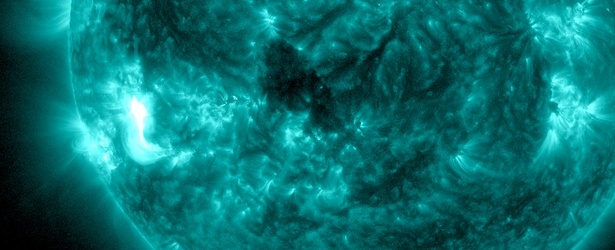
Image credit: NASA SDO AIA 131
A moderately strong solar flare reaching M2.5 at its peak time erupted from Region 2130 on July 31, 2014, at 11:14 UTC. The event started at 11:01 and ended at 11:21 UTC.
Region 2130 has 'beta-gamma-delta' magnetic configuration and is located near the Sun's eastern limb. If CME was produced by this event it should not be Earth directed.
The region is stable but capable of producing strong to major solar flares as it rotates into more geoeffective position in the coming days.

NOAA SWPC forecasters estimate 30% chance for M-class, and 5% chance for X-class solar flares in next two days.
Filament eruption
A 31 degree filament eruption centered near N08E32 (north-eastern quadrant) was observed in SDO/AIA imagery beginning around 30/04:00 UTC. A CME subsequently appeared in SOHO/LASCO C2 imagery at 30/07:00 UTC and was also captured in STEREO A and B COR2 imagery. Preliminary analysis indicated the ejecta was moving around 700 km/s and had an Earth-directed component.

An initial WSA-Enlil model run suggests a glancing blow early on August 02. However, the model solar wind speeds appear to be over-estimated and arrival is expected mid to late on August 02.
Timing will continue to be refined as additional analysis and modeling are carried out.
Sunspots
There are currently 9 numbered sunspot regions on the disk.

Sunspots on July 31, 2014. Image credit: NASA/SDO
2121 – Beta
2123 – Alpha
2125 – Alpha
2126 – Beta
2127 – Beta-Gamma
2128 – Alpha
2129 – Alpha
2130 – Beta-Gamma-Delta
2131 – Beta

Teo Blašković founded The Watchers in 2011 and edited it until 2026, covering seismic and volcanic activity, extreme weather, space weather and near-Earth objects. Articles on this page are his archive.
Published in the last 24 hours
- High Risk of excessive rainfall covers Florida’s Space Coast as St. Johns River near Cocoa reaches 5.67 m
- Asteroid 2026 WJ to pass Earth at 1.7 lunar distances at 04:20 UTC on November 22, with 2026 WD following at 4.4 lunar distances on November 23
- Cyclone Akvan crossed the north Andhra Pradesh and south Odisha coasts close to Gopalpur on November 20 with 70-80 km/h winds gusting to 90, and has weakened into a deep depression
- A broad low over southeastern Florida and the northwestern Bahamas has a 30 percent chance of subtropical or tropical development within 48 hours and a 50 percent chance within 7 days, the National Hurricane Center says
