
Earth Gamma-Ray Blasters
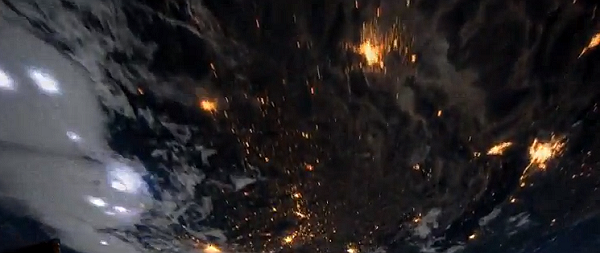
Image credit: TW
From NASA Goddard Space Flight Center. NASA’s The Fermi Gamma-ray Space Telescope has been catching brief outbursts of high-energy light that are mysteriously produced above thunderstorms. The outbursts, known as terrestrial gamma-ray flashes (TGFs), last only a few thousandths of a second, but their gamma rays rank among the highest-energy light that naturally occurs on Earth. The enhanced GBM discovery rate helped scientists show most TGFs also generate a strong burst of radio waves, a finding that will change how scientists study this poorly understood phenomenon.
Lightning emits a broad range of very low frequency (VLF) radio waves, often heard as pop-and-crackle static when listening to AM radio. World Wide Lightning Location Network (WWLLN) researchers routinely detect these radio signals and use them to pinpoint the location of lightning discharges anywhere on the globe to within about 20 km. Scientists have known for a long time TGFs were linked to strong VLF bursts, but they interpreted these signals as originating from lightning strokes somehow associated with the gamma-ray emission.
The researchers identified much weaker radio bursts that occur up to several thousandths of a second before or after a TGF. They interpret these signals as intracloud lightning strokes related to, but not created by, the gamma-ray flash. Scientists suspect TGFs arise from the strong electric fields near the tops of thunderstorms. Under certain conditions, the field becomes strong enough that it drives a high-speed upward avalanche of electrons, which give off gamma rays when they are deflected by air molecules. Because the WWLLN radio positions are far more precise than those based on Fermi’s orbit, scientists will develop a much clearer picture of where TGFs occur and perhaps which types of thunderstorms tend to produce them.
The GBM scientists predict the new operating mode and analysis techniques will allow them to catch about 850 TGFs each year. While this is a great improvement, it remains a small fraction of the roughly 1,100 TGFs that fire up each day somewhere on Earth, according to the team’s latest estimates.
Credit: SpaceRip

Earlier reporting
Nothing on Watchers was published in the last 24 hours. These are older articles.
- Right about now, Voyager 1 is crossing a line no human-made object has ever reached, a full light-day from Earth, which means a message NASA sends tonight won't arrive until tomorrow night, and the spacecraft's answer won't make it home until the night after that
- On October 22, 2017, a single flash of lightning stretched 515 miles from eastern Texas to near Kansas City, a distance that takes eight hours to drive, and nobody realized how far it had gone until scientists went back through the satellite data years later Epicenter
- CPC posts a slight risk of heavy rain from the Gulf Coast to the Northeast urban corridor November 25-29, and a moderate risk of West Coast wind and Sierra snow on November 25
- Florida's east coast faces a moderate flash flood risk Wednesday through Friday, with 4 to 8 inches of rain forecast and the St. Johns River near Cocoa already in major flood at 17.13 feet
