
Fermi sees gamma rays from Sun’s far side
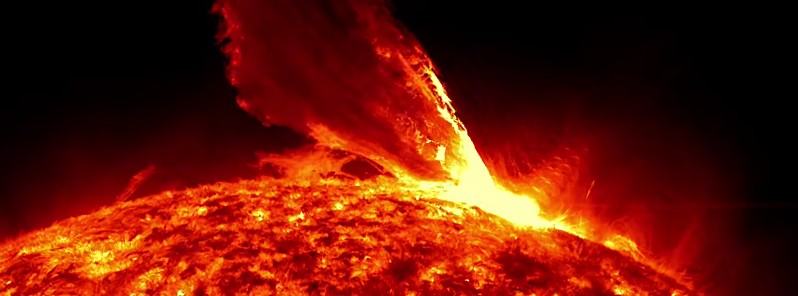
Image credit: NASA/SDO
Fermi Gamma-ray Space Telescope has observed high-energy light from solar eruptions located on the Sun's far side, which should block direct light from these events. This apparent paradox is providing solar scientists with a unique tool for exploring how charged particles are accelerated to nearly the speed of light and move across the sun during solar flares.
These streams of particles must travel some 482 800 km (300 000 miles) within about five minutes of the eruption to produce this light, Nicola Omodei, a research at Stanford University in California, said.
The observatory has doubled the number of these rare events, called behind-the-limb flares, since it began scanning the sky in 2008. Its Large Area Telescope (LAT) has captured gamma rays with energies reaching 3 billion electron volts, some 30 times greater than the most energetic light previously associated with these "hidden" flares.
Thanks to NASA's Solar Terrestrial Relations Observatory (STEREO) spacecraft, which were monitoring the solar far side when the eruptions occurred, the Fermi events mark the first time scientists have direct imaging of beyond-the-limb solar flares associated with high-energy gamma rays.
"Observations by Fermi's LAT continue to have a significant impact on the solar physics community in their own right, but the addition of STEREO observations provides extremely valuable information of how they mesh with the big picture of solar activity," said Melissa Pesce-Rollins, a researcher at the National Institute of Nuclear Physics in Pisa, Italy, and a co-author of the paper.
The hidden flares occurred October 11, 2013, January 6, 2013 and September 1, 2014.
All three events were associated with fast coronal mass ejections (CMEs), where billion-ton clouds of solar plasma were launched into space. The CME from the most recent event was moving at nearly 8 million km/h (5 million mph) as it left the Sun. Researchers suspect particles accelerated at the leading edge of the CMEs were responsible for the gamma-ray emission.
Combined images from NASA's Solar Dynamics Observatory (center) and the NASA/ESA Solar and Heliospheric Observatory (red and blue) show an impressive coronal mass ejection departing the far side of the sun on September 1, 2014. This massive cloud raced away at about 5 million mph and likely accelerated particles that later produced gamma rays Fermi detected. Credit: NASA/SDO and NASA/ESA/SOHO
These solar flares were imaged in extreme ultraviolet light by NASA's STEREO satellites, which at the time were viewing the side of the Sun facing away from Earth. All three events launched fast coronal mass ejections (CMEs). Although NASA's Fermi Gamma-ray Space Telescope couldn't see the eruptions directly, it detected high-energy gamma rays from all of them. Scientists think particles accelerated by the CMEs rained onto the Earth-facing side of the sun and produced the gamma rays. The central image was returned by the STEREO A spacecraft, all others are from STEREO B. Credit: NASA/STEREO
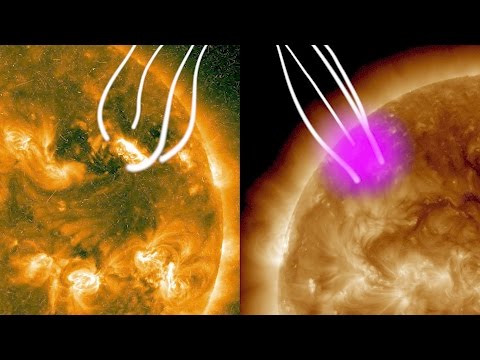
Large magnetic field structures can connect the acceleration site with distant part of the solar surface. Because charged particles must remain attached to magnetic field lines, the research team thinks particles accelerated at the CME traveled to the Sun's visible side along magnetic field lines connecting both locations. As the particles impacted the surface, they generated gamma-ray emission through a variety of processes. One prominent mechanism is thought to be proton collisions that result in a particle called a pion, which quickly decays into gamma rays.
In its first eight years, Fermi has detected high-energy emission from more than 40 solar flares. More than half of these are ranked as moderate, or M class, events. In 2012, Fermi caught the highest-energy emission ever detected from the sun during a powerful X-class flare, from which the LAT detected highenergy gamma rays for more than 20 record-setting hours.
Omodei presented the findings on Monday, January 30, at the American Physical Society meeting in Washington, and a paper describing the results will be published online in The Astrophysical Journal on January 31.
Source: NASA/Goddard

The Watchers team and our contributors bring the latest on extreme weather, earthquakes, volcanic eruptions, space weather, and all things science. We're all about making sense of the natural world and keeping you informed on what’s happening. Got a tip or a question? Hit us up using the form at newstips!
Published in the last 24 hours
- The Leonid meteor shower peaks on the night of November 17, exactly 60 years after the 1966 storm, when some observers reported meteors falling at up to 40 a second, though this year’s show should be closer to 15 an hour
- When Arctic air reached South Florida in January 2020, Miami fell to 40°F and the National Weather Service warned residents to watch for cold-stunned iguanas dropping out of the trees Epicenter
- In May 2024, the strongest solar storm in 20 years put northern lights over the southern US, and across the Plains, GPS-guided tractors built to plant within an inch drifted about 10 feet off their rows Epicenter
- In 1943, a flight instructor in Texas flew a two-seat training plane into the eye of a hurricane because he was curious, then landed and took the base weatherman up for a second pass Epicenter
