
February solar flare was sparked by five spinning sunspots
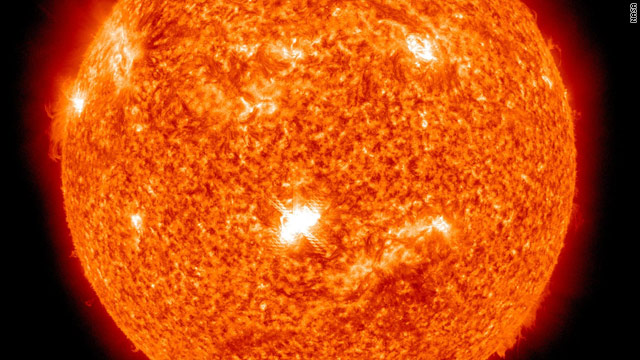
Image credit: TW
The giant solar flare unleashed in February was caused by five rotating sunspots working in concert, the UK’s National Astronomy Meeting has heard.
Images released from the Solar Dynamics Observatory (SDO) clearly show the sunspots, which are centres of magnetic activity on the sun’s surface. As the magnetic fields build up, they “break”, releasing vast amounts of energy in the form of heat and light. The “X-class” flare was accompanied by 40 smaller flares in the same period.
Daniel Brown, an astronomer at the University of Central Lancashire, reported the results at the meeting in Llandudno, Wales. The accompanying video combines data from the SDO’s Helioseismic and Magnetic Imager, which shows the conditions on the Sun’s surface, and the Atmospheric Imaging Assembly, which captured detailed pictures of its atmosphere.

As the sunspots developed, they were seen to rotate through as much as 130 degrees, leading to brightening in the atmosphere that corresponded to the release of solar flares. Rotating sunspots are an extremely efficient way to inject energy into the magnetic field of the Sun’s atmosphere. With five sunspots rotating at the same time, enough energy has been injected into the atmospheric magnetic field to produce the largest solar flare seen for almost five years.
That flare was associated with what is known as a coronal mass ejection, which launches billions of tonnes of charged particles toward the Earth. Such CMEs are known to disrupt satellites and telecommunications, but despite its size February’s event had little effect because the alignment between the magnetic fields of the CME and the Earth served to dampen its effects. (BBC)


Earlier reporting
Nothing on Watchers was published in the last 24 hours. These are older articles.
- On October 22, 2017, a single flash of lightning stretched 515 miles from eastern Texas to near Kansas City, a distance that takes eight hours to drive, and nobody realized how far it had gone until scientists went back through the satellite data years later Epicenter
- CPC posts a slight risk of heavy rain from the Gulf Coast to the Northeast urban corridor November 25-29, and a moderate risk of West Coast wind and Sierra snow on November 25
- Florida's east coast faces a moderate flash flood risk Wednesday through Friday, with 4 to 8 inches of rain forecast and the St. Johns River near Cocoa already in major flood at 17.13 feet
- Cyclone Akvan to make landfall between Nellore and Visakhapatnam around noon on November 20, IMD forecasts 120-130 km/h winds gusting to 145
