
WISPIT 2b: The first confirmed exoplanet in multi-ring disk around star
Astronomers have discovered the first confirmed planet forming inside a multi-ringed disk, WISPIT 2b. It is a young 5 million-year old gas giant, orbiting the star TYC 5709-354-1 (WISPIT 2) at a distance of roughly 8 billion km (5 billion miles).
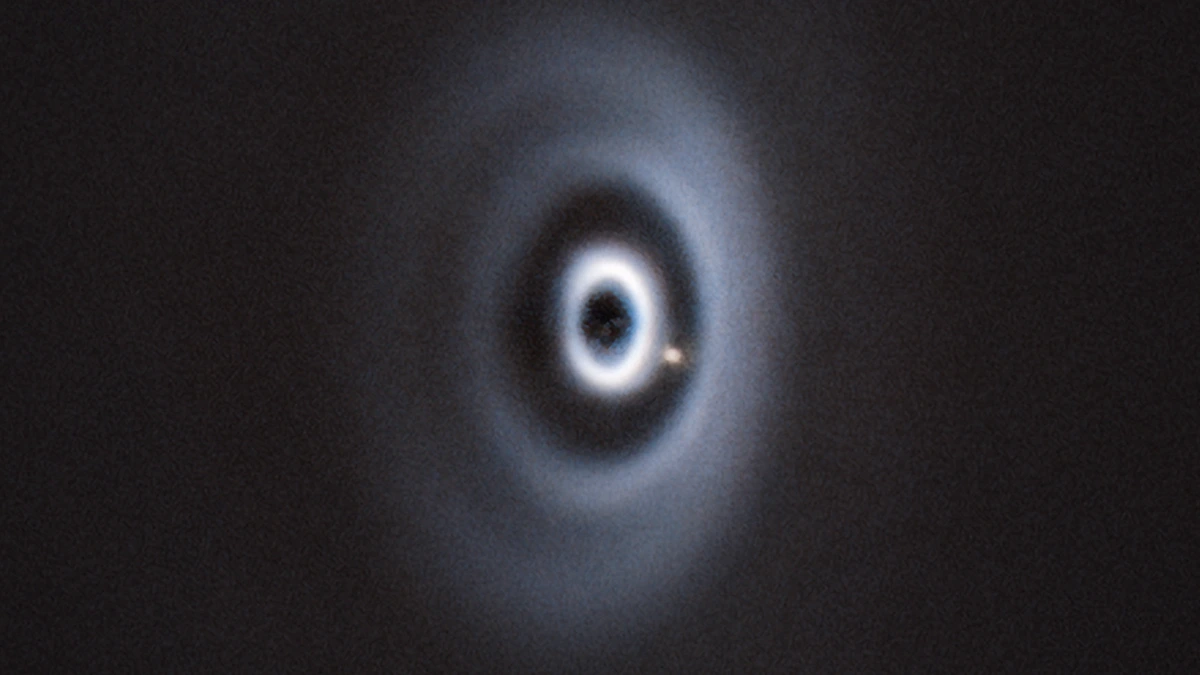
A newborn planet eating its way through its dusty cradle as it orbits its host star. This image, taken with ESO’s Very Large Telescope (VLT) in Chile, is the first clear detection of a baby planet in a disc with multiple rings. Credit: ESO/R.F. Van Capellevan Et Al.
Astronomers used the Magellan Adaptive Optics eXtreme system (MagAO-X) to capture the accreting protoplanet, designated WISPIT 2b, orbiting the young star TYC 5709-354-1 (WISPIT 2) at a distance of about 54 astronomical units (AU) — approximately 8 billion km (5 billion miles).
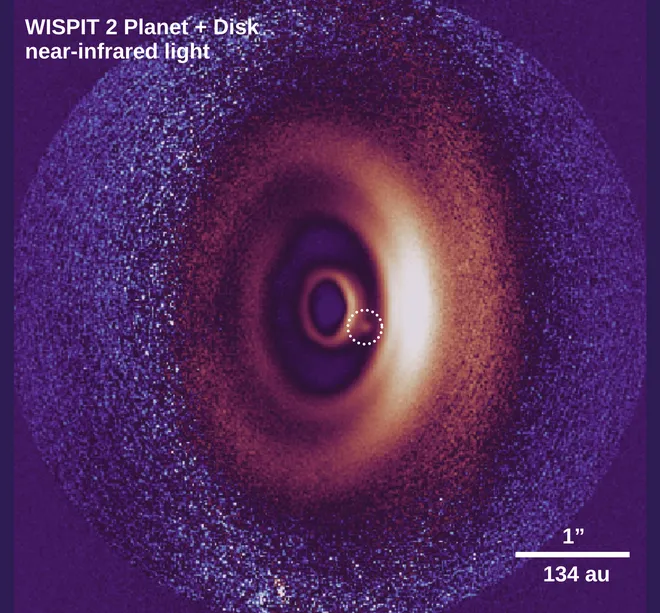
WISPIT 2b is the first confirmed detection of a planet within a multi-ringed protoplanetary disk — a disk that contains multiple gaps and channels, resembling a vinyl record. This makes it an ideal laboratory for studying planet–disk interaction and subsequent evolution.
The planet was detected as part of a five-year observational campaign aimed at determining whether wide-orbit gas giant planets are more commonly found around younger or older stars.
The study was led by Ph.D. student Richelle van Capelleveen from Leiden University, and co-led by a team of graduate students at the University of Galway. A companion study, conducted by the University of Arizona and led by Professor Laird Close, was based on observations initiated after the discovery of the disk by the Leiden and Galway teams.
The planet was discovered with the help of the European Southern Observatory’s Very Large Telescope (ESO’s VLT) in the Atacama Desert, Chile — one of the most advanced ground-based observatories in the world.
Detected at an early stage of formation around a young analog of our Sun, the planet is estimated to be about 5 million years old and is most likely a gas giant similar in size to Jupiter.
It is only the second confirmed planet detected at this early evolutionary stage around a young Sun-like star. The first was discovered in 2018 by a team that also included Dr. Christian Ginski, lecturer at the School of Natural Sciences, University of Galway, and second author of the present study.
The science of WISPIT 2b’s discovery
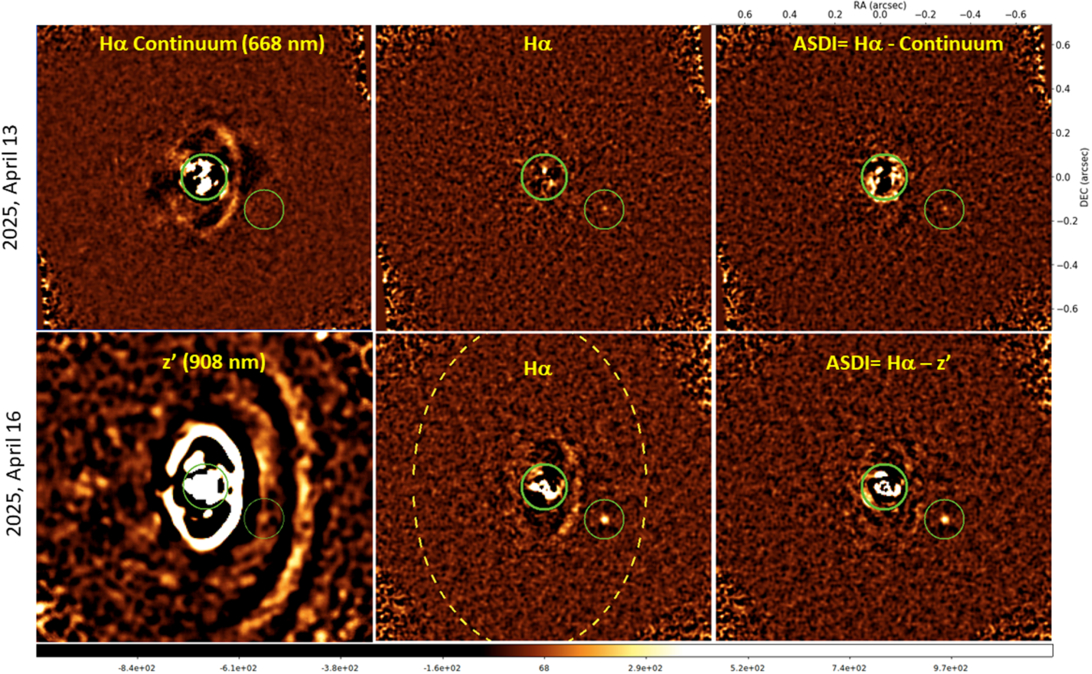
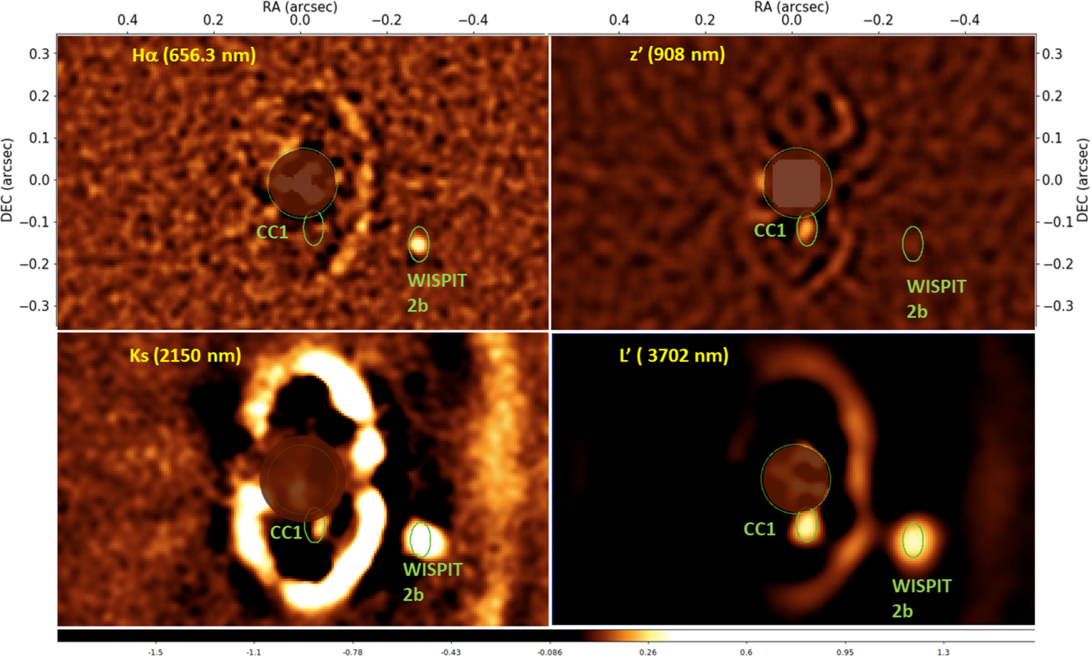
On April 13 and 16, 2025, MagAO-X captured high-resolution H-alpha images that revealed a point source in the dark annular gap between two of the brightest dust rings surrounding WISPIT 2. The signal reached a detection significance of 12.5σ, confirming the presence of a forming planet rather than scattered starlight.
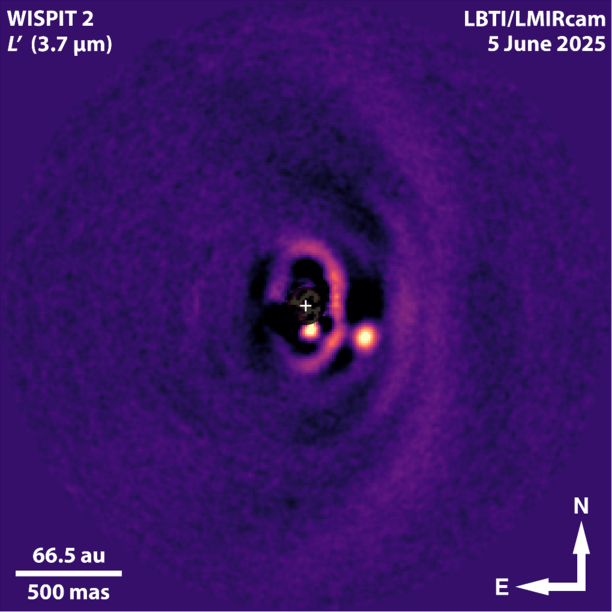
Follow-up infrared imaging with the Large Binocular Telescope’s LMIRcam instrument measured WISPIT 2b’s brightness, yielding an estimated mass of approximately 5 Jupiter masses (5.3 ± 1.0 MJup). Analysis indicates the planet is still actively accreting material at a rate of about 2 × 10⁻¹² solar masses per year — a value consistent with other known H-alpha protoplanets, such as PDS 70b and PDS 70c.
Unlike previously imaged accreting protoplanets, which reside in large central cavities of their disks, WISPIT 2b lies within an annular gap between two bright dust rings. It is the first H-alpha protoplanet confirmed in such a location, offering a direct link between giant planet formation and the sculpting of sub-structures within protoplanetary disks.
The central star also shows evidence of an additional inner companion candidate (CC1) at approximately 15 AU, potentially another young planet with an estimated mass of 9 ± 4 MJup. However, its nature remains uncertain.
What do the scientists say
“Discovering this planet was an amazing experience — we were incredibly lucky,” said van Capelleveen. “WISPIT 2, a young version of our Sun, is located in a little-studied group of young stars, and we did not expect to find such a spectacular system. This system will likely be a benchmark for years to come.”
“We used these really short snapshot observations of many young stars — only a few minutes per object — to determine if we could see a little dot of light next to them that is caused by a planet,” said Dr. Christian Ginski. “However, in the case of this star, we instead detected a completely unexpected and exceptionally beautiful multi-ringed dust disk.
“When we saw this multi-ringed disk for the first time, we knew we had to try and see if we could detect a planet within it, so we quickly asked for follow-up observations.”
Conclusion
The planet was also detected in visible light by the University of Arizona team using a specially designed instrument. This detection at a specific wavelength — H-alpha — indicates that the planet is still actively accreting gas as it forms its atmosphere.
Disks rich in dust and gas around young stars are known to be the birthplaces of planets. They can exhibit complex features such as rings and spiral arms, which are thought to arise from interactions with forming planets. The disk surrounding WISPIT 2 has a radius of about 380 AU — or 380 times the distance between Earth and the Sun.
“Capturing an image of these forming planets has proven extremely challenging and it gives us a real chance to understand why the many thousands of older exoplanet systems out there look so diverse and so different from our own solar system” says Dr. Ginski.
References:
1 Wide Separation Planets in Time (WISPIT): Discovery of a Gap Hα Protoplanet WISPIT 2b with MagAO-X – Laird M. Close et al. – The Astrophysical Journal Letters – August 26, 2025 – DOI: 10.3847/2041-8213/adf7a5

I am an Assistant Editor and Severe Weather & Science Journalist at The Watchers, specializing in real-time severe weather coverage, geophysical event reporting, and research-driven scientific analysis. You can reach me at rishav(at)watchers(.)news.

Commenting rules and guidelines
We value the thoughts and opinions of our readers and welcome healthy discussions on our website. In order to maintain a respectful and positive community, we ask that all commenters follow these rules.