
What the Toba super-eruption 74 000 years ago reveals about human survival
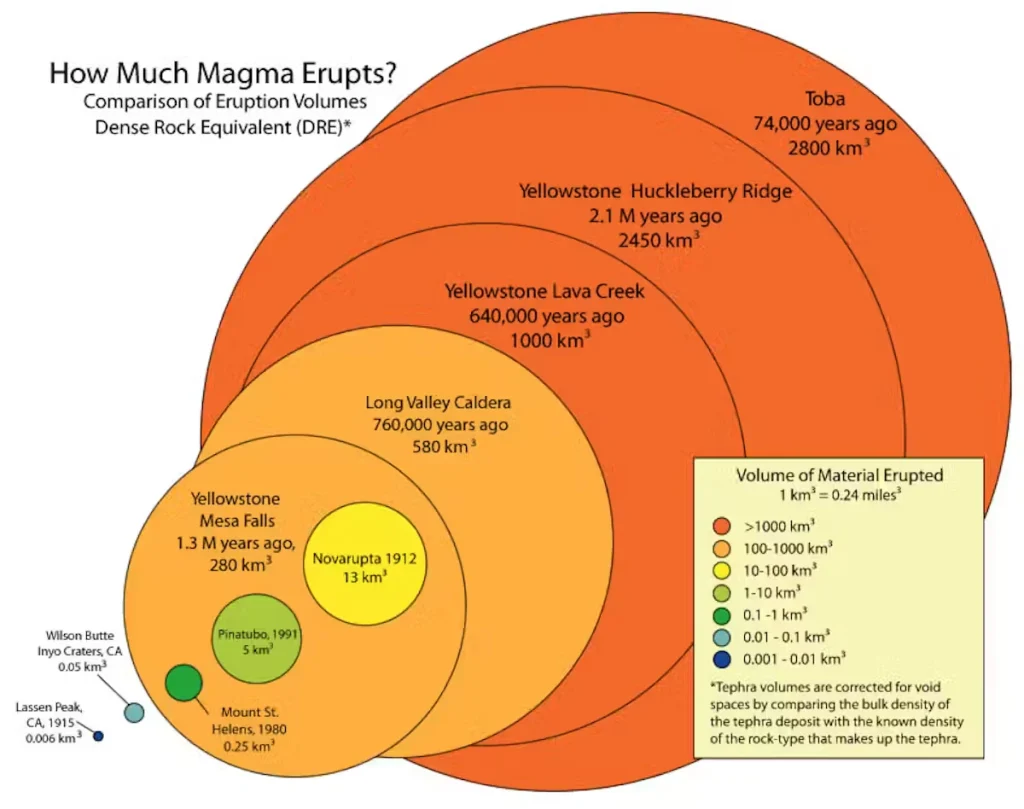
The Toba super-eruption in present-day Indonesia about 74 000 years ago ejected 2 800 km3 (672 mi3) of ash and formed a 100 x 30 km (62 x 18 miles) wide caldera. Once thought to have nearly wiped out our species, evidence now shows that resilience and adaptability, not collapse, defined humanity’s survival.

Raikoke volcano eruption on June 22, 2019. Image credit: NASA/ISS
The Toba super-eruption dwarfs every historical eruption humans have witnessed. It expelled about 2 800 km³ (672 mi³) of ash into the atmosphere, more than 10 000 times the material ejected by Mount St. Helens in 1980.
The eruption carved out today’s Toba Caldera in northern Sumatra — a depression roughly 100 km long and 30 km wide (62 x 18 miles). Lake Toba, the largest volcanic lake in the world, now fills part of this scar.
Ash and aerosols launched into the stratosphere darkened skies and triggered cooling that persisted for years. Climate models suggest regional temperature drops of 3–5°C (5–9°F) and widespread disruption of rainfall patterns.
Acid rain poisoned rivers and lakes, ash buried forests and grasslands, and humans within hundreds of kilometers almost certainly perished.
Toba catastrophe hypothesis
For decades, scientists debated whether Toba nearly wiped out our species. The “Toba catastrophe hypothesis” proposed that the eruption caused a volcanic winter lasting up to six years. According to this view, the cooling, crop failures, and ecological collapse reduced global human populations to fewer than 10 000 individuals.
Genetic data show that around this time, humanity passed through a population bottleneck — a severe reduction in genetic diversity. Whether Toba caused it, however, remains contested. Climate records, archaeological layers, and DNA all provide pieces of the puzzle, but the evidence does not fully align.
Several studies revealed that around this time, Homo sapiens experienced a population bottleneck, a severe reduction in genetic diversity. Some researchers linked this directly to Toba’s aftermath.
However, ice-core climate records, archaeological deposits, and genetic timelines do not perfectly align. While some regions experienced major disruption, others show signs of continuity. The challenge lies in teasing apart whether the bottleneck was caused by Toba, by other climatic swings during the Late Pleistocene, or by a combination of factors.
Today, most researchers see Toba as a powerful but not globally apocalyptic event. It stressed ecosystems and human groups unevenly, but it did not drive our species to the brink of extinction.
Reading the ashes: tephra and cryptotephra
The key to studying Toba lies in volcanic debris.
Ejected fragments of rock and glass, known as tephra, spread across continents. The smallest shards, called cryptotephra, traveled farthest. Invisible to the naked eye, these grains can only be identified under a microscope and chemically matched to their source eruption.
Each eruption leaves a unique composition of silica and trace elements, and by analyzing these fingerprints scientists can connect sediment layers in Africa and Asia directly to Toba, allowing archaeologists to align human artifacts with the eruption horizon and build a timeline of survival and adaptation.

Archaeological evidence of survival
The clearest story comes from archaeological sites where cryptotephra sits alongside evidence of human activity.
- Pinnacle Point 5-6, South Africa: Humans occupied the site before, during, and after Toba. Activity even intensified afterward, with new stone tool technologies appearing.
- Shinfa-Metema 1, Ethiopia: Layers containing Toba cryptotephra also preserve signs of human settlement. Communities adapted to harsher conditions by fishing shallow waterholes and adopting bow-and-arrow technology.
- Sites in India, Indonesia, and China: Archaeological records show continuity of occupation, challenging the idea of a global collapse.
Together, these findings suggest resilience, not extinction. Instead of disappearing, humans shifted strategies — altering diets, technologies, and mobility patterns.
Lessons from the past
If Toba did not wipe us out, what did it do?
In parts of Africa and South Asia, long dry seasons followed the eruption; vegetation patterns shifted, water sources shrank, and animal populations declined, forcing humans to adapt quickly or perish.
Some groups diversified their diets, turning to fish, shellfish, or small game when larger prey disappeared. Others refined stone toolkits, improving cutting efficiency or developing projectiles like arrows. Such innovations increased mobility and allowed exploitation of patchier resources.
The eruption may also have reinforced the role of “refugia” — safe havens along rivers, coastlines, or caves where resources remained more stable. Populations sheltering in these areas could endure the worst years, preserving knowledge and skills.
Rather than a single near-extinction event, in this perspective Toba appears as a crucible that tested, and proved, the resilience of Homo sapiens. The survival strategies it demanded may have strengthened the traits that later supported global dispersal.
Why it matters today
Modern science tracks volcanoes with tools our ancestors could not imagine. The United States Geological Survey (USGS) Volcanic Hazards Program and the Smithsonian Institution’s Global Volcanism Program monitor seismicity, gas emissions, and ground deformation around volcanoes worldwide.
Unlike our ancestors, we now have global communication, predictive models, and disaster response systems. Yet the Toba case reminds us that resilience also depends on adaptability, shifting technologies, strategies, and behaviors in response to crisis.
By studying how early humans survived one of the most powerful eruptions in geological history, scientists gain insight into how societies might withstand future catastrophic events.
References:
1 A massive eruption 74,000 years ago affected the whole planet – archaeologists use volcanic glass to figure out how people survived – The Conversation – September 11, 2025
2 The feeder system of the Toba supervolcano from the slab to the shallow reservoir – Ivan Koulakov et al. – Nature Communications – July 19, 2016 – https://doi.org/10.1038/ncomms12228 – OPEN ACCESS
3 The Toba supervolcano eruption caused severe tropical stratospheric ozone depletion – Sergey Osipov – Nature – April 12, 2025 – https://doi.org/10.1038/s43247-021-00141-7 – OPEN ACCESS

I’m a science journalist and researcher at The Watchers, contributing to the Epicenter edition, where I cover peer-reviewed scientific research and emerging discoveries across Earth and space sciences. With a background in astronomy and a passion for environmental science, I’ve worked in shark and coral conservation in Fiji, conducting reef and shark-behavior research, contributing to mangrove restoration, and earning PADI Open Water and Coral Reef Certifications. I bring a blend of scientific rigor and storytelling to illuminate the discoveries shaping our planet and beyond.

Commenting rules and guidelines
We value the thoughts and opinions of our readers and welcome healthy discussions on our website. In order to maintain a respectful and positive community, we ask that all commenters follow these rules.