
The largest iceberg on Earth, more than twice the size of Greater London, broke off Antarctica in 1986 and sat stuck to the seabed for over 30 years, and when it finally floated free, it got caught above an undersea mountain and spent months spinning slowly on the spot
Iceberg A23a, the world’s largest freely floating iceberg through much of 2025, spent about 34 years pinned to the Weddell Sea floor, completed roughly 15 rotations above an undersea mountain in 2024, grounded again near South Georgia and finally collapsed in March 2026—months short of its 40th anniversary.

Satellite image of Iceberg A23a recorded on February 28, 2025. Image credit: US National Ice Center
Its environmental effect changed with its condition. A study published in April 2026 found little glacial meltwater and limited biological uptake when a research ship sampled around A23a in December 2023. Satellite imagery later showed an extensive phytoplankton bloom around the iceberg and its fragments as they disintegrated in January 2026.
A23a was not the largest iceberg ever recorded; several bergs observed during the satellite era were larger. Its distinction was that it became the largest iceberg still freely afloat after larger rivals fragmented. At the December 2023 sampling, it covered about 3 940 km2 (1 520 miles2), more than twice the area of Greater London, and was estimated to weigh nearly 1 trillion tonnes (about 1.1 trillion US tons).
A research station floated away with it
A23a began with a major calving from Antarctica’s Filchner Ice Shelf in 1986. Ice fractured along the Grand Chasms and separated into three large bergs designated A22, A23, and A24. A23a was the largest surviving portion of A23 after another piece split away.
The calving carried more than ice into the Weddell Sea. The Soviet seasonal research station Druzhnaya 1 stood on A23 and drifted away with it. An expedition reached the iceberg in February 1987 and recovered the station’s equipment, leaving behind one of the more unusual human markers in A23a’s history.
Soon after calving, A23a’s deep keel settled onto the shallow seabed in the southern Weddell Sea. The iceberg was afloat, but its submerged base rested on the bottom, holding it in nearly the same area while currents and winds moved other bergs north.
Thirty-four years on the seabed
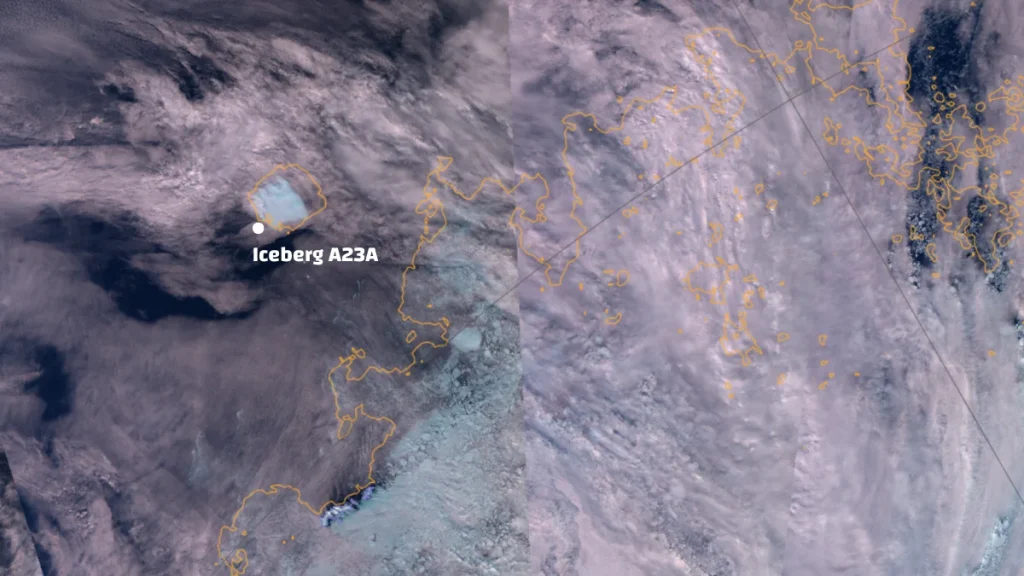
A23a remained grounded for more than three decades. Published area figures are not identical: NASA later described the iceberg as spanning more than 6 000 km2 (2 300 miles2) in 2020, while the 2026 peer-reviewed reconstruction used 4 120 km2 (1 590 miles2). For its internally consistent comparison, the study estimated a decline from 5 510 km2 (2 130 miles2) in the late 1980s to 4 120 km2 in 2020—a loss of roughly one quarter while the iceberg was still pinned down.
The release was gradual rather than a single clean departure. Satellite records show intermittent movement beginning in 2020, while NASA reported that the iceberg was floating unencumbered by March 2023. Thinning from basal melt, changing sea ice and ocean conditions may all have helped free its keel, but the observations do not identify one decisive trigger.
Once mobile, A23a followed the usual route out of the Weddell Sea, moving north through a corridor often called iceberg alley. By late 2023, it had reached open water near the northern tip of the Antarctic Peninsula.
Why A23a spun in place
A23a stopped again in early April 2024, about 200 km (125 miles) north of the South Orkney Islands. This time its keel had not hit the bottom. The iceberg had entered a Taylor column above Pirie Bank, an undersea rise in the path of the current.
A Taylor column forms when flowing water in a rotating ocean meets a submerged obstacle. The water above the obstacle can organize into a persistent rotating column, producing a circulation that holds floating material in the same area. The mountain did not snag A23a directly; it reorganized the water above it.
The iceberg made about 15 counterclockwise revolutions between March and November 2024, averaging roughly one turn every 25 days. Satellite tracking showed that it could rotate by about 15 degrees a day while making little northward progress.
“I am not aware of an iceberg that has been trapped in such a persistent manner in such a small area,” Antarctic sea-ice scientist Jan Lieser said. A23a spun out of the circulation in mid-November, and the British Antarctic Survey announced on December 13 that it was moving north again.
Grounded again near South Georgia

The next leg carried A23a toward South Georgia, a subantarctic island whose waters support major colonies of penguins and seals. Scientists watched closely because a giant berg grounded near the coast could alter access to feeding grounds and release large volumes of freshwater and sediment into the local ecosystem.
A23a slowed on February 25, 2025, and grounded around March 1 on the continental shelf about 90 km (56 miles) southwest of the island. A satellite measurement on March 4 put its area near 3 460 km2 (1 340 miles2). It remained parked through early May and lost more than 360 km2 (140 miles2) from its edges during that period.
The iceberg worked free by late May and resumed drifting. Its area had fallen to about 2 510 km² (970 miles2) by July 22 and to just over 1 500 km2 (580 miles2) by September 11. By then it had lost about two-thirds of the area it carried when it first left Antarctica and had shed several fragments large enough to receive their own tracking names.
What scientists found beside A23a
On December 1, 2023, before the Taylor-column episode, scientists aboard the RRS Sir David Attenborough crossed the waters around A23a. They sampled along a transect beginning about 75 km (47 miles) west of the iceberg, passed within roughly 400 m (1 300 ft) of its northern side and continued about 75 km (47 miles) to the northeast.
Lead author Laura Taylor described the scale of the encounter plainly: “Being so close to these icebergs is like standing next to a moving cliff face.” The team measured water chemistry, nutrients, chlorophyll, and biological particles to see whether melting ice had changed the surrounding surface ocean.
The meltwater contribution near A23a ranged from about 1.19% to 2.32%, values the researchers said were within the regional background. The water remained rich in macronutrients, but the chemical evidence showed little nutrient uptake by phytoplankton. Mean chlorophyll-a was 0.39 mg/m³, about 8.5 times lower than the 3.32 mg/m³ measured around iceberg A76A during a separate voyage in January 2023.
The authors suggested that A23a’s long grounding may have stripped away much of the sediment and micronutrient material it once carried. They also emphasized an important limit: the iceberg had been near the sampling site for only about five days. A biological response may not have had time to develop, and the comparison with A76A involved a different iceberg, location, and point in the season.
The study therefore does not show that giant icebergs never fertilize the Southern Ocean. It shows that size alone is not enough to predict the outcome; an iceberg’s history, surrounding waters, season and stage of decay can matter as much as its area.
A bloom appeared during the final breakup
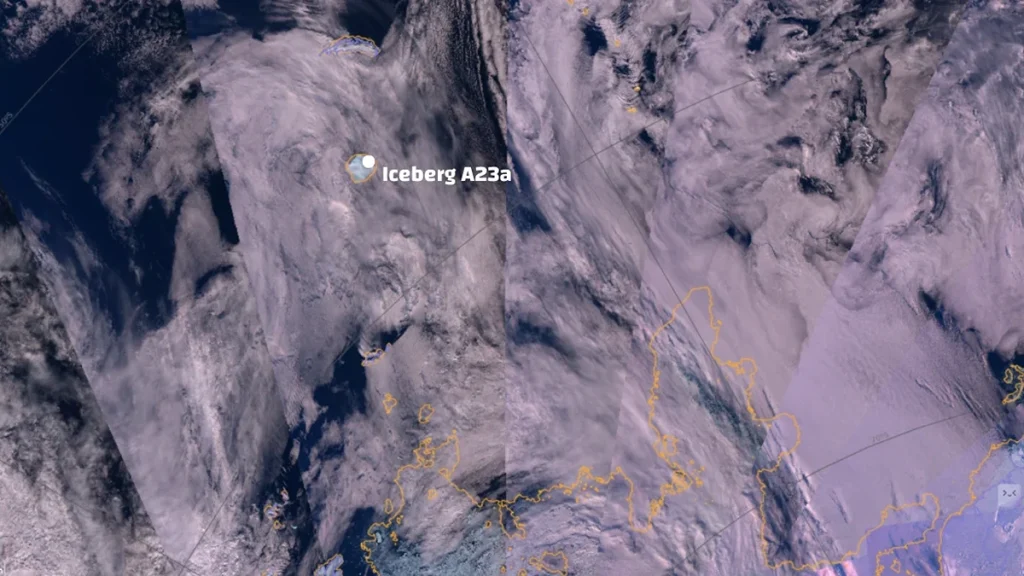
Those limits became visible two years later. Satellite imagery acquired on January 25, 2026, showed extensive green and turquoise phytoplankton blooms around A23a and several of its fragments. The patterns spread outward from the ice rather than forming as a uniform regional bloom.
By then, A23a was smaller, deeply fractured, and surrounded by meltwater pools. Its breakup exposed new ice surfaces and could release iron-rich dust and other material carried from Antarctica. The satellite observations could not by themselves quantify nutrient uptake, but they documented a visible biological response absent from the December 2023 shipboard measurements.
The two observations are not contradictory. They captured the same iceberg under sharply different conditions: recently mobile and mostly intact in early summer 2023, then disintegrating in warmer water more than two years later.
The 40-year journey ends
A23a covered about 1 182 km2 (456 miles2) on January 8, 2026. More named fragments separated during the following weeks, including A23J in mid-January. A23a left the US National Ice Center’s area of analysis during the week of February 6, and monitoring passed to Argentina’s weather service as the remnant drifted into maritime traffic lanes.
By late March, the remaining slab covered just over 170 km2 (66 miles2). Satellite imagery on March 31 showed the remnant collapsing into a field of smaller pieces, bringing the named iceberg’s journey to an end only months before the 40th anniversary of the 1986 calving.
The smaller fragments continued to melt into the Southern Ocean. What ended in March was the coherent, trackable iceberg—not the physical existence of every piece of ice that once made up A23a.
References:
1 The 1986 Filchner calving – US Geological Survey EROS
2 Icebergs. State of the Climate in 2024: Antarctica – Fetterer, F., et al. – Bulletin of the American Meteorological Society – 2025
3 Antarctic iceberg spins out – NASA Earth Observatory – December 17, 2024
4 Megaberg ends its long odyssey at sea – NASA Earth Observatory – April 13, 2026
5 Taylor, L. R., et al. (2026). Giant iceberg behaviour impacts regional biogeochemical cycling in the Southern Ocean. Communications Earth & Environment, 7, 353. https://doi.org/10.1038/s43247-026-03440-z
6 Not all icebergs are equal—and that matters for the climate, new study finds – British Antarctic Survey – April 20, 2026

Rishav Kothari is Editor-in-Chief of The Watchers, where he runs the newsroom and covers earthquakes, volcanoes, severe weather and space weather.

