
Tanzania’s Ol Doinyo Lengai erupts lava at about 930°F, too cool to glow in daylight, and within days its black flows turn white, leaving the summit looking snow-capped
Ol Doinyo Lengai in northern Tanzania erupts natrocarbonatite lava at temperatures near 500°C (930°F), hundreds of degrees cooler than common basaltic lava. Fresh flows can appear black in daylight, but their sodium-rich minerals begin reacting with atmospheric moisture within hours, producing pale surface minerals that can turn the lava white within days. Hotter lava lakes and spatter can still glow, particularly after dark.
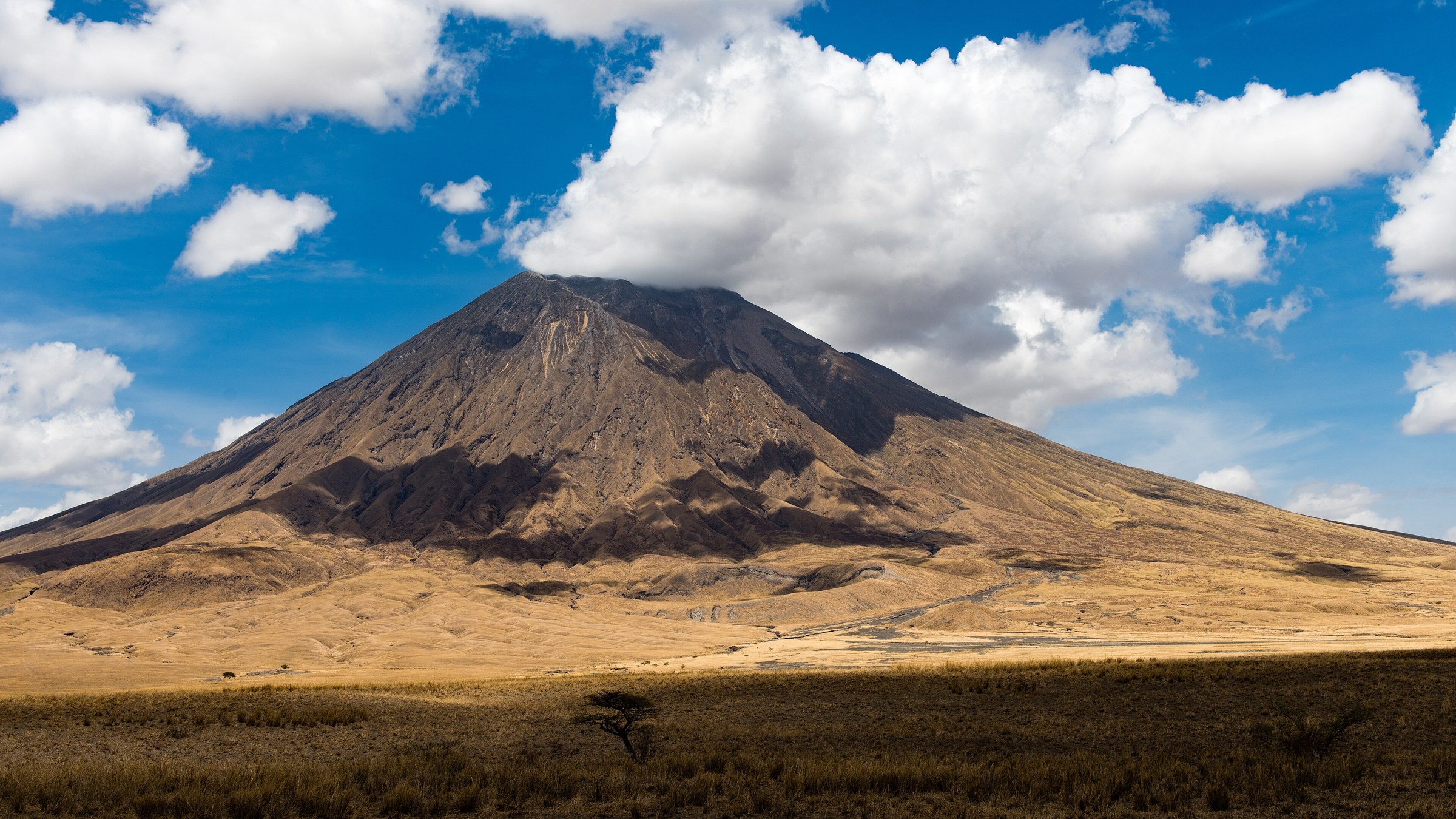
Ol Doinyo Lengai in northern Tanzania. Credit: Christoph Strässler, CC BY-SA 2.0, via Wikimedia Commons.
Ol Doinyo Lengai rises 2 962 m (9 718 feet) above northern Tanzania near the southern end of Lake Natron in the East African Rift. The Smithsonian Global Volcanism Program describes it as the only volcano where eruptions of carbonatite tephras and lavas have been observed. Unlike the silicate-rich magmas that feed most volcanoes, its natrocarbonatite is dominated by sodium- and potassium-rich carbonate minerals.
That composition gives researchers access to a type of active magma that is otherwise absent from observed eruptions. Ol Doinyo Lengai’s lava combines two physical properties that normally seem contradictory: it erupts at exceptionally low temperatures but remains highly fluid. Its instability at Earth’s surface also means that fresh samples begin changing chemically almost immediately, so the black lava seen during eruption can look very different only hours or days later.
Lava near 500°C (about 930°F)
Krafft and Keller measured active flows and lava lakes during effusive activity in June 1988. Their measurements ranged from 491°C to 519°C (916°F to 966°F), with a maximum of 544°C (1 011°F) in a carbonatite lava lake. Laboratory melting experiments on natural samples independently supported the exceptionally low magmatic temperatures.
The measurements were several hundred degrees below temperatures typical of basaltic lava. The difference also changes how the eruption looks. Much of the flowing natrocarbonatite appears black or dark brown in daylight rather than displaying the bright orange-red incandescence commonly associated with silicate lava, although the hottest parts of the system can still glow.
A Smithsonian field report from June 1988 documents that distinction directly. Observers measured 544°C (1 011°F) in the hottest orange-colored material in a lava lake and 495°C (923°F) at advancing flow fronts. At night, the lake appeared red and became orange when hotter magma surged to the surface.
The same field observations recorded exceptionally rapid flow despite the low temperatures. On June 24, lava overflowing from one lake formed streams approximately 1–1.5 m (3.3–4.9 feet) wide and 20–40 cm (7.9–15.7 inches) deep. Estimated flow speeds reached 1–5 m/s (2–11 mph). About four hours of overflow produced a fresh lava field approximately 100 m (330 feet) long and 10–40 m (33–131 feet) wide.
Krafft and Keller found that the carbonatite melt at the measured temperatures had lower viscosity than the most fluid basaltic lavas. The unusual behavior comes from the chemistry of the melt rather than extreme heat: carbonate melts can remain highly mobile at temperatures where common silicate magma would be far less fluid.
Black lava begins changing within hours
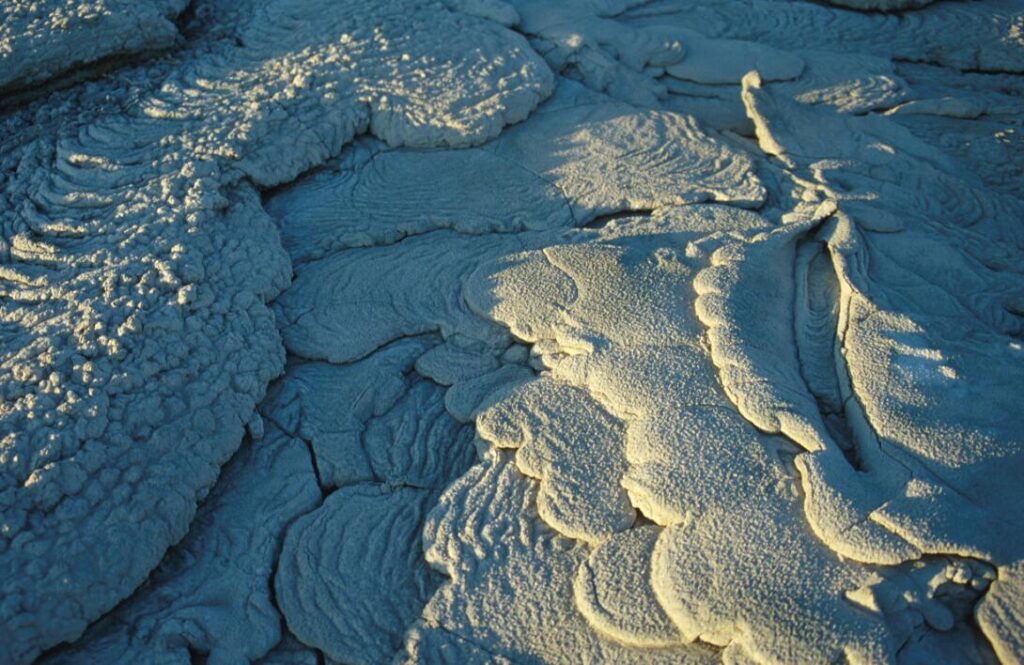
The change from black to white is not simply the lava cooling. It is a rapid mineralogical and chemical transformation caused by the instability of fresh natrocarbonatite under atmospheric conditions.
Zaitsev and Keller examined 105 samples ranging from freshly erupted material to natrocarbonatite about a century old. They found that secondary minerals can begin forming only 2–3 hours after solidification, or immediately when rain is present. Samples collected 2–24 hours after eruption contained newly formed minerals including nahcolite, trona, sylvite and halite.
Atmospheric humidity begins altering the initially black lava within hours. White powdery thermonatrite and nahcolite form on the surface as water interacts with the unstable primary minerals. Meteoritic water also dissolves readily soluble phases and hydrates nyerereite, one of the characteristic carbonate minerals in fresh Lengai lava.
Longer exposure continues the transformation. Over weeks, months and years, weathering produces additional carbonate phases including pirssonite, gaylussite, shortite, trona, thermonatrite, nahcolite and calcite. Zaitsev and Keller reported that one year can be sufficient to transform solid natrocarbonatite into unconsolidated material under surface conditions.
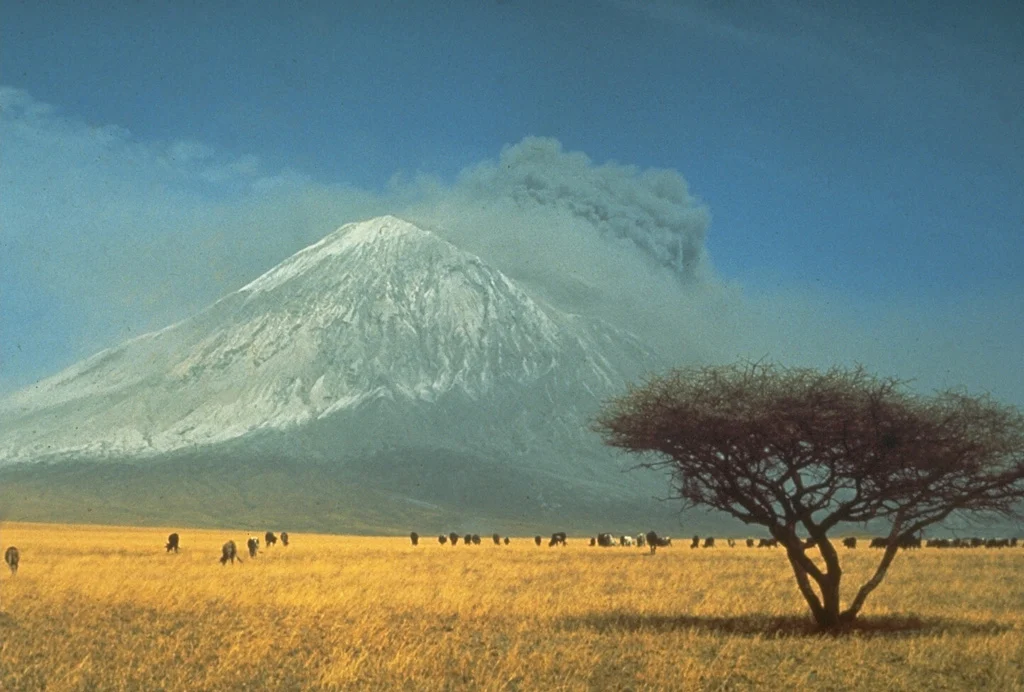
The mineralogical evidence matches direct observations at the volcano. The June 1988 Smithsonian report described active lava as black. About 24 hours after emplacement, the edges of flows had become whitish; after roughly 48 hours, their surfaces were entirely whitish. The pale material covering parts of the summit is therefore altered carbonatite rather than snow.
An active volcano with different eruptive modes
Ol Doinyo Lengai’s low-temperature lava does not mean the volcano is incapable of explosive activity. Its eruptive history includes both quiet effusion of natrocarbonatite and explosive phases involving ash and other pyroclastic material.
Explosive activity during 2007 and 2008 substantially changed the northern crater after a long period dominated by effusive eruptions. NASA satellite imagery shows the contrast between the broad, lava-filled summit visible before the explosive phase and the steep-walled crater and new cone left afterward.
The Smithsonian database records the eruptive period that began on April 9, 2017 as continuing through its March 31, 2026 data endpoint. Smithsonian notes that a classification as continuing does not mean a volcano is erupting every day; it indicates intermittent eruptive activity without a sufficiently long confirmed break to close the eruptive period.
The latest detailed Smithsonian bulletin for the volcano covers activity through January 2024. Satellite observations during the second half of 2023 showed mainly low-power thermal anomalies within the summit crater, including a small lava effusion confined to the crater on November 19, 2023.
Magma movement detected below the volcano
Surface measurements have also recorded changes beneath Ol Doinyo Lengai that cannot be seen from the crater. A study published on September 18, 2026 analyzed a period of ground uplift detected between March 2022 and August 2023 by Global Navigation Satellite System (GNSS) instruments around the volcano.
GNSS stations measure small changes in the position of the ground. At an active volcano, coordinated outward and upward movement can be used to investigate whether pressure or magma is changing beneath the surface. The measurements do not reveal an underground magma body directly; researchers infer its location and geometry by comparing the observed surface movement with mathematical models.
Stamps et al. (2026) tested spherical, sill-like, spheroidal and dike-like source geometries using the U.S. Geological Survey’s dMODELS software. Statistical comparison favored a sill-like source, a broadly sheet-shaped body of magma emplaced roughly parallel to the surrounding rock layers.
The preferred model placed the source about 3.1 ± 2.2 km (1.9 ± 1.4 miles) below the active vent and calculated a volume increase of 0.99 ± 0.22 million m3 (35 ± 8 million ft3). The researchers interpreted the deformation as consistent with shallow magma intrusion during the 2022–2023 uplift episode.
The depth is a modeled result rather than a direct measurement, and its uncertainty is substantial. Only five GNSS sites relative to the reference station were available to constrain the inversion, while the mathematical models assume a homogeneous elastic subsurface that does not reproduce the full geological complexity of an active rift volcano. The authors nevertheless found measurable uplift at each station and outward horizontal movement greater than the observational uncertainties.
The uplift did not culminate in an explosive eruption. The 2026 study instead places the episode within a more complex, multi-level magmatic system beneath Ol Doinyo Lengai and the surrounding Natron Rift. Earlier geophysical work has identified magma storage and fluid pathways at several depths, making continued deformation measurements valuable for distinguishing temporary magma recharge from changes that accompany future eruptive activity.
The monitoring does not provide a method for predicting the timing of the volcano’s next eruption. Continuous measurements can, however, establish how the system behaves between eruptive episodes and provide a baseline against which future changes in deformation, seismicity and summit activity can be compared.
References:
1 Krafft, M., & Keller, J. (1989). Temperature measurements in carbonatite lava lakes and flows from Oldoinyo Lengai, Tanzania. Science, 245(4914), 168-170. https://doi.org/10.1126/science.245.4914.168
2 Zaitsev, A. N., & Keller, J. (2006). Mineralogical and chemical transformation of Oldoinyo Lengai natrocarbonatites, Tanzania. Lithos, 91(1-4), 191-207. https://doi.org/10.1016/j.lithos.2006.03.018
3 Stamps, D. S., Saria, E., Daud, N., Battaglia, M., Adams, A. N., Huang, M.-H., Brounce, M. J., Ji, K.-H., Meshili, V. A., & Roos, B. (2026). Inflation at Ol Doinyo Lengai driven by shallow magma intrusion during the 2022-2023 uplift episode in an early-phase continental rift. Frontiers in Earth Science, 14, 1881885. https://doi.org/10.3389/feart.2026.1881885
Featured image: Ol Doinyo Lengai in northern Tanzania. Credit: Christoph Strässler, CC BY-SA 2.0, via Wikimedia Commons.

I’m a science journalist and researcher at The Watchers, contributing to the Epicenter edition, where I cover peer-reviewed scientific research and emerging discoveries across Earth and space sciences. With a background in astronomy and a passion for environmental science, I’ve worked in shark and coral conservation in Fiji, conducting reef and shark-behavior research, contributing to mangrove restoration, and earning PADI Open Water and Coral Reef Certifications. I bring a blend of scientific rigor and storytelling to illuminate the discoveries shaping our planet and beyond.
