
Study links lower solar activity to higher radiation proxy at flight altitudes
High-altitude balloon measurements over southern Israel found an inverse association between solar activity and a gamma-equivalent dose-rate proxy at aviation altitudes. The peer-reviewed study, first published online on August 29, 2026, analyzed six balloon launches from October 2014 to August 2016.
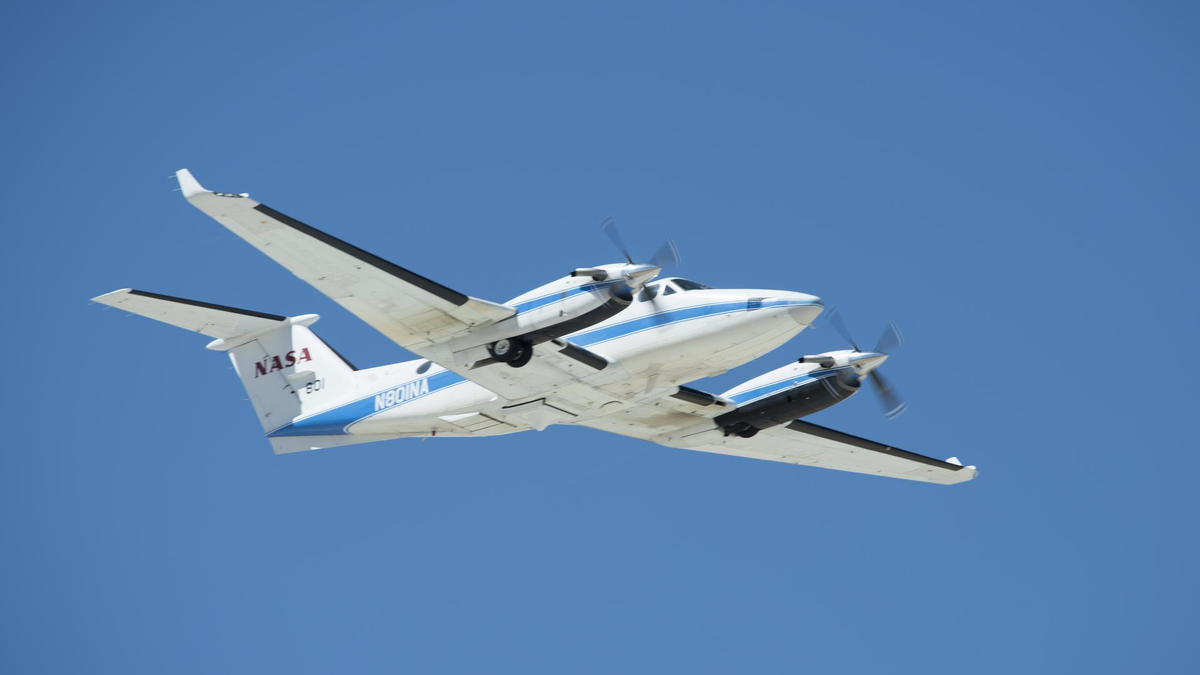
NASA’s B200 King Air aircraft. NASA has used airborne research campaigns to study cosmic-radiation exposure at aviation altitudes and improve understanding of the radiation environment encountered by aircraft. This image is illustrative and is not from the balloon campaign over Israel. Credit: NASA.
The measured ionization profiles reached the Regener–Pfotzer maximum at approximately 17–20 km (10.6–12.4 miles), where secondary cosmic-ray production reaches its atmospheric maximum. The mean gamma-equivalent dose-rate profile peaked near 17–19 km (10.6–11.8 miles), reaching about 2.8–3 μSv/h before decreasing at greater altitude. The paper identifies 9–12 km (5.6–7.5 miles) as a typical commercial aviation cruising range.
At about 10 km (6.2 miles), the paper reports gamma-equivalent dose-rate proxy values of approximately 0.9–1.3 μSv/h. That range requires caution because the paper’s tabulated chronology does not cleanly match the stated six-launch 2014–2016 campaign; the inconsistency is detailed below.
During the declining phase of Solar Cycle 24, the measurements showed an inverse association between the aviation-altitude dose-rate proxy and solar activity. The reported correlation was r = −0.71, with a two-tailed p-value of approximately 0.11 and n = 6. Because the result was not statistically significant at the 0.05 level, the authors describe the limited-sample relationship as indicative rather than definitive, while noting that its direction is consistent with the established solar modulation of galactic cosmic rays.
Roy Yaniv, affiliated with the Gertner Institute Climate Center at Sheba Medical Center and the Hebrew University of Jerusalem, conducted the study with Yoav Yair of Reichmann University and Colin Price of Tel Aviv University.
The researchers used radiosonde balloons carrying two miniature LND714 Geiger–Müller tubes above the Wise Observatory at Mitzpe Ramon in southern Israel, at 30°35′N, 34°45′E and an elevation of 850 m (2 789 feet). The six launches reached up to about 35 km (22 miles), and the system sampled the vertical profile at approximately 5 m (16 feet) resolution.
Why lower solar activity allows more cosmic rays through
The solar wind and heliospheric magnetic field modulate the flux of galactic cosmic rays reaching Earth. The study uses heliospheric modulation potential as a measure of that solar modulation: higher modulation potential, associated with stronger solar activity, corresponds to fewer high-energy galactic cosmic rays penetrating the atmosphere, while lower modulation potential corresponds to greater penetration.
The researchers extrapolated the measured relationship to modulation potentials of 100–200 MV, representing solar-minimum and deep-solar-minimum conditions in their analysis. The extrapolation produced gamma-equivalent dose-rate proxy values about 40%–60% above the study’s solar-maximum values at aviation altitudes. The 100–200 MV points were calculated beyond the directly measured campaign range rather than observed during balloon flights, and the authors caution that the estimate is extrapolative.
Short-term heliospheric disturbances were not explicitly modeled. The researchers examined neutron-monitor observations from Oulu for the balloon campaign periods and identified no major Forbush decreases coinciding with the flights. Storm-time changes in geomagnetic cutoff rigidity were also not explicitly modeled, leaving a source of possible short-term variability separate from the longer-term solar-cycle relationship examined in the study.
Geomagnetic shielding adds another geographic control. The launch site had a nominal vertical geomagnetic cutoff rigidity of about 10.3 GV, a measure of how strongly Earth’s magnetic field excludes lower-rigidity charged cosmic rays. Routes at higher geomagnetic latitudes generally have lower cutoff rigidities, allowing greater galactic cosmic-ray penetration than at the Israeli site.
What the balloon detector did and did not measure
The Geiger–Müller tubes were most sensitive to photons and charged secondary particles and had negligible direct neutron sensitivity. The authors therefore treat the readings as a gamma-equivalent proxy that mainly tracks the modeled electromagnetic component, while noting additional detector response to charged particles including relativistic muons. The measurements cannot be interpreted directly as the complete radiation exposure aboard an aircraft.
For radiation-protection comparisons, the researchers used ambient dose equivalent H*(10), a quantity defined at a depth of 10 mm in a tissue-equivalent sphere and used as a measurable proxy for penetrating whole-body radiation exposure. At approximately 10 km (6.2 miles), the EXPACS/PARMA model produced total H*(10) values of 2.36–2.49 μSv/h, compared with 0.93–0.98 μSv/h for the modeled electromagnetic component.
Neutrons contributed about 40%–45% of modeled total H*(10), while photons, electrons and positrons accounted for roughly 35%–40%. Protons and other modeled particle components accounted for the balance. Neutrons became increasingly important above about 8–10 km (5–6.2 miles) and were the largest contributor to modeled H*(10) through much of the aviation-altitude range.
Measured gamma-equivalent values were typically within approximately 10%–15% of the modeled electromagnetic component for most of the tabulated comparisons, and the paper reports a correlation of about r = 0.8 between the measured proxy and modeled electromagnetic contribution. Two 2017 entries in Table 2 show larger measured-to-modeled differences of approximately 45% and 35%. The authors use the model comparison as a consistency test for the electromagnetic component rather than direct validation of total radiation exposure.
The paper contains an unresolved chronology inconsistency relevant to those comparisons. The Results text says the vertical gamma-equivalent profile was derived from eight measurements obtained during six balloon flights, six ascents and two descents. However, the captions for Figures 2 and 3 refer to eight balloon flights, while Table 2 lists eight comparison dates, including February 6 and May 11, 2017, beyond the stated October 2014–August 2016 six-launch campaign. The paper does not explain the two additional 2017 dates or the conflicting figure-caption wording.
Dose-rate measurements were calculated as averages over 1-minute sampling intervals and are not cumulative radiation doses. The study also identifies calibration uncertainty and the difference between the detector’s cobalt-60 calibration field and the mixed atmospheric radiation environment as measurement limitations. The complete processed dataset used for the study’s figures and tables has been deposited in Zenodo.
For passenger context, the U.S. Centers for Disease Control and Prevention states that radiation exposure from air travel is generally low and depends on flight duration, altitude and latitude; the agency says typical air-travel radiation levels are small and unlikely to affect human health. Repeated occupational exposure remains relevant for aircrew because exposure accumulates across flights.
The U.S. Federal Aviation Administration uses its CARI-7 system to calculate effective galactic cosmic-radiation dose along aircraft routes. CARI-7 accounts for altitude, geographic location, changes in Earth’s magnetic field and solar activity, illustrating why a balloon-borne gamma-equivalent proxy cannot by itself represent a passenger or crew member’s total route-specific dose.
References:
1 Yaniv, R., Yair, Y., & Price, C. (2026). Cosmic radiation dose-rates for civil aviation in the Middle East: Vertical structure, solar modulation, and comparison with models. Journal of Geophysical Research: Atmospheres, 131, e2026JD047316. DOI 10.1029/2026JD047316

I’m a science journalist and researcher at The Watchers, contributing to the Epicenter edition, where I cover peer-reviewed scientific research and emerging discoveries across Earth and space sciences. With a background in astronomy and a passion for environmental science, I’ve worked in shark and coral conservation in Fiji, conducting reef and shark-behavior research, contributing to mangrove restoration, and earning PADI Open Water and Coral Reef Certifications. I bring a blend of scientific rigor and storytelling to illuminate the discoveries shaping our planet and beyond.
