
New study challenges existing models of the universe’s expansion
A new study has confirmed that the universe is expanding faster than previously thought, deepening the Hubble constant discrepancy.

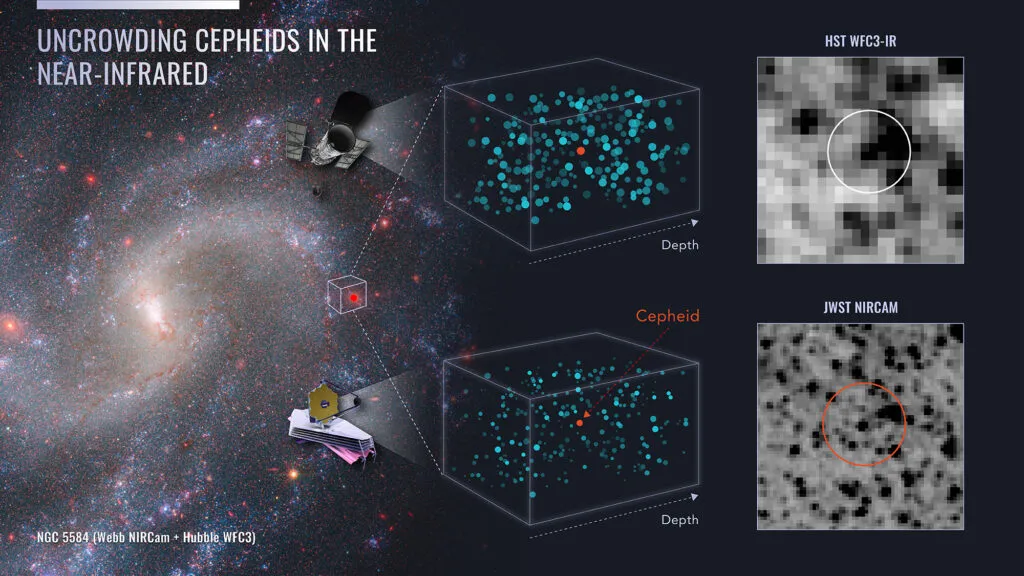
Combined observations from NASA’s NIRCam (Near-Infrared Camera) and Hubble’s WFC3 (Wide Field Camera 3) show spiral galaxy NGC 5584, which resides 72 million light-years away from Earth. Among NGC 5584’s glowing stars are pulsating stars called Cepheid variables and Type Ia supernova, a special class of exploding stars. Astronomers use Cepheid variables and Type Ia supernovae as reliable distance markers to measure the universe’s expansion rate. Image credit: NASA, ESA, CSA, and A. Riess (STScI)
- Scientists have measured the Coma Cluster’s distance with good accuracy using the Dark Energy Spectroscopic Instrument (DESI) and revealed a faster cosmic expansion rate that contradicts existing cosmological models.
- The study determined a Hubble constant of 76.5 ± 2.2 km/s/Mpc (47.5 ± 1.4 mi/s/Mpc) which conflicts with the 67.4 km/s/Mpc (41.9 mi/s/Mpc) derived from Planck satellite data and intensified the ongoing Hubble tension.
A recent study has reinforced the ongoing discrepancy in the measured value of the Hubble constant (H0) challenging current models of the universe’s expansion.
Researchers at the Kitt Peak National Observatory in Arizona have used the Dark Energy Spectroscopic Instrument (DESI) to determine the distance to the Coma Cluster which is a massive galaxy cluster approximately 320 million light-years (98 megaparsecs) away. The results indicate a higher rate of cosmic expansion than previously estimated by the Planck satellite’s observations of the early universe.
“The tension now turns into a crisis,” said Dan Scolnic from Duke University, who led the research team.
“We’re at a point where we’re pressing really hard against the models we’ve been using for two and a half decades, and we’re seeing that things aren’t matching up.”
New distance measurements and their impact
The DESI collaboration analyzed 12 Type Ia supernovae within the Coma Cluster to determine a precise distance measurement. Type Ia supernovae are often referred to as “standard candles,” and they provide reliable distance indicators because of the consistent peak luminosities.
The team’s calculations place the Coma Cluster at 98.5 ± 2.2 megaparsecs (321 ± 7 million light-years). The value aligns with historical distance estimates but contradicts the prediction from the Planck satellite’s cosmic microwave background (CMB) measurements which suggest Coma should be at 111.8 ± 1.8 megaparsecs (364 ± 6 million light-years).
The measured Hubble constant from this study is 76.5 ± 2.2 km/s/Mpc (47.5 ± 1.4 mi/s/Mpc) which is a value consistent with other local universe measurements using Cepheids and surface brightness fluctuations. It remains higher than the 67.4 km/s/Mpc (41.9 mi/s/Mpc) inferred from the standard ΛCDM cosmological model.
The growing Hubble tension
The Hubble tension refers to the persistent difference between direct measurements of H0 in the local universe and values inferred from early-universe data. If the standard ΛCDM model were correct both methods should yield the same expansion rate. Discrepancies have instead only become more pronounced with increasingly precise measurements.
Independent of DESI’s findings, alternative techniques such as Cepheid variable stars, the tip of the red giant branch (TRGB) method from the James Webb Space Telescope (JWST), and infrared surface brightness fluctuations from the Hubble Space Telescope (HST) also support a lower Coma Cluster distance of less than 100 megaparsecs (326 million light-years).
The results further contradict the greater distance expected from the Planck-calibrated Hubble constant while adding to the mounting evidence that there may be missing physics in our cosmological understanding.
What does this mean for cosmology?
A potential explanation for this discrepancy could involve new physics beyond the standard ΛCDM model. Some hypotheses suggest unknown interactions between dark matter and dark energy while others propose modifications to gravity on cosmological scales.
Cosmologists will continue refining observational techniques and theoretical models to bridge the gap until a definitive resolution emerges.
“This may be reshaping how we think about the Universe, and it’s exciting! There are still surprises left in cosmology, and who knows what discoveries will come next?” Scolnic emphasized.
References:
1 The Hubble Tension in Our Own Backyard: DESI and the Nearness of the Coma Cluster – Daniel Scolnic, Adam G. Riess, Yukei S. Murakami, et. al. – The Astrophysical Journal Letters – January 15, 2025 – https://doi.org/10.3847/2041-8213/adaObd – OPEN ACCESS

Rishika holds a Master’s in International Studies from Stella Maris College, Chennai, India, where she earned a gold medal, and an MCA from the University of Mysore, Karnataka, India. Previously, she served as a Research Assistant at the National Institute of Advanced Studies, Indian Institute of Science, Bengaluru, India. During her tenure, she contributed as a Junior Writer for Europe Monitor on the Global Politics website and as an Assistant Editor for The World This Week. Her work has also been published in The Hindu newspaper, showing her expertise in global affairs. Rishika is also a recipient of the Women Empowerment Award at the district level in Haryana, India, in 2022.

Commenting rules and guidelines
We value the thoughts and opinions of our readers and welcome healthy discussions on our website. In order to maintain a respectful and positive community, we ask that all commenters follow these rules.