
NASA and IBM unveil Surya, an AI model to forecast solar storms
The first-of-its-kind Surya Heliophysics Foundation Model, developed by NASA and IBM, uses 9 years of solar observations to forecast flare activity and solar storms with high accuracy.

Solar prominence eruption on August 20, 2025. Credit: NASA SDO/AIA 304
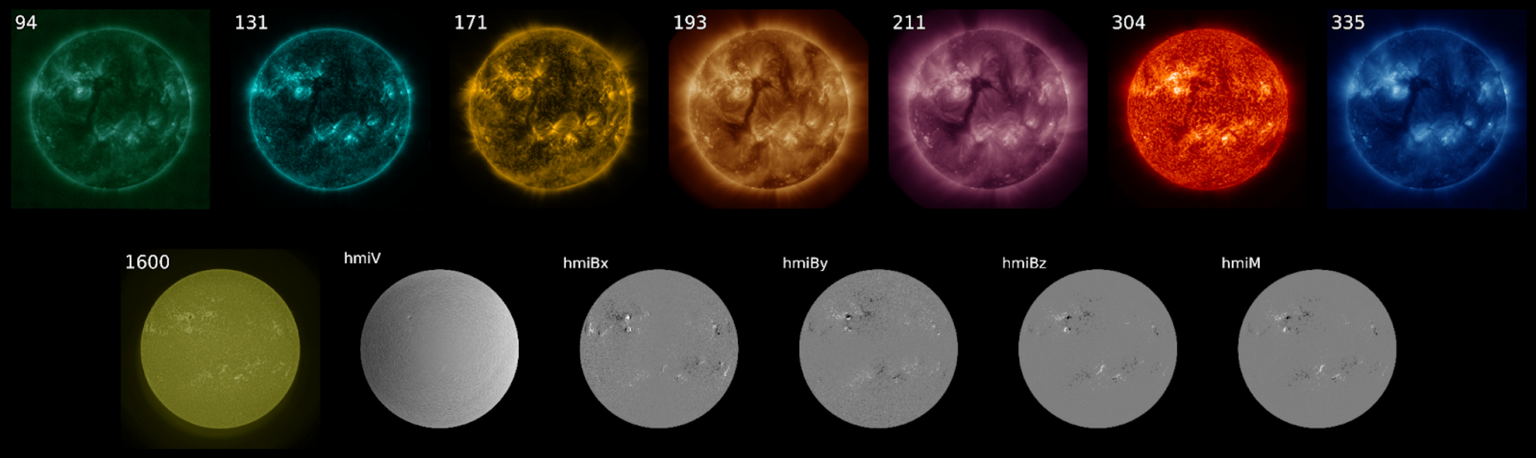
NASA and IBM have developed a first-of-its-kind AI model trained on over 9 years worth of solar observations from NASA’s Solar Dynamics Observatory (SDO). Surya Heliophysics Foundational Model, is a system designed to improve the understanding of solar eruptions and enhance space weather prediction capabilities.
The name “Surya” is derived from the Sanskrit word for the Sun.
Surya aims to assist scientists in predicting solar flares and coronal mass ejections–solar events that can disrupt satellites, power grids, and communication systems. The model can provide early warnings for satellite operators and help forecast the Sun’s ultraviolet influence on Earth’s upper atmosphere.
What makes Surya special
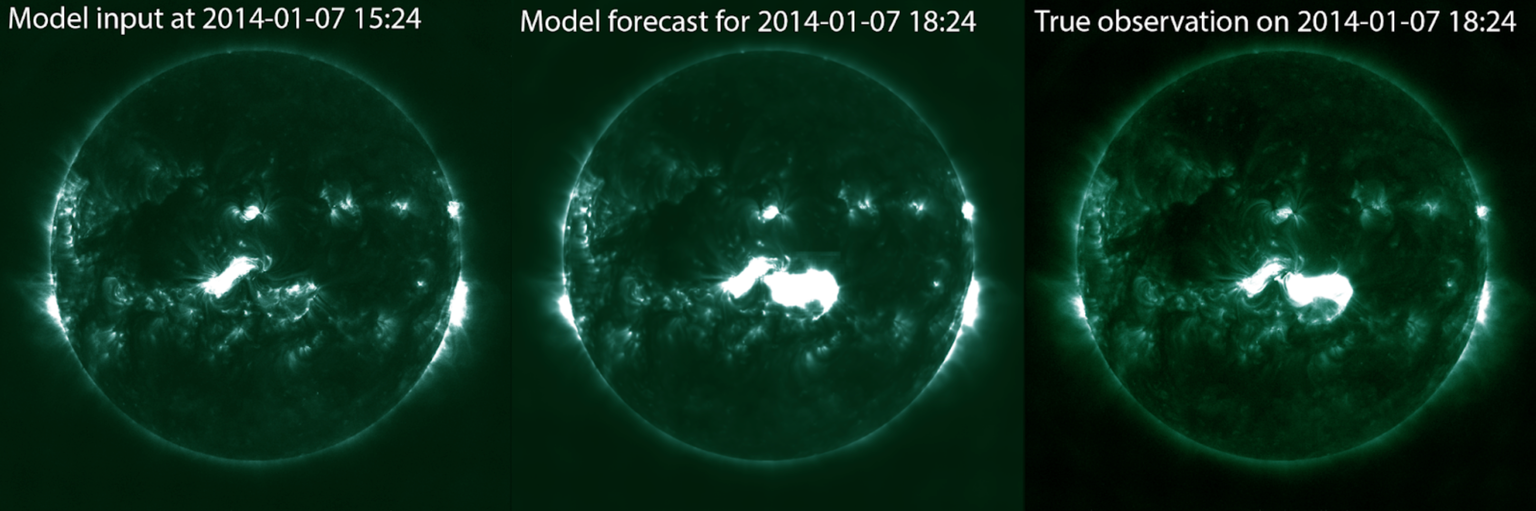
Preliminary test results show that Surya achieves 16% better accuracy in classifying solar flares compared to older methods. Uniquely, Surya can also visually predict where solar flares will occur up to two hours in advance, providing a detailed image of the predicted location.
The model’s success builds directly on the Solar Dynamics Observatory’s long-term database. Launched in 2010, NASA’s Solar Dynamics Observatory has provided an unbroken, high-resolution record of the Sun for nearly 15 years through capturing images every 12 seconds in multiple wavelengths, plus precise magnetic field measurements.
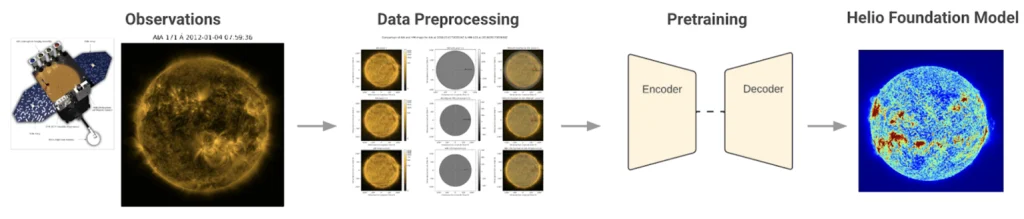
Surya’s strength lies in its foundation model architecture, which learns directly from raw solar data. Unlike traditional AI systems that require extensive labeling, Surya can adapt quickly to new tasks and applications.
Applications include tracking active regions, forecasting flare activity, predicting solar wind speed, and integrating data from other observatories including the joint NASA-ESA Solar and Heliospheric Observatory mission and NASA’s Parker Solar Probe.
This stable, well-calibrated dataset, spanning an entire solar cycle, is uniquely suited for training AI models like Surya, enabling them to detect subtle patterns in solar behavior that shorter datasets would miss.
Why is it important to predict space weather and solar storms
The Sun is 150 million km (93 million) miles away but it can impact our day-to-day life quite easily. Solar storms pose significant risks to our technology-dependent society. Powerful solar events energize Earth’s ionosphere, resulting in substantial GPS errors or complete signal loss to satellite communications.
They also pose risks to power grids, as geomagnetically induced currents from coronal mass ejections can overload transformers and trigger widespread outages.
According to a systemic risk scenario created by Lloyd’s, the global economy could be exposed to losses of USD 2.4 trillion over a five-year period, with the expected loss of USD 17 billion from the threat of a hypothetical solar storm. Recent solar events have already demonstrated the risk, disrupting GPS services, forcing flight diversions, and damaging satellites.
In commercial aviation, solar flares can disrupt radio communications and navigation systems while exposing high-altitude flights to increased radiation. The stakes are even higher for human spaceflight. Astronauts bound for the Moon or Mars may need to depend on precise predictions to shelter from intense radiation during solar particle events.
What do the scientists say
“By developing a foundation model trained on NASA’s heliophysics data, we’re making it easier to analyze the complexities of the sun’s behavior with unprecedented speed and precision,” Kevin Murphy, chief science data officer at NASA Headquarters in Washington, said in a statement.
“This model empowers broader understanding of how solar activity impacts critical systems and technologies that we all rely on here on Earth,” he added.
Conclusion
Surya is part of a broader initiative by NASA and IBM to apply generative and automated approaches for scalable algorithm development. The model is openly available on Hugging Face, with source code on GitHub, encouraging the scientific community to experiment with it.
Surya joins IBM’s Prithvi family of foundation models, which also includes AI models for geospatial data and weather forecasting. In 2024, IBM and NASA released the Prithvi weather model on Hugging Face to support the development of short- and long-term weather and climate projections.

I am an Assistant Editor and Severe Weather & Science Journalist at The Watchers, specializing in real-time severe weather coverage, geophysical event reporting, and research-driven scientific analysis. You can reach me at rishav(at)watchers(.)news.

Commenting rules and guidelines
We value the thoughts and opinions of our readers and welcome healthy discussions on our website. In order to maintain a respectful and positive community, we ask that all commenters follow these rules.