
MIT physicists achieve the cleanest test of double-slit experiment using single atoms
Physicists at the Massachusetts Institute of Technology (MIT) demonstrated the cleanest version to date of the double-slit experiment by using two single atoms as the slits, confirming wave–particle duality.
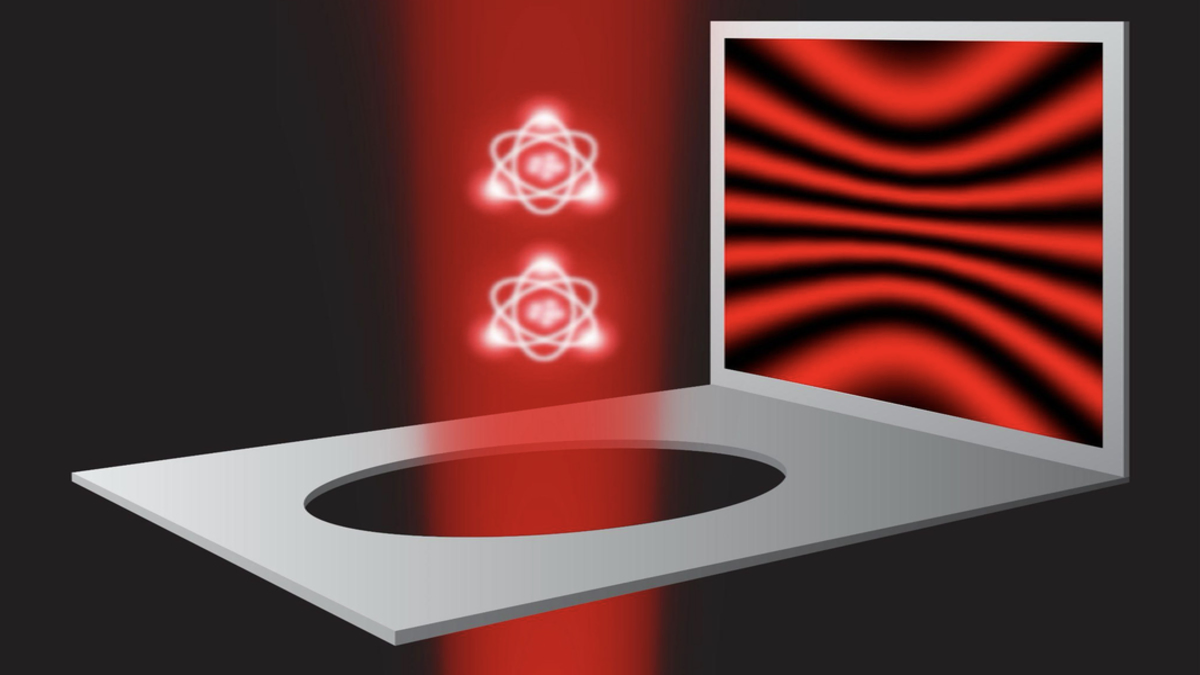
Experiment schematic: Two single atoms floating in a vacuum chamber are illuminated by a laser beam and act as the two slits. The interference of the scattered light is recorded with a highly sensitive camera depicted as a screen. Incoherent light appears as background and implies that the photon has acted as a particle passing only through one slit. Credit: Wolfgang Ketterle, Vitaly Fedoseev, Hanzhen Lin, Yu-Kun Lu, Yoo Kyung Lee and Jiahao Lyu
The experiment, reported in Physical Review Letters on July 22, directly implemented Albert Einstein’s thought experiment from the 1920s.
Instead of a pair of slits, the researchers used rubidium atoms cooled to near absolute zero and arranged in an optical lattice. In this setup, two individual atoms acted as effective slits, scattering single photons whose behavior revealed whether interference fringes or particle-like spots would emerge.
The team, led by Wolfgang Ketterle, cooled more than 10 000 atoms in a vacuum chamber and confined them in laser-made traps. By adjusting the confinement strength, the physicists controlled the atoms’ positional uncertainty.
When atoms were tightly trapped, they had well-defined positions and provided little path information, allowing interference fringes to appear. When atoms were loosely confined, they could move upon scattering, carrying a faint trace of photon interaction. This information was enough to collapse the interference pattern, leaving only two bright spots.
The findings support Niels Bohr’s principle of complementarity, which states that a quantum system cannot display both wave-like and particle-like properties at once. They also challenge Einstein’s suggestion that interference could be lost merely due to experimental noise.
To confirm this, the MIT group repeated measurements after removing the laser traps, letting the atoms float freely. The outcome was unchanged, eliminating the possibility that the confinement itself influenced the results.
“This was the most difficult part,” said Hanzhen Lin, a PhD student at MIT, referring to the need to repeat the experiment thousands of times because the light beam was so faint that only minimal information could be gathered per cycle.
The study, Coherent and Incoherent Light Scattering by Single-Atom Wave Packets, further showed that coherence properties of the scattered light were independent of whether atoms were confined or freely expanding. The authors concluded that phenomena such as recoil-free scattering, trap-induced sidebands, or oscillator excitations are not essential for explaining whether scattering remains coherent or becomes incoherent.
“I think this is a beautiful experiment and a testament to how far our experimental control has come,” said Thomas Hird, a physicist at the University of Birmingham, UK.
The MIT team now plans to study cases where two atoms occupy each lattice site. According to Lin, interactions between atoms at each site may produce new interference effects.
References:
1 Coherent and Incoherent Light Scattering by Single-Atom Wave Packets – Fedosev et al. – Phys. Rev. Lett. 135, 043601 –July 22, 2025 – DOI: https://doi.org/10.1103/zwhd-1k2t
2 Famous double-slit experiment gets its cleanest test yet – Physics World – August 27, 2025

I’m a science journalist and researcher at The Watchers, contributing to the Epicenter edition, where I cover peer-reviewed scientific research and emerging discoveries across Earth and space sciences. With a background in astronomy and a passion for environmental science, I’ve worked in shark and coral conservation in Fiji, conducting reef and shark-behavior research, contributing to mangrove restoration, and earning PADI Open Water and Coral Reef Certifications. I bring a blend of scientific rigor and storytelling to illuminate the discoveries shaping our planet and beyond.

Hey why https://arxiv.org/abs/1901.05074 A Dynamic ‘Double Slit’ Experiment in a Single Atom is not cited?
we have touched the face of God