
JAXA’s Hayabusa2# to attempt ultra-close, high-speed flyby of asteroid Torifune
JAXA’s Hayabusa2# spacecraft is scheduled to perform an ultra-close flyby of asteroid Torifune at high speed on July 5, 2026, with a planned closest approach of 1-10 km (0.6-6.2 miles) from the asteroid’s center at approximately 5.25 km/s. The encounter involves a small body about 450 m (1 480 feet) in diameter and will be conducted under limited pointing capability during a short observation window.
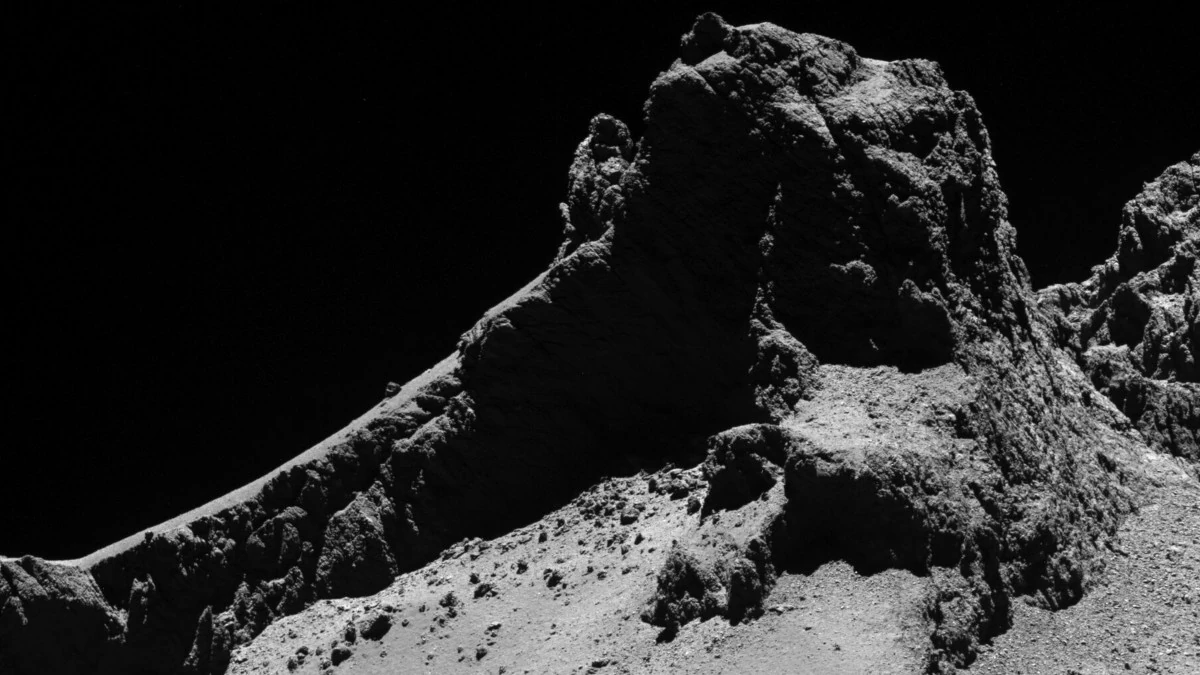
Representative small-body imagery from ESA’s Rosetta mission showing a section of Comet 67P/Churyumov–Gerasimenko, photographed from a distance of about 8 km (5 miles) on October 14, 2014. Credit: ESA/Rosetta/MPS for OSIRIS Team MPS/UPD/LAM/IAA/SSO/INTA/UPM/DASP/IDA
JAXA’s Hayabusa2# spacecraft will fly by asteroid (98943) Torifune on July 5, as part of its extended mission following the sample-return phase at Ryugu. Mission plans call for a high-speed encounter at approximately 5.25 km/s, with a targeted closest approach of 1-10 km (0.6-6.2 miles) from the asteroid’s center, subject to final navigation and safety constraints.
Torifune (formerly known as 2001 CC21) is estimated to be about 450 m (1 480 feet) in diameter and is classified as an Sq-type asteroid, consistent with ordinary chondrite analogs, including L and LL chondrites. However, its small size and the planned encounter velocity will limit the duration of effective observations during the flyby.
Because Hayabusa2# was designed for rendezvous operations rather than high-speed flybys, its instrumentation is not optimized for rapid-pass imaging. Observations will thus rely on pre-planned spacecraft pointing with only limited adjustment during the encounter. JAXA states that post-closest-approach observations will be constrained, placing priority on data collection during the inbound phase.
Mission planners are evaluating a trajectory that could bring the spacecraft to within approximately 1 km (0.6 miles) of the asteroid’s surface, which requires balancing observation objectives with collision avoidance, given uncertainties in Torifune’s shape, rotation state, and surface features ahead of the flyby.
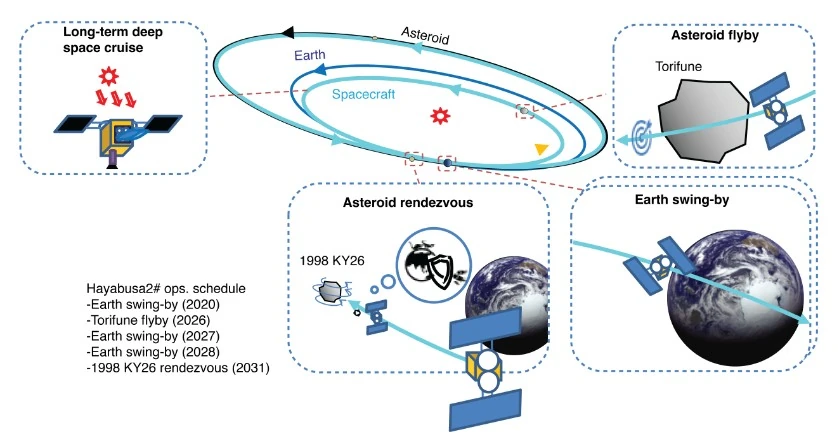
During the flyby, the spacecraft will operate five onboard instruments to characterize the asteroid’s shape, surface composition, and thermal properties.
The encounter provides conditions distinct from most asteroid missions, which involve either low-velocity rendezvous or distant flybys. The combination of a small target, high relative speed, and limited observation time restricts the margin for extended imaging sequences.
This flyby is a practical case for the rapid characterization of small bodies observed on short timescales. High-speed encounters with limited observation windows are relevant to scenarios in which near-Earth objects are detected with little advance notice, requiring fast assessment of size, shape, rotation, and composition.
JAXA describes the flyby as both a scientific opportunity and an engineering demonstration within the extended mission. Data collected during the encounter are intended to improve understanding of small S-complex asteroids.
Additionally, if the spacecraft can navigate with exceptional precision, it would even be possible to intentionally crash the spacecraft into a small asteroid. This is critically important technology for planetary defense.
In 2022, NASA conducted an experiment in which a spacecraft called DART was intentionally crashed into an asteroid. The purpose was to determine to what extent the asteroid’s orbit could be altered by the spacecraft’s impact.
“If Hayabusa2# can be navigated with this kind of accuracy, Japan will also be able to contribute to the prevention of celestial bodies colliding with the Earth,” JAXA scientists said.
Hayabusa2# is pronounced “Hayabusa2 Sharp,” with SHARP standing for Small Hazardous Asteroid Reconnaissance Probe. The extended mission began after Hayabusa2 returned Ryugu samples to Earth on December 6, 2020, and includes cruise-phase observations, the July 2026 flyby of asteroid Torifune, and a planned rendezvous with asteroid 1998 KY26 in 2031.
References:
1 Flyby of asteroid Torifune on July 5, 2026 – JAXA – December 19, 2025
2 Hirabayashi, M., Tsuda, Y., Yoshikawa, M., Tachibana, S., Watanabe, S., & Hayabusa2# mission team. (2026). Overview of Hayabusa2 extended mission’s flyby of Near-Earth Asteroid (98943) Torifune. arXiv. https://arxiv.org/abs/2604.08832v1
3 Popescu, M., Devogèle, M., Ferrais, M., Birlan, M., Carry, B., Binzel, R. P., de León, J., Fornasier, S., Polishook, D., Rivkin, A. S., & Reddy, V. (2025). Spectral and photometric characterization of (98943) Torifune in preparation for the Hayabusa2# spacecraft flyby. Astronomy & Astrophysics, 693, A24. https://doi.org/10.1051/0004-6361/202452498

I'm a dedicated researcher, journalist, and editor at The Watchers. With over 20 years of experience in the media industry, I specialize in hard science news, focusing on extreme weather, seismic and volcanic activity, space weather, and astronomy, including near-Earth objects and planetary defense strategies. You can reach me at teo /at/ watchers.news.

Commenting rules and guidelines
We value the thoughts and opinions of our readers and welcome healthy discussions on our website. In order to maintain a respectful and positive community, we ask that all commenters follow these rules.