
Ionosphere revealed signals two hours before the 2021 Peru earthquake
Ionospheric disturbances were observed up to two hours before the Mw 7.5 earthquake that struck northern Peru at 10:52 UTC (05:52 LT) on November 28, 2021, according to a new study published in the Journal of Atmospheric and Solar-Terrestrial Physics on September 27, 2025.
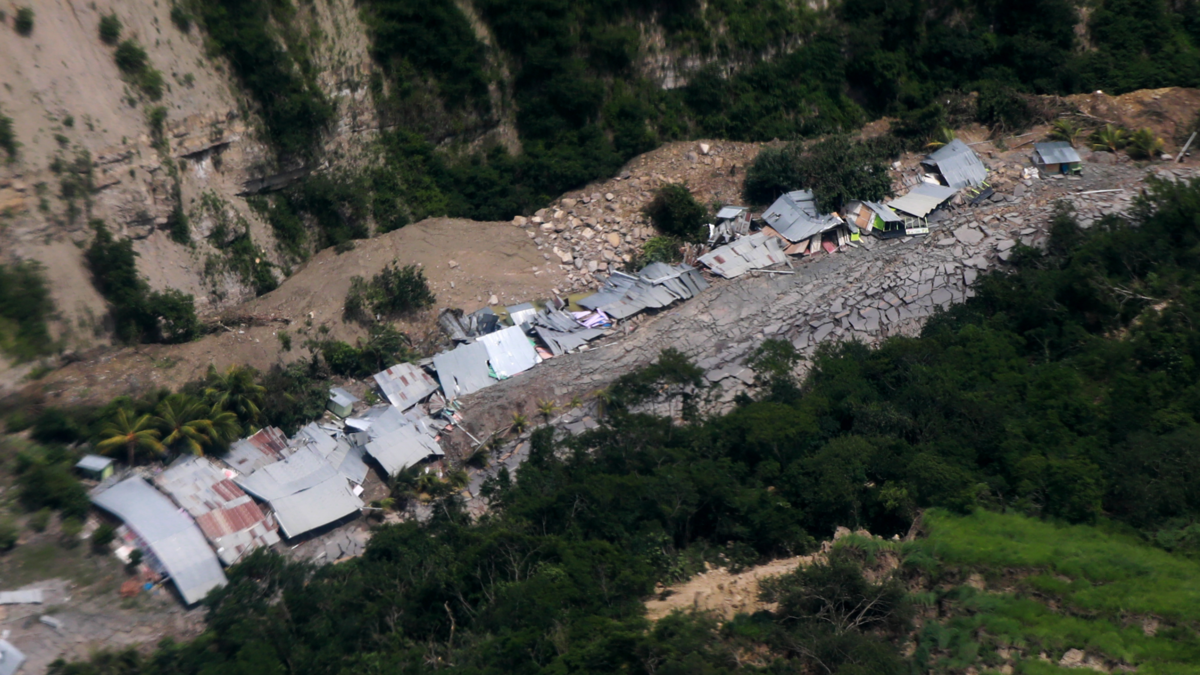
Collapsed houses in Utcubamba Province. Credit: Ministry of Defence (Peru)
The Mw 7.5 earthquake in northern Peru ruptured deep inside the subducted Nazca plate, 126 km (78 miles) beneath the surface. Well before the mainshock, anomalies in the ionosphere were already visible.
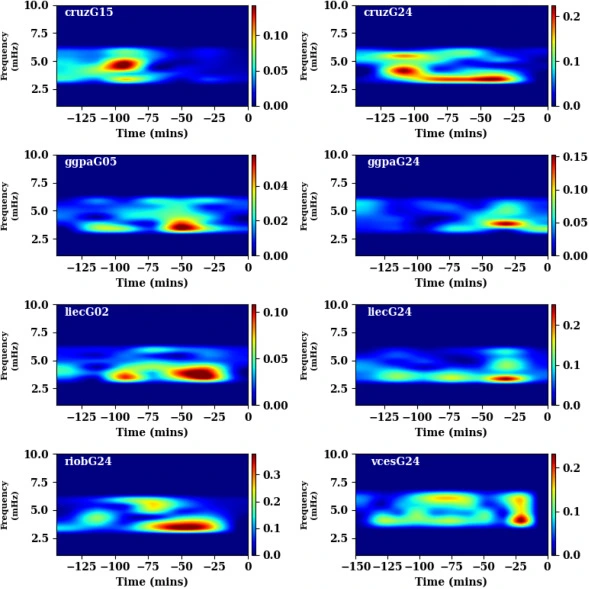
Using Global Navigation Satellite System (GNSS) data, researchers detected Total Electron Content (TEC) disturbances between 20 and 120 minutes before the event. These anomalies did not appear on the previous day, suggesting a direct link to seismic processes.
The anomalies became progressively stronger as the mainshock approached. This sequential increase in amplitude points to a possible buildup of tectonic stress mirrored in the ionosphere. For comparison, earlier studies usually reported anomalies only 30 to 40 minutes before major quakes, making this case unusual.
Frequencies match acoustic and infrasonic waves
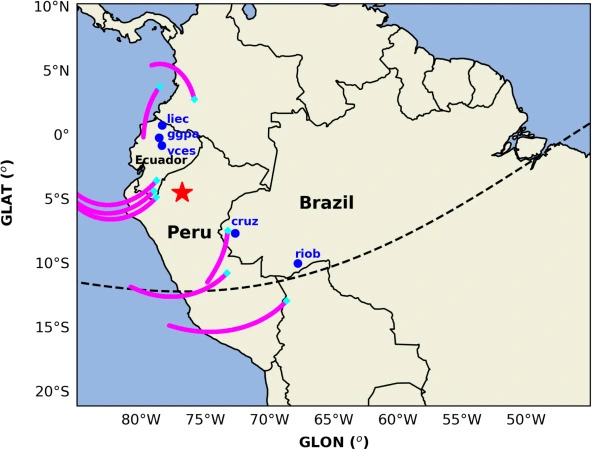
Spectral analysis showed that the disturbances had center frequencies between 3.63 mHz and 4.80 mHz. This range aligns with acoustic and infrasonic waves, low-frequency pressure oscillations that can travel from the ground into the ionosphere.
The disturbances propagated at speeds of about 0.60 km/s (0.37 mi/s), a value consistent with sound velocity in the thermosphere at altitudes above 150 km (93 miles). The close match suggests that foreshocks or subtle ground uplift could have produced waves strong enough to disturb the ionosphere.
Although ground motion prior to the mainshock was very small, on the order of millimeters per second, these weak uplifts were sufficient once amplified in the rarefied upper atmosphere. Past research has shown that even slight surface motions can trigger detectable ionospheric compression or displacement.
Disturbances were strongest near the equator
The strength of the anomalies was not uniform across space. Receivers located close to the epicenter recorded strong signals, but trajectories extending toward the geomagnetic equator registered even higher amplitudes.
This equatorward amplification is a recurring pattern in seismo-ionospheric studies. It is thought to be driven by stronger ion-neutral coupling and the nearly horizontal magnetic field lines at low latitudes. Both effects make equatorial regions more sensitive to disturbances triggered by seismic activity.
Such regional differences mean that earthquake-related ionospheric signals may be easier to detect in some locations than others. The Peru case reinforces that geographic and geomagnetic context are critical for interpreting these anomalies.

What drives these ionospheric changes
The study points to acoustic and infrasonic waves as the primary drivers. The roughly nine-minute delay between foreshock ground uplift and ionospheric anomalies matches the expected travel time for waves moving vertically from the ground to ionospheric heights.
Other processes could also play a role. Seismo-generated electric fields may arise from stress in the crust, modifying atmospheric conductivity and producing plasma drifts that affect ionospheric density. These electric field effects may be especially strong at low latitudes.
The Peru results show that several mechanisms could be working together. Acoustic waves appear dominant in this case, but ionospheric anomalies may emerge from multiple coupling pathways between the lithosphere, atmosphere, and ionosphere.
Why this matters for earthquake science
Conventional earthquake early warning systems usually give seconds to minutes of lead time, limited by seismic wave travel. If ionospheric disturbances can be reliably linked to earthquakes, they could extend the warning window by tens of minutes or even hours.
However, global studies do not show consistent anomalies before every major earthquake. Some quakes with foreshocks appear to produce clear ionospheric signals, while others do not. This suggests that conditions such as depth, tectonic setting, and geomagnetic environment may determine whether PIDs appear.
Historical cases like the 1999 Chi-Chi earthquake in Taiwan, the 2008 Wenchuan earthquake in China, and the 2015 Nepal earthquake all showed ionospheric changes before the mainshock. But timing, amplitude, and frequency varied, making it difficult to build a universal forecasting model.
The 2021 Peru case provides one of the clearest examples yet that ionospheric monitoring could aid earthquake science. Still, much broader testing across different regions and tectonic environments is needed before the method can be used for reliable public warning.
References:
1 Pre-seismic ionospheric disturbances (PIDs) associated With 2021 Mw 7.5 Northern Peru earthquake: GNSS and ground uplift observations – Oluwasegun M. Adebayo et al. – Journal of Atmospheric and Solar-Terrestrial Physics – September 27, 2025 – https://doi.org/10.1016/j.jastp.2025.106644 – OPEN ACCESS

I’m a science journalist and researcher at The Watchers, contributing to the Epicenter edition, where I cover peer-reviewed scientific research and emerging discoveries across Earth and space sciences. With a background in astronomy and a passion for environmental science, I’ve worked in shark and coral conservation in Fiji, conducting reef and shark-behavior research, contributing to mangrove restoration, and earning PADI Open Water and Coral Reef Certifications. I bring a blend of scientific rigor and storytelling to illuminate the discoveries shaping our planet and beyond.

Commenting rules and guidelines
We value the thoughts and opinions of our readers and welcome healthy discussions on our website. In order to maintain a respectful and positive community, we ask that all commenters follow these rules.