
Hidden patterns in geological time reveal Earth’s variability limit of 500 million years
An international study published in Earth and Planetary Science Letters revealed that geological time boundaries follow a multifractal pattern, with Earth’s variability saturating at approximately 500 million years. The research has significant implications for paleoclimatology, paleobiology, and geology, explaining why analyses restricted to shorter timescales often fail to capture the extremes of Earth system dynamics.
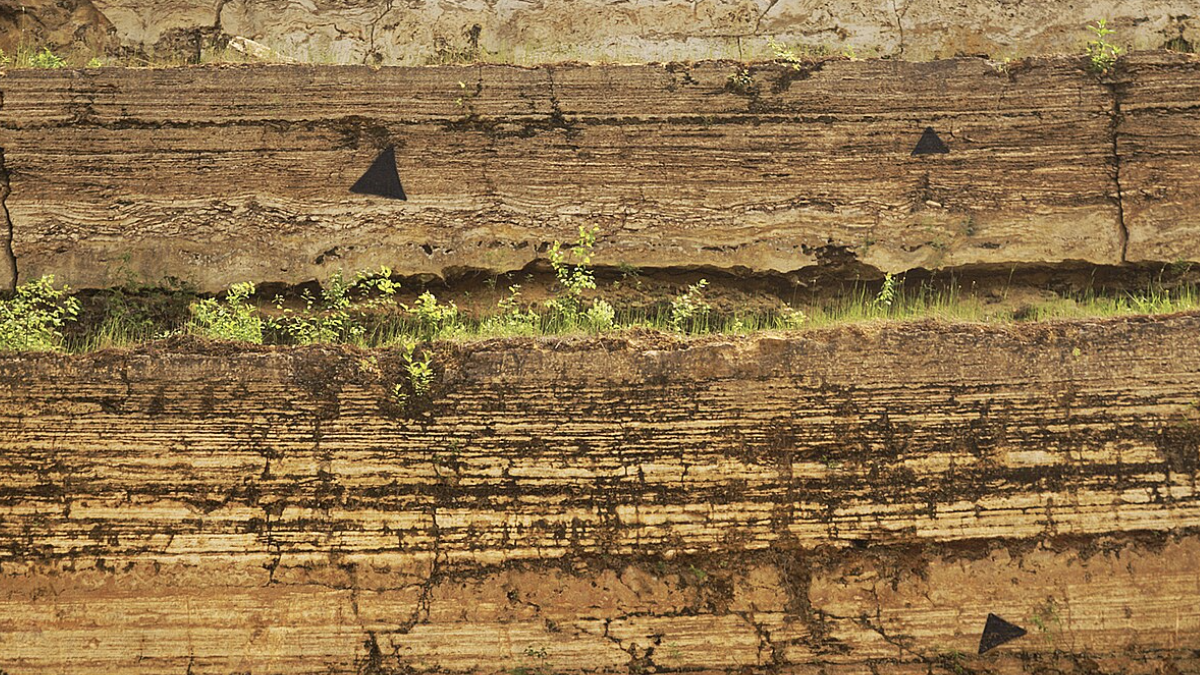
Image credit: Ustill
A new study, led by researchers from Canada, Chile, Germany, and Lithuania, has identified hidden hierarchical patterns in the boundaries that define geological time.
The research examined the distribution of epochs, periods, and eras within the International Geochronological Chart and several biozone-based time scales, which rely on the temporal ranges of extinct species such as conodonts, graptolites, and ammonoids.
The analysis revealed that these time boundaries are not evenly distributed. Instead, they form clusters separated by extended intervals of relative stability. This clustering was described using multifractals — mathematical structures in which patterns repeat at multiple scales.
The findings suggest that the intervals between evolutionary explosions, mass extinctions, and other major events follow a statistical order rather than a random occurrence.
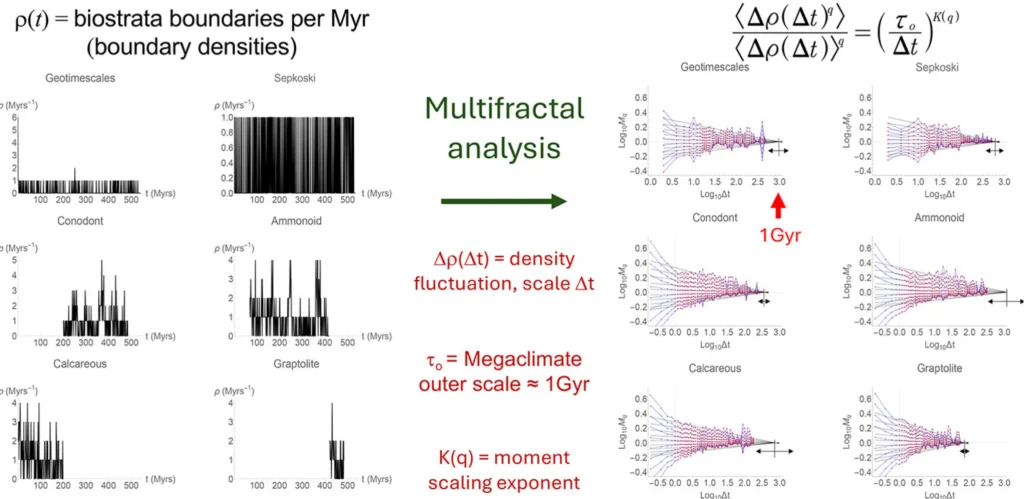
The researchers introduced a new theoretical framework, the Compound Multifractal-Poisson Process, to explain how these boundaries emerge. According to the model, geological events are nested within one another, forming clusters within clusters. This hierarchy reflects the structured variability of the Earth system over hundreds of millions of years.
Using multifractal scaling techniques, the team estimated the “outer time scale” of Earth’s system, which is the minimum duration required to capture its full variability.
The analysis determined that this limit is approximately 500 million years and could extend to 1 billion years. This result implies that geological records shorter than this duration cannot fully capture the range of planetary fluctuations, from prolonged stability to catastrophic upheavals.
According to the authors, this insight has significant implications for paleoclimatology, paleobiology, and geology. It explains why analyses restricted to shorter timescales often fail to capture the extremes of Earth system dynamics.
By identifying the multifractal structure of geological boundaries, the study provides a quantitative framework for interpreting deep-time variability and for correcting statistical biases in paleontological and stratigraphic analyses.
References:
1 From eons to epochs: multifractal geological time and the compound multifractal – Poisson process – Shaun Lovejoy et al. – Earth and Planetary Science Letters – August 22, 2025 – https://doi.org/10.1016/j.epsl.2025.119460
2 Hidden Patterns in Geological Time Revealed: Earth’s Variability Saturates at Half a Billion Years – Vilnius University – August 25, 2025

I’m a science journalist and researcher at The Watchers, contributing to the Epicenter edition, where I cover peer-reviewed scientific research and emerging discoveries across Earth and space sciences. With a background in astronomy and a passion for environmental science, I’ve worked in shark and coral conservation in Fiji, conducting reef and shark-behavior research, contributing to mangrove restoration, and earning PADI Open Water and Coral Reef Certifications. I bring a blend of scientific rigor and storytelling to illuminate the discoveries shaping our planet and beyond.

Commenting rules and guidelines
We value the thoughts and opinions of our readers and welcome healthy discussions on our website. In order to maintain a respectful and positive community, we ask that all commenters follow these rules.