
ESA and JAXA sign planetary defence agreement for Ramses mission to Apophis
The European Space Agency (ESA) and Japan Aerospace Exploration Agency (JAXA) signed a Memorandum of Cooperation on planetary defense and a dedicated Ramses mission agreement in Berlin, Germany, on May 7, 2026. The agreement supports Ramses, planned to rendezvous with asteroid (99942) Apophis before its safe April 13, 2029 flyby about 32 000 km (20 000 miles) above Earth.
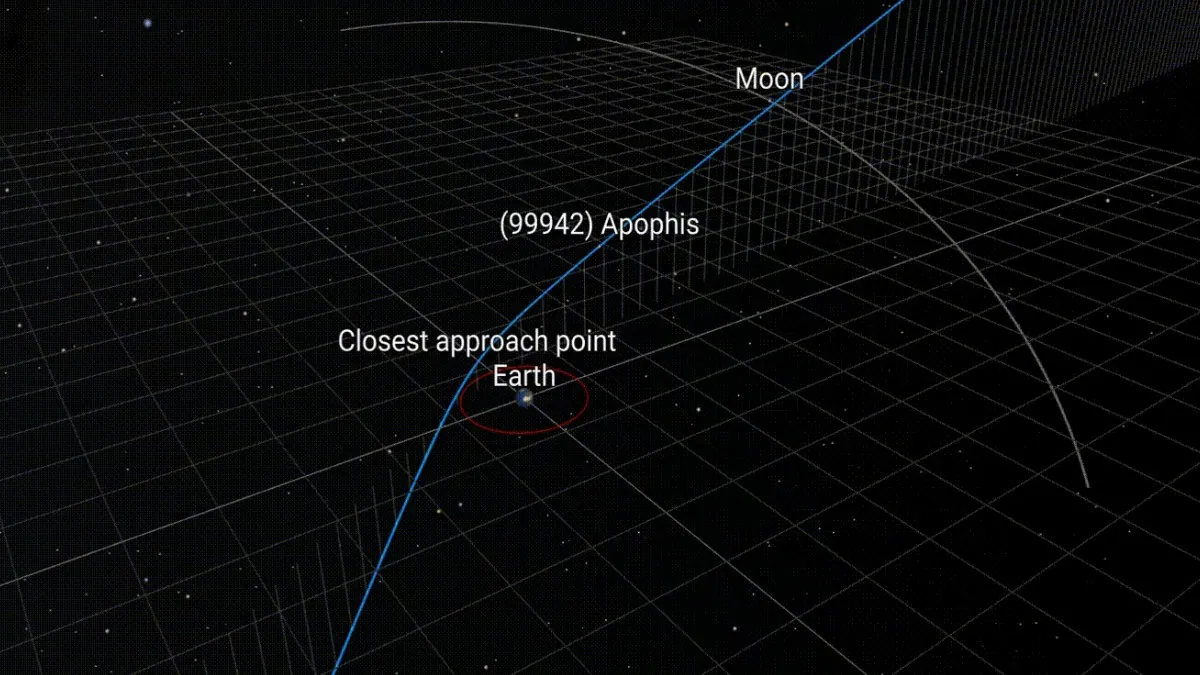
On Friday, April 13, 2029, the infamous asteroid Apophis will make a close approach of Earth. Passing at a distance less than 32 000 km, it will be visible to the naked eye for many in Europe and Africa. Credit: ESA
ESA Director General Josef Aschbacher and JAXA President Hiroshi Yamakawa signed the agreements at the Embassy of Italy in Berlin, with European and Japanese institutional and industrial representatives present. The event was hosted by the Italian Space Agency after ESA selected OHB Italia as the prime contractor for Ramses.
Ramses, the Rapid Apophis Mission for Space Safety, is planned as a joint ESA–JAXA mission to the near-Earth asteroid Apophis. JAXA will provide lightweight Solar Array Wings, a Thermal Infrared Imager, and launch aboard the H3 launch vehicle, while ESA will lead spacecraft design, integration, and operations.
ESA describes Apophis as roughly 375 m (1 230 feet) across, while NASA estimates the asteroid’s mean diameter as 340 m (1 115 feet). The object will pass about 32 000 km (20 000 miles) above Earth’s surface on April 13, 2029, bringing it closer than geosynchronous satellites and within about one-tenth of the average Earth–Moon distance.
NASA says Apophis will safely pass Earth and that there is no risk of the asteroid impacting the planet for at least 100 years. The 2029 passage has drawn scientific interest because it’s the closest approach to Earth by an asteroid of this size known in advance.
Ramses needs to launch in April 2028 to arrive at Apophis in February 2029, about two months before closest approach to Earth, according to ESA. The spacecraft will accompany Apophis through the flyby and observe changes in the asteroid’s shape, surface, orbit, rotation, and orientation as Earth’s gravity acts on it.
The mission is intended to provide data on Apophis’ composition, interior structure, cohesion, mass, density, and porosity. ESA said those properties are needed to assess how a hazardous asteroid would respond if an object on a collision course with Earth had to be redirected.
The agreement follows a November 2024 ESA–JAXA joint statement that identified planetary defense as an area for expanded cooperation. The Ramses collaboration also builds on JAXA’s role in ESA’s Hera planetary defense mission and ongoing ESA–JAXA missions, including EarthCARE and BepiColombo.
“Planetary defence is, by definition, a global responsibility,” Aschbacher said. Yamakawa said the cooperation is expected to advance international efforts in planetary defense.
NASA has redirected OSIRIS-REx, renamed OSIRIS-APEX, toward Apophis after its Bennu sample-return mission. ESA says OSIRIS-APEX will arrive at Apophis roughly one month after the 2029 flyby, while Ramses is designed to provide before-and-during observations needed to compare the asteroid’s pre-encounter and post-encounter state.
References:
1 ESA and JAXA team up on planetary defence, Ramses mission to asteroid Apophis – ESA – May 7, 2026

I'm a dedicated researcher, journalist, and editor at The Watchers. With over 20 years of experience in the media industry, I specialize in hard science news, focusing on extreme weather, seismic and volcanic activity, space weather, and astronomy, including near-Earth objects and planetary defense strategies. You can reach me at teo /at/ watchers.news.

Commenting rules and guidelines
We value the thoughts and opinions of our readers and welcome healthy discussions on our website. In order to maintain a respectful and positive community, we ask that all commenters follow these rules.