
CERN achieves first transport of trapped antimatter by truck
Scientists from CERN’s BASE experiment transported a trap containing 92 antiprotons across the laboratory’s main site on March 23, 2026, marking the first successful truck transport of trapped antimatter at CERN. The portable cryogenic trap remained operational during and after the move, demonstrating that antiprotons can be relocated for future high-precision measurements in lower-noise laboratories.
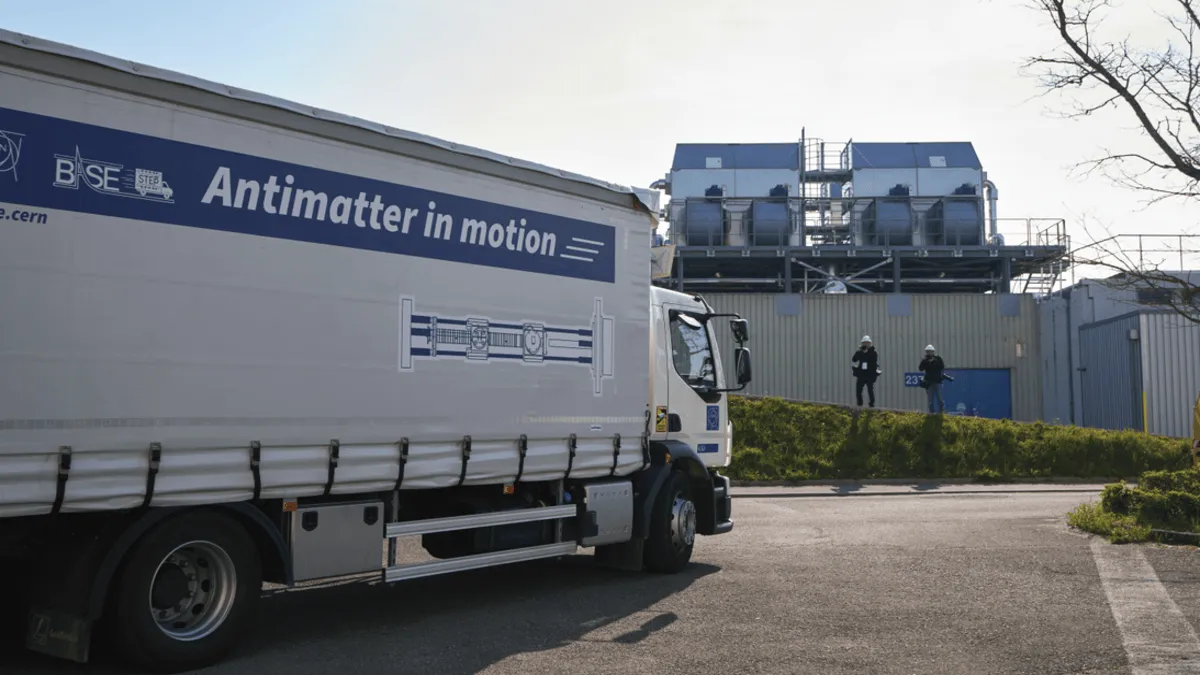
Truck transporting the BASE-STEP trap filled with antiprotons. Credit: CERN
A team from the Baryon Antibaryon Symmetry Experiment (BASE) at CERN successfully transported a trap containing antiprotons across the laboratory’s main site on March 23, demonstrating for the first time that antimatter can be moved in a controlled and operational state outside a fixed experimental installation.
Researchers accumulated a cloud of 92 antiprotons inside a portable cryogenic Penning trap, disconnected the system from the experimental facility, and transported it by truck while maintaining stable confinement conditions. The apparatus continued operating after transport, confirming the integrity of the system under real-world movement conditions.
Antimatter annihilates on contact with ordinary matter, so antiprotons must be confined using electric and magnetic fields in a near-perfect vacuum. The BASE-STEP system uses a superconducting magnet, cryogenic cooling with liquid helium, and a Penning-trap vacuum chamber to keep the particles isolated.
For future long-distance transport, CERN says the superconducting magnet would need to remain below 8.2 K, about −265°C (−445°F), to preserve superconductivity and trap stability.
The transported apparatus has a mass of approximately 1 000 kg (2 205 pounds) and is designed to withstand mechanical disturbances such as vibrations during transport. Its compact structure allows it to pass through standard laboratory infrastructure while maintaining the required environmental conditions for antimatter storage.
The experiment addresses a key limitation at CERN’s antimatter factory, where magnetic field fluctuations on the order of 10⁻⁹ tesla constrain measurement precision. Stefan Ulmer, Spokesperson for the BASE collaboration, explained that these fluctuations are approximately 20 000 times smaller than Earth’s magnetic field but still sufficient to affect ultra-precise measurements of antiproton properties.
Because CERN’s antimatter factory is the only place in the world where antiprotons can be produced, stored and studied, the collaboration developed BASE-STEP to relocate them to dedicated low-noise laboratories.
The successful transport is the first operational validation of that approach and supports future plans to deliver antiprotons to facilities, including Heinrich Heine University Düsseldorf and Leibniz University Hannover.
Maintaining cryogenic conditions during extended transport remains a technical constraint. BASE-STEP Project Leader Christian Smorra noted that ensuring stable temperatures below −265°C (−445°F) over journeys lasting at least 8 hours will require continuous cooling using liquid helium and an onboard power supply for a cryocooler. He added that transferring antiprotons at the destination without annihilation remains the most critical operational challenge.
The BASE collaboration focuses on high-precision comparisons between protons and antiprotons, targeting measurements of magnetic moments and charge-to-mass ratios. These measurements test CPT symmetry, a principle of the Standard Model of particle physics that predicts identical but opposite properties between matter and antimatter counterparts. Any deviation from this symmetry could provide insight into the observed imbalance between matter and antimatter in the Universe.
Using a system of four Penning traps, the experiment has achieved measurement precision of 1.5 parts per billion for magnetic moments and 16 parts per trillion for charge-to-mass ratios.
The setup includes dedicated traps for spin-state detection, precision frequency measurements, particle cooling to quantum-limited temperatures, and long-term storage of antiprotons, where the team has previously demonstrated record-breaking confinement for up to 600 days.
The team has made rapid advancements in recent years, including developing improved cooling techniques in 2024. In 2025, they demonstrated coherent quantum transition spectroscopy with a single antiproton spin, sustaining coherence for 50 seconds. This system functions as the first antimatter quantum bit and has the potential to increase measurement precision by at least two orders of magnitude.
CERN Director for Research and Computing Gautier Hamel de Monchenault said transporting antimatter represents a significant milestone and marks the beginning of a new phase in experimental physics aimed at improving the understanding of fundamental particle properties.
The successful transport of antiprotons establishes a technical foundation for distributed antimatter research and represents a transition from fixed experimental systems to mobile, high-precision measurement platforms.
References:
1 BASE experiment at CERN succeeds in transporting antimatter – CERN – March 24, 2026

I’m a science journalist and researcher at The Watchers, contributing to the Epicenter edition, where I cover peer-reviewed scientific research and emerging discoveries across Earth and space sciences. With a background in astronomy and a passion for environmental science, I’ve worked in shark and coral conservation in Fiji, conducting reef and shark-behavior research, contributing to mangrove restoration, and earning PADI Open Water and Coral Reef Certifications. I bring a blend of scientific rigor and storytelling to illuminate the discoveries shaping our planet and beyond.

Commenting rules and guidelines
We value the thoughts and opinions of our readers and welcome healthy discussions on our website. In order to maintain a respectful and positive community, we ask that all commenters follow these rules.