
Ancient artifacts reveal extreme magnetic spikes in Earth’s history
Archaeomagnetic data from Iron Age copper slag in southern Jordan revealed the strongest geomagnetic anomaly ever recorded, dating between 1100 and 550 B.C. and showing intensities far above modern values.
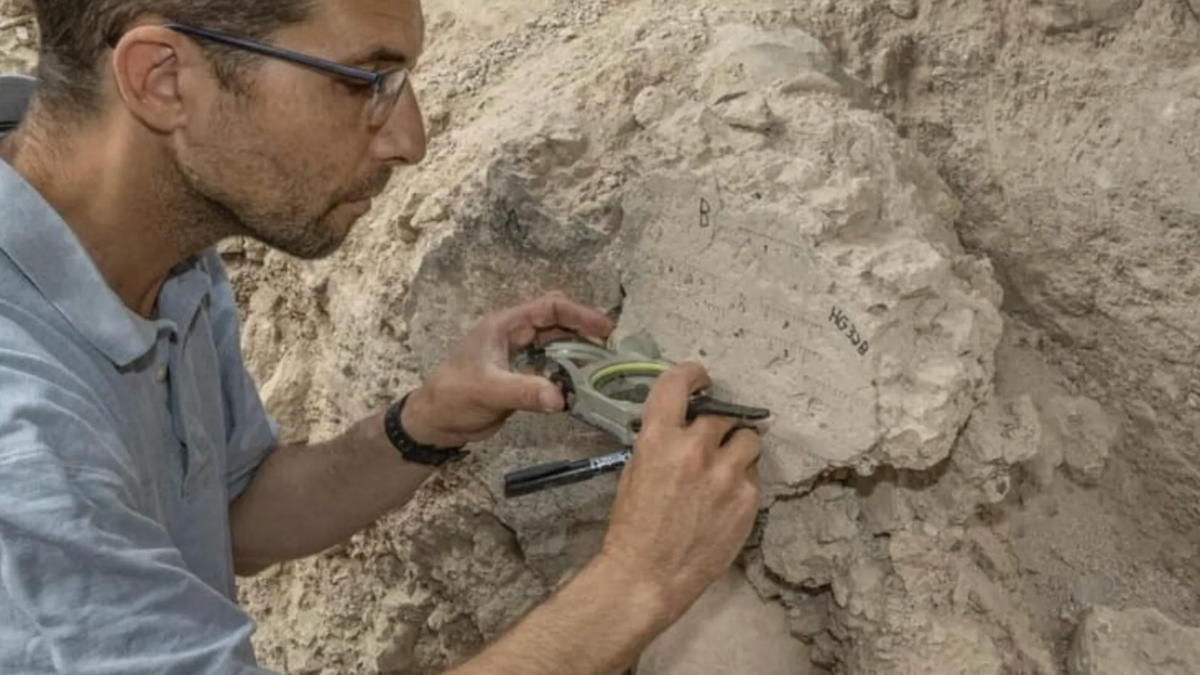
Yoav Vaknin, an archaeologist at Tel-Aviv University and The Hebrew University of Jerusalem, collects samples from a burnt Iron Age structure in Jerusalem. Credit: Yoav Vaknin
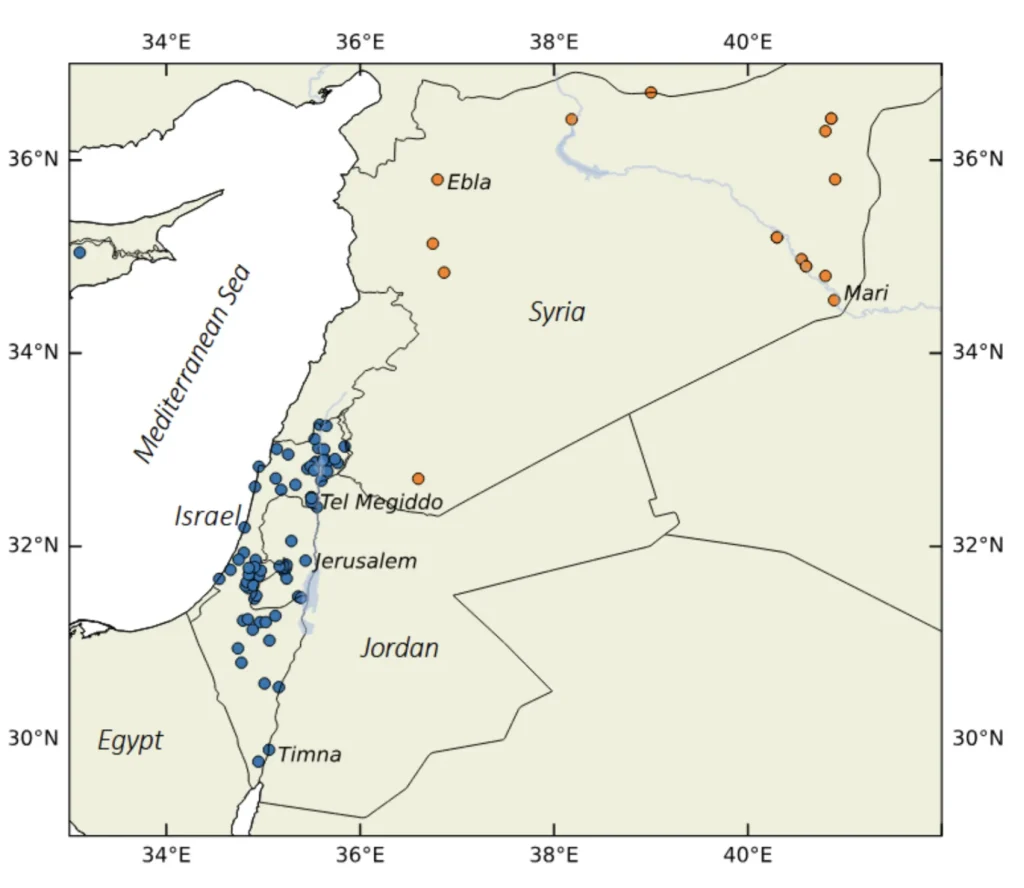
In 2008, researchers at Khirbat en-Nahas in southern Jordan uncovered copper slag that preserved an extraordinary record of Earth’s magnetic field about 3 000 years ago. The waste material from smelting captured the ambient field as it cooled, locking in a magnetic memory.
This record showed rapid spikes in intensity, now called the Levantine Iron Age Anomaly (LIAA). Between 1100 and 550 B.C., archaeomagnetic values fluctuated with sudden surges. Some samples exceeded 120 microteslas (μT), much higher than typical modern surface values of 25–65 μT depending on location.
At the time of discovery, geophysicists doubted the results as no model explained such intense, localized surges. But over a decade of sampling across the Levant, combined with stratigraphically dated slag mounds and pottery, confirmed the anomaly’s reality.
The LIAA is now recognized as one of the strongest magnetic events documented in Earth’s recent history. It forces scientists to rethink how fast and how strongly the geodynamo can shift.
How archaeomagnetism preserves Earth’s field
Archaeomagnetism relies on human activity that heated materials in the past, from pottery kilns to metal smelting. When heated above a critical temperature, magnetic minerals lose their alignment. As they cool, they realign with the geomagnetic field and remain fixed.
Each artifact offers a regional snapshot of about 500 km (310 miles). When combined with radiocarbon or stratigraphic dating, these measurements produce chronological records of intensity and direction.
Unlike volcanic rocks, which preserve field data sporadically, human activity provides abundant and well-dated samples. This makes archaeomagnetism one of the most valuable tools for reconstructing the field over the last 10 000 years.
The copper slag from Khirbat en-Nahas became a benchmark for the technique. Its exceptional preservation showed how industrial debris could reveal rapid changes otherwise invisible in natural archives.
Challenges of global archaeomagnetic data
Despite its promise, archaeomagnetism faces hurdles. High-precision magnetometers used in archaeointensity work cost hundreds of thousands of US dollars, limiting the number of labs worldwide that can process samples.
To determine intensity, samples undergo Thellier-type experiments, involving repeated heating and remagnetization. Researchers describe reheating a single sample about 20 times before reliable results emerge.
This restricts global coverage. About 90% of available data comes from Europe, creating strong geographic bias. Africa has no dedicated archaeomagnetic facilities, leaving much of the continent blank in reconstructions.
Without broader sampling, anomalies observed in East Asia or Africa cannot yet be fully compared to the Levantine record. Expanding the database is critical to test whether intense spikes are global phenomena or local events.
The link to modern anomalies
The discovery of the LIAA shifted scientific focus from low-intensity intervals and pole reversals to high-intensity spikes. These events suggest the geodynamo, the churning liquid iron in Earth’s outer core, can produce abrupt surges as well as declines.
Today, geophysicists closely watch the South Atlantic Anomaly (SAA). This region of weakened field strength spans South America to southern Africa, allowing more solar particles to reach low-Earth orbit. Satellites passing through the SAA often experience memory errors and data corruption.
The SAA differs from the LIAA: it is a weakening, not a strengthening. Yet both highlight the field’s instability. Some simulations suggest deep mantle structures, such as superplumes beneath Africa, may interact with the geodynamo to produce flux patches that cause anomalies. These remain hypotheses under active study.
Understanding whether such flux patches can explain both weakening regions and intense spikes is central to building a unified model of geomagnetic behavior.
Risks for satellites and technology
Earth’s magnetic field shields life from cosmic and solar radiation. A weaker field increases the flux of high-energy particles reaching the atmosphere and low-Earth orbit.
As of 2025, satellite trackers report roughly 14 000–15 000 active satellites, up from about 3 000 in 2020. Projections from the U.S. Government Accountability Office (GAO) estimate tens of thousands more could be launched by 2030, with figures often cited in the range of 50 000–60 000.
A weakening geomagnetic field, especially in regions like the SAA, amplifies risks for these spacecraft. Radiation-induced errors can shorten satellite lifespans, disrupt communications, and increase costs for operators.
For human activity, this risk extends to astronauts aboard the International Space Station, which frequently passes through the SAA. Protective shielding and operational protocols reduce exposure, but long-term weakening trends could compound risks.
Expanding archaeomagnetism worldwide
Efforts to expand archaeomagnetic coverage are growing. The University of Minnesota’s Institute for Rock Magnetism curates the Geomagia50 database, a global repository of archaeomagnetic data.
New contributions are beginning to fill geographic gaps. Cambodia’s first archaeomagnetic dataset appeared in 2021, and Africa’s first regional field model for the past 4 000 years was published in 2022.
Yet the global record remains patchy. Many regions with rich archaeological history, including sub-Saharan Africa, South America, and parts of Asia, still lack systematic sampling.
Building these datasets will allow scientists to compare anomalies worldwide, test whether intense spikes recur in multiple regions, and refine predictions of future geomagnetic change.
Referenes:
1 Geomagnetic intensity spike recorded in high resolution slag deposit in Southern Jordan – Erez Ben-Yosef et al. – Science Direct – September 26, 2009 – https://doi.org/10.1016/j.epsl.2009.09.001

I’m a science journalist and researcher at The Watchers, contributing to the Epicenter edition, where I cover peer-reviewed scientific research and emerging discoveries across Earth and space sciences. With a background in astronomy and a passion for environmental science, I’ve worked in shark and coral conservation in Fiji, conducting reef and shark-behavior research, contributing to mangrove restoration, and earning PADI Open Water and Coral Reef Certifications. I bring a blend of scientific rigor and storytelling to illuminate the discoveries shaping our planet and beyond.

Commenting rules and guidelines
We value the thoughts and opinions of our readers and welcome healthy discussions on our website. In order to maintain a respectful and positive community, we ask that all commenters follow these rules.