
125 years since the 1900 Galveston Hurricane, the deadliest natural disaster in U.S. history
A major hurricane struck Galveston Island, Texas, on September 8, 1900 — exactly 125 years ago — producing a catastrophic storm surge and winds that killed an estimated 6 000–12 000 people and destroyed much of the city. In less than 24 hours, Galveston transformed from a thriving port city into a flattened landscape of wreckage. It remains the deadliest natural disaster in U.S. history.

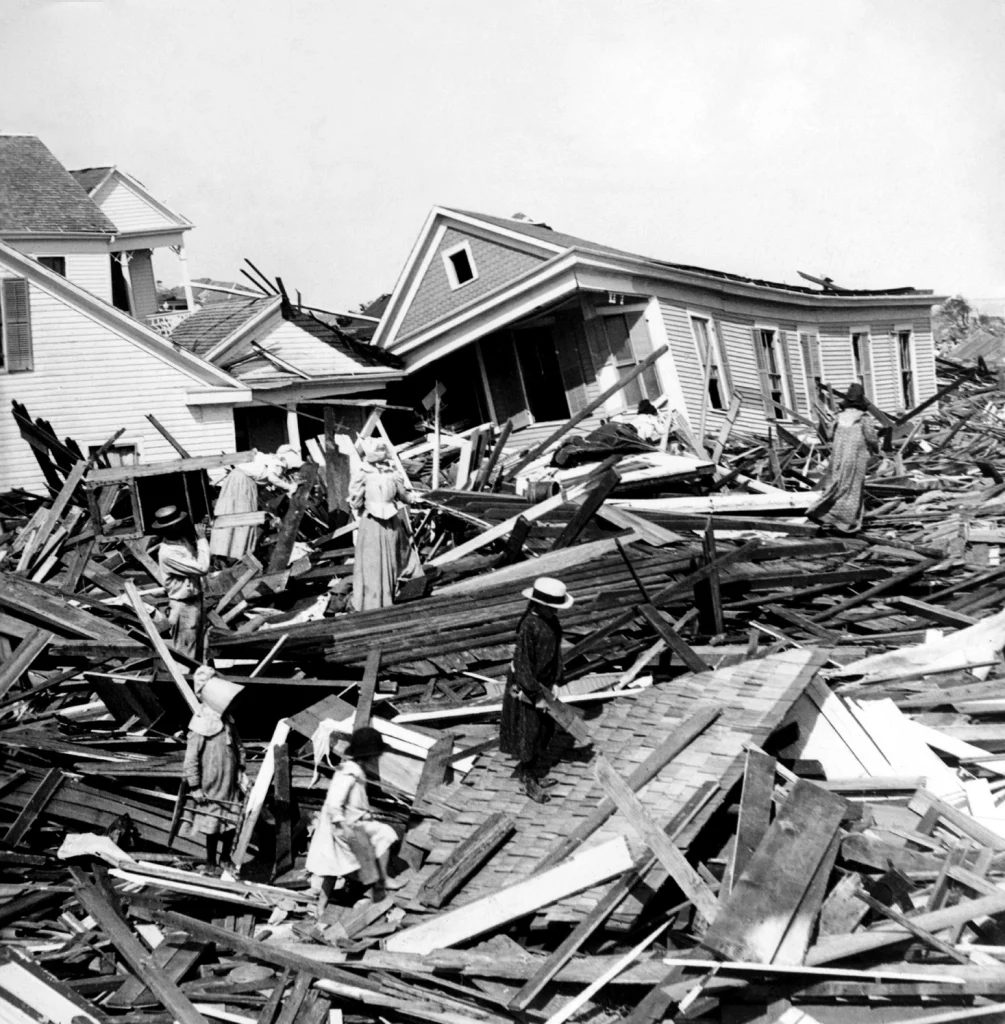
Homes in Galveston were reduced to timbers by the hurricane winds and floods caused by the Galveston Hurricane of 1900. Credit: NOAA Photo Library
- The storm produced a surge of approximately 4.8 m (16 feet), overtopping the island and sweeping away entire neighborhoods.
- Between 6 000 and 12 000 people were killed, many drowned or buried in mass graves, making this the deadliest natural disaster in U.S. history.
- In the aftermath, Galveston built a 5.2 m (17 feet) high seawall and raised its city grade by up to 5 m (16 feet) in one of the largest engineering projects of its time.
The system that became the Galveston hurricane was first observed in late August 1900 in the Atlantic and tracked across the Caribbean before entering the Gulf of Mexico. By the evening of September 8, the storm struck Galveston Island with estimated sustained winds of 225–230 km/h (140–145 mph).
Exact measurements are uncertain because instruments were destroyed or absent, but modern reanalyses place the central pressure near 936 hPa.
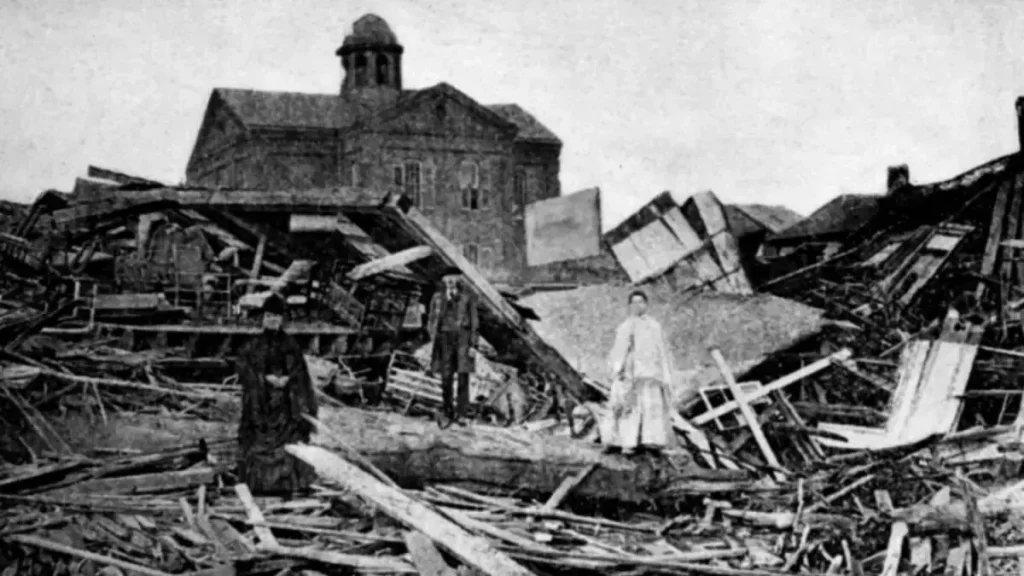
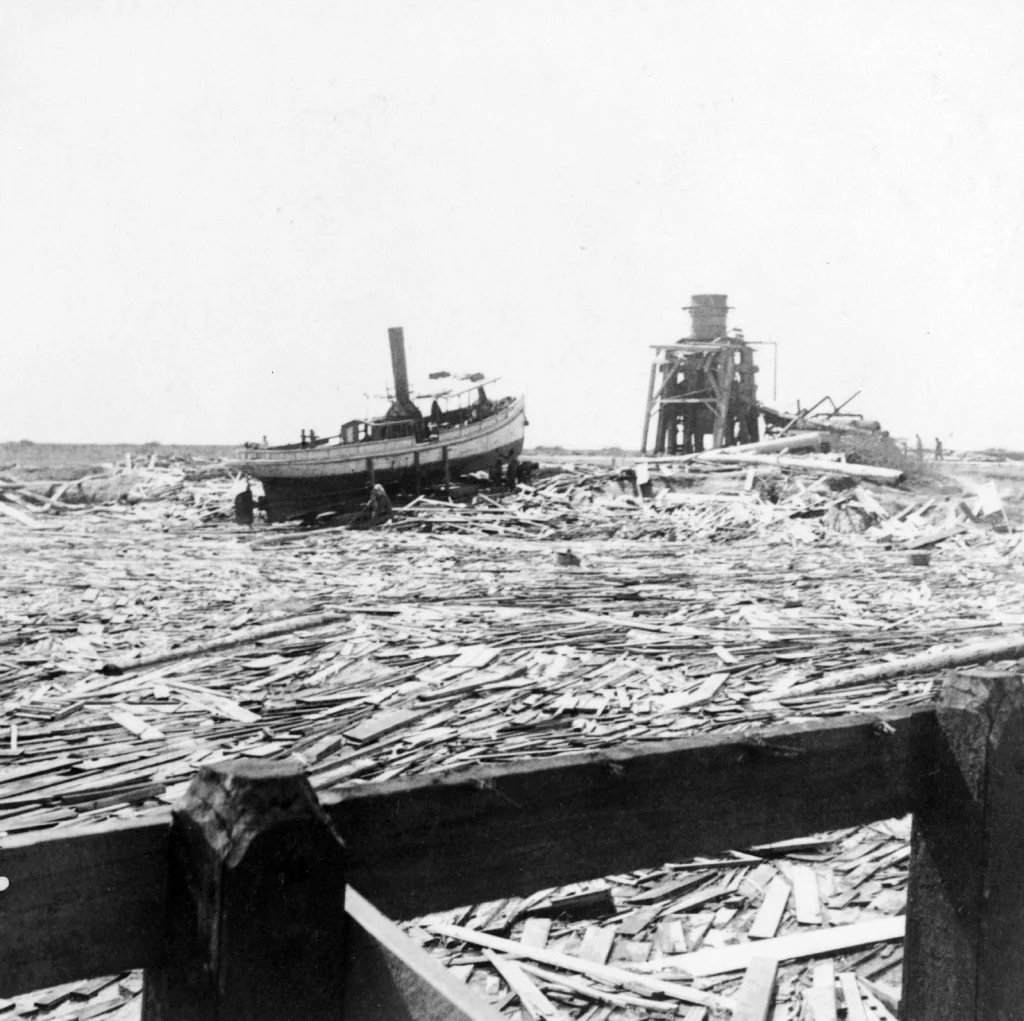
The storm surge reached about 4.8 m (16 feet) at its peak, overtopping the island and flooding entire neighborhoods. Waves and floating debris smashed wooden houses, while the city’s low elevation made escape nearly impossible. In less than 24 hours, Galveston changed from a thriving port city into a flattened landscape of wreckage.
How storm surge and warning failures drove the death toll
Three main factors explain why the Galveston hurricane became the deadliest natural disaster in U.S. history:
Storm surge inundation: The surge swept across most of the island, drowning thousands. Survivors described houses being lifted from their foundations and swept away.
Communication and warning failures: Ship reports and Cuban meteorologists had signaled a major storm, but the U.S. Weather Bureau was slow to issue strong warnings. Telegraph lines failed early, and without robust communication networks, many residents did not grasp the severity until it was too late.
Population exposure: In June 1900, Galveston’s population was nearly 38 000, and summer visitors increased the number of people present. Most houses were wooden and built on low ground, leaving few safe places when the surge arrived.
The storm killed between 6 000 and 12 000 people. Many bodies were washed out to sea, and others were buried hastily in mass graves, making an exact count impossible. The uncertainty remains a central part of the disaster’s historical record.
Engineering responses: seawall construction and grade raising
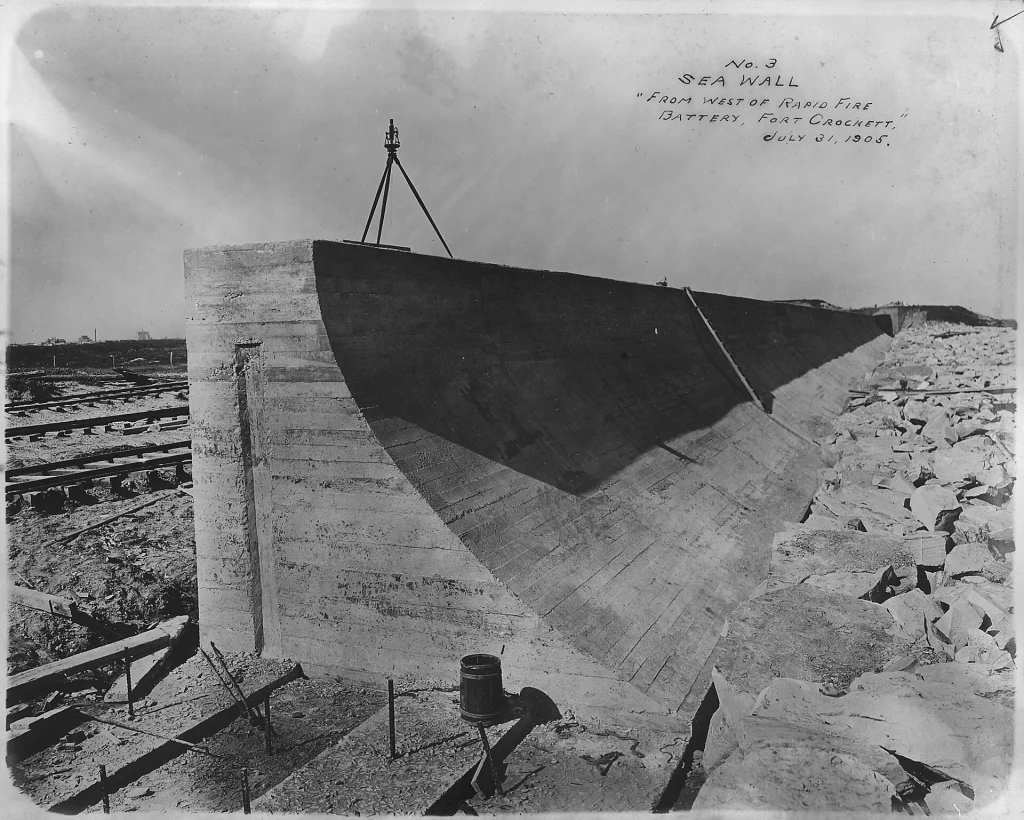
The devastation convinced Galveston’s leaders that drastic engineering solutions were necessary if the city were to remain habitable. Within two years, construction began on a massive concrete seawall designed to shield the city from future storm surges. The first 5.3 km (3.3 miles) of the wall, standing 5.2 m (17 feet) high, was completed in 1904. Over the following decades, it was extended to cover much of the vulnerable coastline.
At the same time, engineers undertook one of the largest grade-raising projects in U.S. history. Entire city blocks were lifted by hydraulic jacks, and sand pumped from the bay was used to fill the space beneath them. Some buildings were elevated by as much as 5 m (16 feet). Between 1902 and 1911, hundreds of homes, businesses, and even large public buildings were raised above the new grade.
The seawall and raised city together provided a powerful line of defense. In later storms, including the 1915 hurricane, these measures prevented catastrophic loss of life, proving the value of ambitious engineering in hazard mitigation.
Institutional reforms in forecasting and communication
The hurricane also exposed weaknesses in the nation’s meteorological system. The U.S. Weather Bureau, which later became the National Weather Service, was criticized for its slow communication and reluctance to trust foreign observations. At the time, Cuban meteorologists had accurately warned of the storm’s severity, but their warnings were largely ignored due to bureaucratic restrictions.
In the years that followed, the Weather Bureau began adopting new technologies such as wireless telegraphy for ship-to-shore communication. This allowed forecasters to track storms more effectively in real time. Procedures for issuing hurricane warnings were revised, and the culture of the Bureau slowly shifted toward greater openness to external data.
These institutional changes laid the foundation for the modern hurricane forecasting and warning system, which today includes satellites, aircraft reconnaissance, and global communication networks.
Economic consequences for Galveston and Houston
Before 1900, Galveston was the leading commercial port in Texas and one of the most important on the Gulf Coast. Its banks, shipping companies, and cotton trade made it a regional hub. The hurricane, however, dealt a blow from which the city never fully recovered.
Although the seawall and grade raising reduced future risk, many investors redirected their focus to Houston. The development of the Houston Ship Channel, combined with its more sheltered inland location, positioned Houston as the dominant port of the region. Over time, Galveston became less of a commercial powerhouse and more of a residential and tourism center.
This economic shift illustrates how natural disasters can permanently alter regional development trajectories, even when engineering solutions are implemented to reduce future risk.
Why casualty figures remain uncertain
The wide fatality range of 6 000–12 000 reflects the chaotic aftermath of the storm. Thousands of seasonal visitors were in Galveston when the hurricane struck, but their presence was not recorded in census data.
Entire families were swept away, leaving no one to report them missing. In the days after the storm, overwhelmed authorities ordered mass burials and even disposal of bodies at sea. Later, when those bodies washed back ashore, crews burned them in large pyres to prevent disease.
Because records were inconsistent and incomplete, historians have never been able to determine a precise death toll. The uncertainty itself is part of the storm’s legacy, highlighting the challenges of disaster record-keeping in the early 20th century.
The long-term legacy for U.S. coastal hazard management
The Galveston hurricane is remembered not only for its immediate destruction but also for its role in shaping U.S. approaches to hazard management. It demonstrated the need for robust forecasting, effective communication, and large-scale engineering. It also showed that disaster recovery requires both immediate action and long-term structural change.
Galveston’s seawall and grade raising remain landmarks of civil engineering, often cited as among the most ambitious urban flood-protection projects in U.S. history. The institutional reforms in forecasting that followed laid the groundwork for the development of modern meteorology.
Lessons for the 21st century
More than a century later, the 1900 Galveston hurricane remains the deadliest natural disaster in U.S. history. It shows that the combination of exposure, vulnerability, and limited communication can be more deadly than storm intensity alone.
While today’s technology provides earlier warnings and better data, the Galveston disaster shows that preparedness and trust in scientific communication are just as critical as physical defenses.
References:
1 Galveston hurricane of 1900 – National Park Service – Accessed September 8, 2025
2 Galveston Storm of 1900 – NWS Heritage Projects – Accessed September 8, 2025

I’m a science journalist and researcher at The Watchers, contributing to the Epicenter edition, where I cover peer-reviewed scientific research and emerging discoveries across Earth and space sciences. With a background in astronomy and a passion for environmental science, I’ve worked in shark and coral conservation in Fiji, conducting reef and shark-behavior research, contributing to mangrove restoration, and earning PADI Open Water and Coral Reef Certifications. I bring a blend of scientific rigor and storytelling to illuminate the discoveries shaping our planet and beyond.

Commenting rules and guidelines
We value the thoughts and opinions of our readers and welcome healthy discussions on our website. In order to maintain a respectful and positive community, we ask that all commenters follow these rules.