
Wildfire forces evacuations and damages rare wildlife habitat at Dunwich Heath, England
A fast-moving wildfire forced more than 200 caravans to be evacuated from a holiday park near Dunwich Heath in Suffolk, England, after burning at least 150 ha (371 acres) of heathland since Thursday, July 30, 2026. The fire also spread into the RSPB Minsmere nature reserve, threatening rare birds and destroying habitat that may take decades to recover.
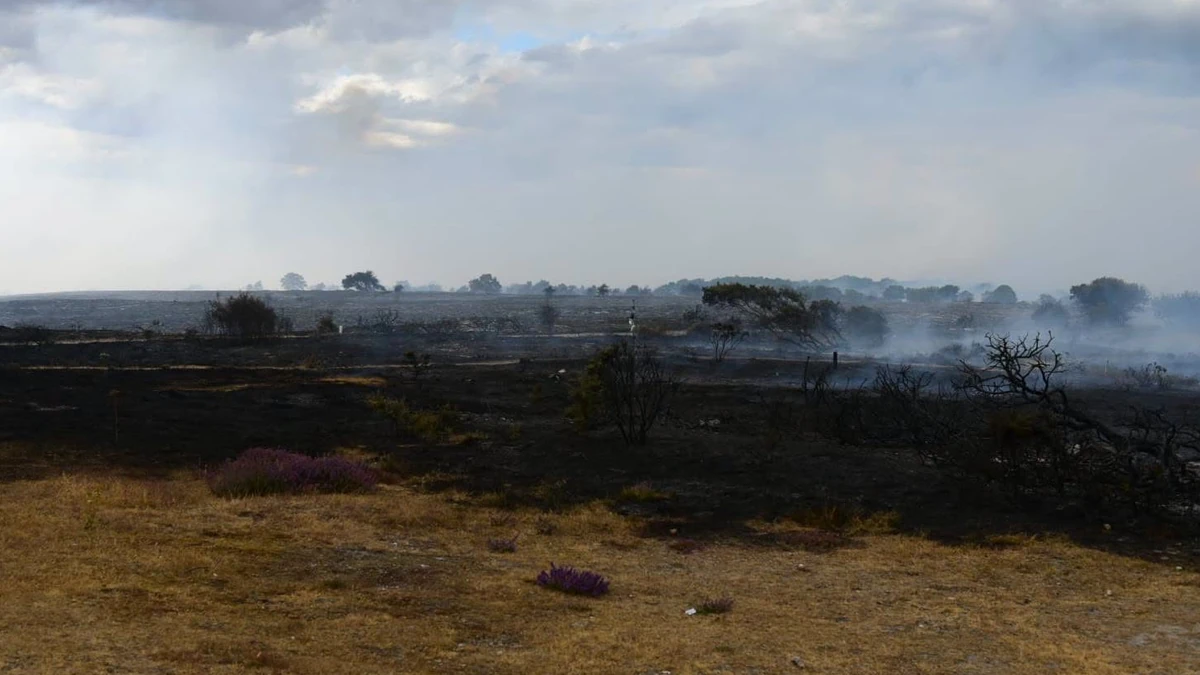
Area burnt by a major wildfire Dunwich Heath, England on July 30, 2026. Credit: Suffolk Fire and Rescue
Over 200 caravans at the Cliff House Holiday Park were evacuated due to the spread of a large wildfire at Dunwich Heath on Friday, July 30.
The blaze was first reported at approximately 17:00 LT on Thursday, July 29. A Major Incident had been declared due to the size of the fire. It had burned at least 150 ha (371 acres) by 17:30 LT on July 30 before conditions began to improve. Over 100 firefighters were battling the blaze at its peak.
“Crews remain at the scene, but thanks to intensive firefighting efforts, support from the helicopter, and the creation of fire breaks, an earlier identified risk to buildings around the Coastguard Cottages area has stabilized. Importantly, no properties have been lost,” Suffolk Fire and Rescue reported on July 31.
“The blaze is one of the largest that I remember in the history of Suffolk,” Chief Fire Officer of Suffolk Fire and Rescue Service Jon Lacey said at a press conference on July 30.

The burned area included parts of the Royal Society for the Protection of Birds (RSPB) Minsmere nature reserve, which is home to many rare and endangered species of birds, reptiles, and insects.
Adam Rowlands, the Suffolk area manager for the RSPB, told the BBC that it was the biggest blaze at Minsmere “in living memory.” He added that rare butterfly species would have been in the egg stage at the time of the fire, and bird populations would be at risk.
“Most of them have finished breeding, so they’ll be able to escape the fire, and last night we could see nightjars flying above the fireball up on the heath,” he said.
“But the problem is it will look like a scene of devastation afterward. All the vegetation will go, and the majority of those birds will lose the places where they nest,” he added.

The area is home to multiple species, including Dartford warblers, nightjars, and stonechats, and native reptiles such as adders, common lizards, and slow worms, the BBC reported.
“Some of that habitat will take 5, 10, or 25 years to come back to what it looked like before the fire broke out yesterday afternoon,” Rowlands said.
There have been no reported casualties or injuries to members of the public or emergency responders.
The smoke plume has changed direction during the day. Health advice remains unchanged: if you are affected by smoke, please keep windows and doors closed, Suffolk County Council said in an update at 16:30 LT on July 31.
References:
1 Large forest fire on Dunwich Heath – Suffolk County Council – July 31, 2026
2 Fire-ravaged heath ‘could take 25 years to recover’ – BBC – July 31, 2026

I’m a science journalist and researcher at The Watchers, contributing to the Epicenter edition, where I cover peer-reviewed scientific research and emerging discoveries across Earth and space sciences. With a background in astronomy and a passion for environmental science, I’ve worked in shark and coral conservation in Fiji, conducting reef and shark-behavior research, contributing to mangrove restoration, and earning PADI Open Water and Coral Reef Certifications. I bring a blend of scientific rigor and storytelling to illuminate the discoveries shaping our planet and beyond.
