
M-class flare risk remains high from Regions 4420 and 4425 through April 29
Solar activity reached high levels on April 26, 2026, after Region 4420 produced an M6.0 flare at 22:57 UTC, reaching R2 – Moderate radio blackout level. NOAA’s Space Weather Prediction Center (SWPC) forecasts a 70% chance of additional M-class flares capable of R1–R2 radio blackouts and a 25% chance of X-class flares capable of R3 or greater events through April 29.
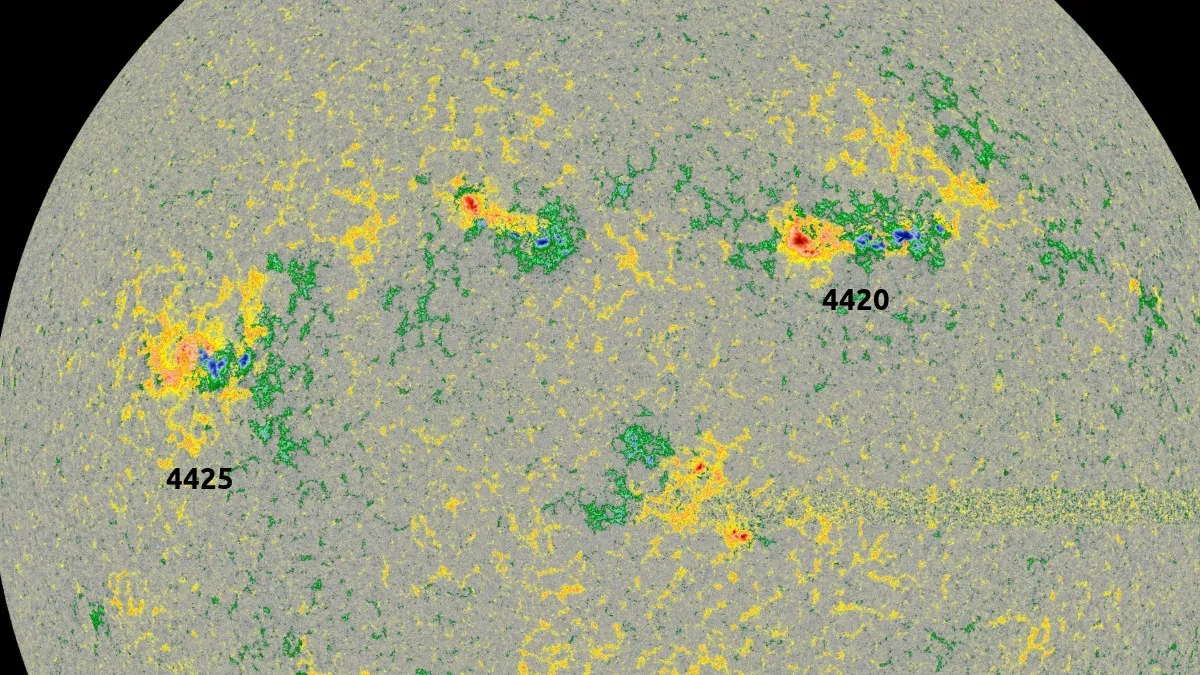
Active regions 4425 and 4420 on April 27, 2026. Credit: NASA SDO/HMI, The Watchers
Region 4420 produced three M-class flares on April 26 — an M1.4 flare at 14:03 UTC, an M1.7 at 19:24 UTC, and the M6.0 flare at 22:57 UTC with an associated Type II radio sweep estimated at 834 km/s and an F10cm radio burst of 260 sfu. None of the events had an associated coronal mass ejection (CME) seen in coronagraph imagery.
Region 4425 produced an M2.2 flare at 20:04 UTC on April 26 and an M1.0 flare at 06:45 UTC on April 27. Both these regions have a ‘beta-gamma-delta’ magnetic configuration, and are capable of producing strong to major eruptions. Their locations would favor at least partial Earth-directed components if either produces a sufficiently wide CME in the days ahead.
SWPC forecasts a 70% probability of R1–R2 radio blackouts on April 27, April 28, and April 29, while R3 or greater events carry a 25% probability on each of those days.

Solar radiation storm conditions remained below NOAA scale thresholds during the previous 24 hours. SWPC lists a 10% chance of S1 or greater solar radiation storm conditions on each day from April 27 through April 29, with greater than 10 MeV proton flux mainly forecast to remain at background levels.
The geomagnetic field was quiet to unsettled in 24 hours to 12:30 UTC today. An isolated active period is still possible on April 27 positive polarity coronal hole high speed stream (+CH HSS) influences gradually wane.
A return to mostly quiet conditions, with possible isolated unsettled levels, is expected by April 28. Unsettled conditions are anticipated late on April 29 with the arrival of a CIR ahead of an anticipated negative-polarity coronal hole high speed stream (-CH HSS).
Solar wind parameters continued to reflect positive-polarity coronal hole high-speed stream influence, with possible weak transient effects mixed in. SWPC reported total magnetic field values ranging from 2 nT to 8 nT and solar wind speeds generally near 455 km/s, with brief periods closer to 485 km/s.
Solar wind parameters are forecast to return near background levels from April 27 into April 28. Solar wind activity is forecast to increase late on April 29 with the expected arrival of a co-rotating interaction region ahead of a -CH HSS.
References:
1 Forecast Discussion – SWPC – Issued at 12:30 UTC on April 27, 2026

I'm a dedicated researcher, journalist, and editor at The Watchers. With over 20 years of experience in the media industry, I specialize in hard science news, focusing on extreme weather, seismic and volcanic activity, space weather, and astronomy, including near-Earth objects and planetary defense strategies. You can reach me at teo /at/ watchers.news.

Commenting rules and guidelines
We value the thoughts and opinions of our readers and welcome healthy discussions on our website. In order to maintain a respectful and positive community, we ask that all commenters follow these rules.