
Episode 42 shows high-intensity magma discharge and dual-vent activity at Kīlauea volcano
Kīlauea volcano’s Halemaʻumaʻu crater produced one of its most intense eruptive episodes in months on February 15, 2026, when dual vents discharged lava at rates up to 780 m³/s (1 000 yd³/s) and fountains rose 400 m (1 300 feet) high before the activity paused at 23:38 HST. The episode released an estimated 11.4 million m³ (15 million yd³) of lava and covered about half of the crater floor.
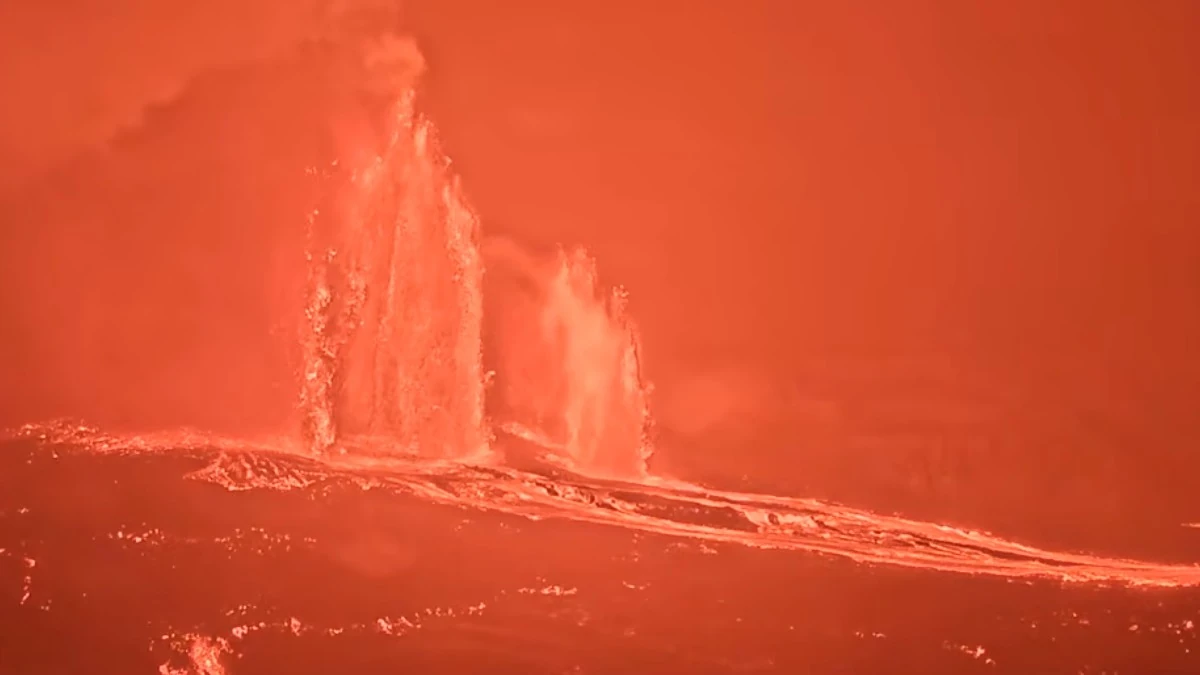
Eruption at Kilauea (Episode 42) at 21:41 HST on February 15, 2026. Credit: USGS/HVO
The U.S. Geological Survey (USGS) reported that Episode 42 of the ongoing Halemaʻumaʻu eruption at Kīlauea volcano ended at 23:38 HST on February 15. The eruption lasted 9 hours and 48 minutes, producing sustained lava fountains from both north and south vents within the summit crater before activity paused.
The episode began at 13:50 HST (23:50 UTC) on February 15 with a sharp increase in tremor and a deflationary tilt recorded by the Uēkahuna tiltmeter (UWD).
Fountain heights peaked between 14:00 and 15:00 HST, with the south vent reaching approximately 400 m (1 300 feet) and the north vent about 300 m (1 000 feet). Maximum instantaneous effusion rates approached 780 m³ s⁻¹ (1 000 yd³ s⁻¹) near 15:00 HST, while the average rate for the episode was about 330 m³ s⁻¹ (430 yd³ s⁻¹).
During the period of highest activity, a volcanic ash plume rose to an altitude of 10 600 m (35 000 feet) above sea level, according to the National Weather Service. Cloudy and rainy conditions during the afternoon limited direct observations, but the USGS estimated that the south vent fountains fluctuated between 330 and 400 m (1 100–1 300 feet) for much of the day.
Episode 42 produced an estimated 11.4 million m³ (15 million yd³) of lava, covering about 50 percent of the Halemaʻumaʻu crater floor. Tilt measurements indicated 33.7 microradians of deflationary change during the episode, consistent with magma withdrawal beneath the summit.
Light tephra fall, consisting mainly of fine ash and Pele’s hair, was reported in Pāhala, Punaluʻu, and Nāʻālehu to the southwest of the crater. USGS noted in their latest bulletin that tephra dispersal was less extensive than during Episode 41 due to strong northeast trade winds, which confined ash fallout near the summit.
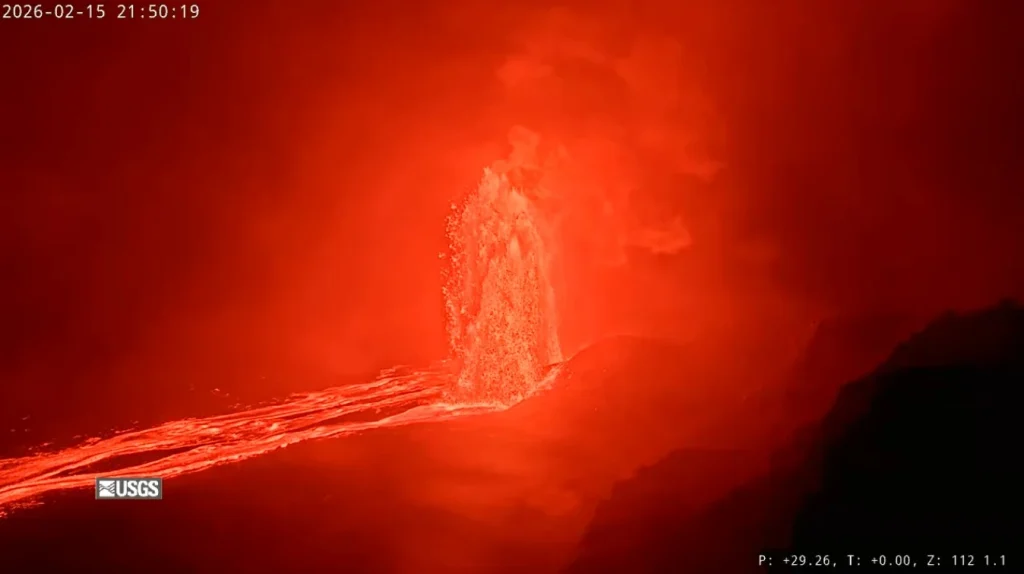
Precursory activity began on February 14 at 13:05 HST with minor overflows from the north vent, followed by intermittent spattering and several short overflows from both vents through the night and early morning of February 15. Continuous overflows began shortly after 13:00 HST, transitioning into sustained fountaining at 13:50 HST.
By 18:00 HST, fountain heights began to oscillate, with the south vent varying between 250 and 400 m (800–1 300 feet) before declining steadily to 180 m (600 feet) by 23:00 HST. The eruption paused shortly after 23:38 HST, marking the end of the ninth eruptive hour.
Volcanic gases, including water vapor (H2O), carbon dioxide (CO2), and sulfur dioxide (SO2), continued to be released during the episode. Conversion of sulfur dioxide in the atmosphere produced visible vog (volcanic smog) downwind, posing potential respiratory and visibility hazards.
Tephra composed of fine ash, scoria, Pele’s hair, and reticulite remained confined to areas near the summit and along the southwest sector.
Lava flows during Episode 42 remained confined to the Halemaʻumaʻu crater and the southwest portion of Kaluapele, Kīlauea’s summit caldera. However, the USGS warned that instability of crater walls, ground cracking, and rockfalls continue to pose significant hazards around the caldera rim, which has been closed to the public since 2007.
References:
1 Hawaiian Volcano Observatory Status Report for Kīlauea Volcano – USGS/HVO – Issued at 10:04 UTC on February 16, 2026

I'm a dedicated researcher, journalist, and editor at The Watchers. With over 20 years of experience in the media industry, I specialize in hard science news, focusing on extreme weather, seismic and volcanic activity, space weather, and astronomy, including near-Earth objects and planetary defense strategies. You can reach me at teo /at/ watchers.news.

Commenting rules and guidelines
We value the thoughts and opinions of our readers and welcome healthy discussions on our website. In order to maintain a respectful and positive community, we ask that all commenters follow these rules.