
Very bright fireball streaks across night sky over New Zealand
An exceptionally fast fireball was observed over much of New Zealand at 10:25 UTC on January 29, 2026, glowing from 120 km (75 miles) altitude and burning up entirely by 70 km (43 miles). The event was visible across the lower North Island and upper South Island.
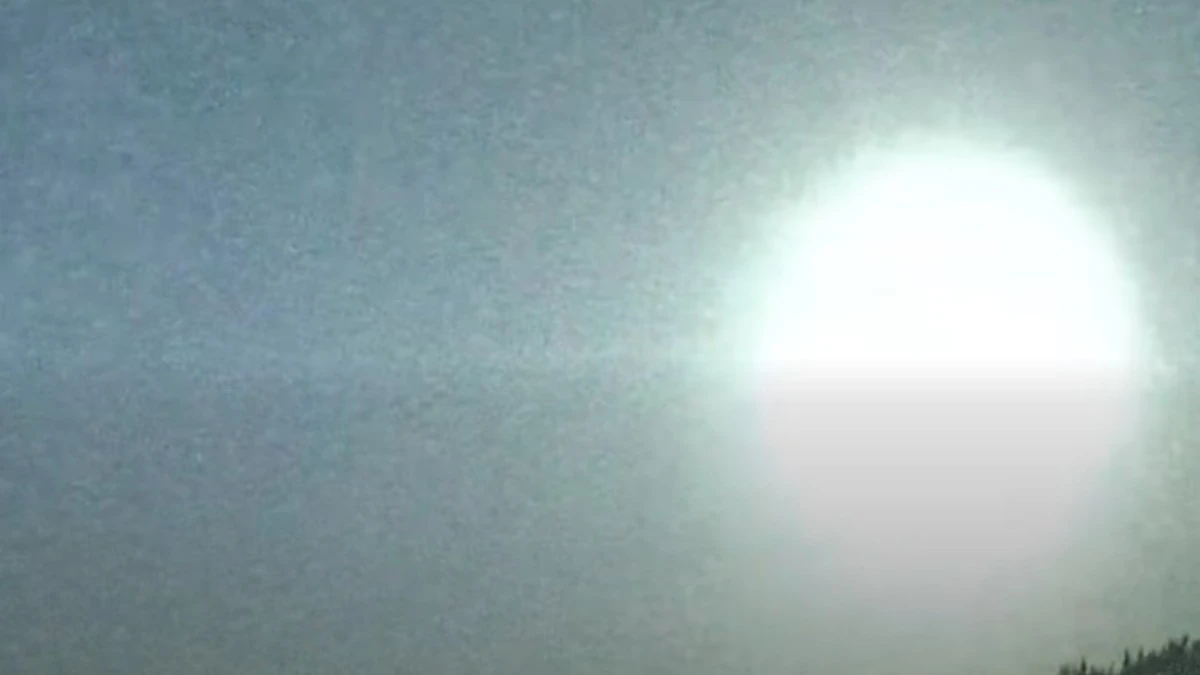
Fireball over New Zealand on January 29, 2026. Credit: Canterbury Astronomical Society
A very bright fireball was recorded over New Zealand at approximately 23:25 LT on January 30, according to Fireballs Aotearoa. Cameras from the national meteor network captured the object as it entered the atmosphere at a speed of about 233 000 km/h (145 000 mph), roughly three times faster than a typical meteoroid.
Observers from Wellington, Lower Hutt and Manawatū reported a greenish-blue streak across the sky followed by a persistent trail lasting several minutes. Sightings were also reported from the northern South Island.
Radio New Zealand and 1News both received numerous public accounts describing a bright flash and brief illumination of the night sky.
Fireballs Aotearoa reported that the meteoroid approached on a strongly elliptical clockwise orbit around the Sun, intersecting Jupiter’s path before crossing Earth’s orbit.
Because Earth was moving in its usual anticlockwise trajectory around the Sun and the meteoroid was approaching from the opposite direction, their relative velocity was extremely high. This alignment caused a brief but intense interaction with the upper atmosphere.
The fireball began with visible luminous emission at about 120 km (75 miles) altitude, which is still technically in space. Fragmentation occurred as it descended through the rarified air near 90 km (56 miles), and by 70 km (43 miles) the object had been completely ablated to dust.
No sonic booms or ground impacts were reported, and no meteorites are expected to have survived to the surface.
Meteoroids usually enter the atmosphere at 40 000–260 000 km/h (25 000–160 000 mph), but those approaching on retrograde orbits, such as this one, can reach the upper limit of that range. The combination of speed and entry angle explains why the object was completely vaporized high above the ground.

Teo Blašković founded The Watchers in 2011 and edited it until 2026, covering seismic and volcanic activity, extreme weather, space weather and near-Earth objects. Articles on this page are his archive.
Published in the last 24 hours
- High Risk of excessive rainfall covers Florida’s Space Coast as St. Johns River near Cocoa reaches 5.67 m
- Four small asteroids will pass close to Earth from November 21 to 23
- Cyclone Akvan weakens after landfall near Gopalpur; more than 300 000 evacuated in Odisha, India
- A broad low over southeastern Florida and the northwestern Bahamas has a 30 percent chance of subtropical or tropical development within 48 hours and a 50 percent chance within 7 days, the National Hurricane Center says
