
Record-high effusion rate measured during episode 36 of Kīlauea’s Halemaʻumaʻu eruption
Episode 36 of the ongoing Halemaʻumaʻu eruption at Kīlauea volcano, Hawaiʻi, ended at 16:16 LT on November 9 (02:16 UTC, November 10), 2025, after just under 5 hours of continuous fountaining. The event produced record-high lava effusion rates of around 500 m³/s (650 yd³/s) and built fountains up to 330 m (1 100 feet) high, covering 60–80% of the Halemaʻumaʻu crater floor.
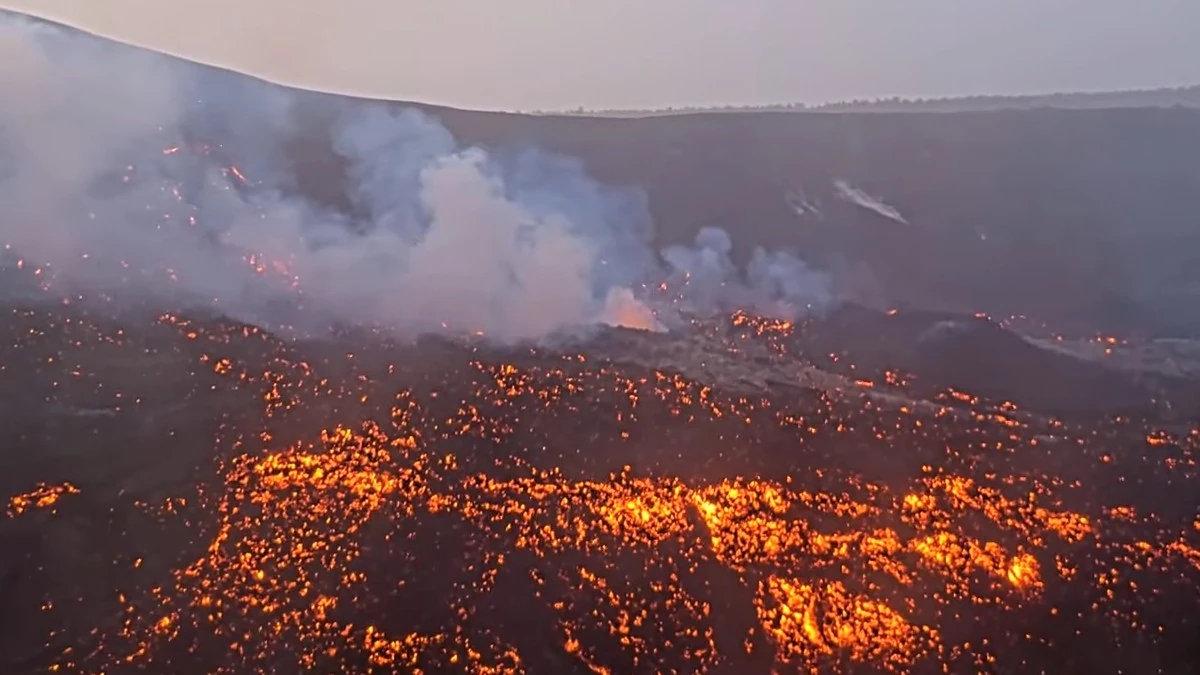
Kilauea volcano following episode 36 on November 10, 2025. Credit: USGS/HVO
According to the Hawaiian Volcano Observatory (HVO), Episode 36 began at 11:19 LT (21:19 UTC) and involved sustained fountaining from two vents on the floor of Halemaʻumaʻu crater, within the southern part of Kaluapele (Kīlauea caldera). The north vent ceased activity at approximately 15:38 LT, while the south vent continued until 16:16 LT.
Lava fountains during this episode reached maximum heights of 300–330 m (1 000–1 100 feet), generating an estimated 8–9 million m³ (10–11 million yd³) of lava over the five-hour period. The combined output rate from both vents averaged over 500 m³/s (650 yd³/s), marking the highest effusion rate measured since the ongoing eruption began in December 2024.
Flows from the fountains spread across much of the crater floor, forming new surfaces that now cover between 60% and 80% of Halemaʻumaʻu. Volcanic gas emissions, primarily sulfur dioxide (SO2), decreased significantly following the end of the episode. Between eruptive episodes, SO2 emissions at Kīlauea typically range between 1 200 and 1 500 tonnes per day.
The Uēkahuna tiltmeter (UWD) recorded about 23 microradians of deflation during the episode, starting with the onset of fountaining at 11:19 LT. Deflationary tilt and seismic tremor decreased sharply after the eruption ended.
HVO scientists expect a return to rapid inflation in the coming days, consistent with the established pattern observed in previous episodes of this eruption sequence.
No changes have been detected in Kīlauea’s East Rift Zone or Southwest Rift Zone, and all current activity remains confined to the summit region within Hawaiʻi Volcanoes National Park. The volcano’s Alert Level and Aviation Color Code remain at WATCH/ORANGE.
Around 12:00 LT on November 9, observers recorded a transient tornado-like vortex forming over the lava fountains within Halemaʻumaʻu crater. The feature, informally referred to as a “volnado,” developed as extreme surface heat generated strong updrafts and localized rotation.
Although the current eruptive activity is restricted to the closed summit area, several volcanic hazards remain present. Elevated levels of volcanic gases, mainly water vapor (H2O), carbon dioxide (CO2), and sulfur dioxide (SO2), can form volcanic smog (vog) downwind. High concentrations of vog may cause respiratory irritation and reduced air quality in affected communities.
Another hazard associated with Kīlauea’s summit eruptions is the fallout of Pele’s hair — fine strands of volcanic glass produced by lava fountaining. Pele’s hair can be carried more than 15 km (10 miles) from the vent and may cause minor skin or eye irritation upon contact. Occasional deposition of Pele’s hair has been reported as far as Highway 11, west of Hawaiʻi Volcanoes National Park, depending on wind conditions.
Lava flows generated during this episode are expected to continue cooling and may display faint incandescence for several days.
The summit area remains hazardous due to unstable crater walls, ground cracking, and potential rockfalls, especially around the closed rim of Halemaʻumaʻu crater, which has remained off-limits to the public since 2007.
The current Halemaʻumaʻu eruption began on December 23, 2024, and has so far produced 36 short-lived episodes separated by pauses of several days. Most individual episodes have lasted less than a day, characterized by brief but intense fountaining and rapid changes in summit tilt.
References:
1 Kilauea Volcanic Activity Notice – USGS/HVO – 02:29 UTC on November 10, 2025

I'm a dedicated researcher, journalist, and editor at The Watchers. With over 20 years of experience in the media industry, I specialize in hard science news, focusing on extreme weather, seismic and volcanic activity, space weather, and astronomy, including near-Earth objects and planetary defense strategies. You can reach me at teo /at/ watchers.news.

On USGS [V1 Cam]
21 Nov 2025 – a slow steady lava from 10:22 – 12:02 (Hawaii Time)
– Also visible on USGS [V2 Cam] from about 10:45 due to smoke obscuration
From [V3] USGS video feed
On 25 Nov 2025 – a slow flow of lava from 11:07 – 11:19 (Hawaii time)