
New sensors deployed to monitor Mount Adams following spike in earthquake activity, U.S.
New temporary sensors were deployed around Mount Adams this month in response to the volcano experiencing an unusual spike in seismic activity since September 2024.
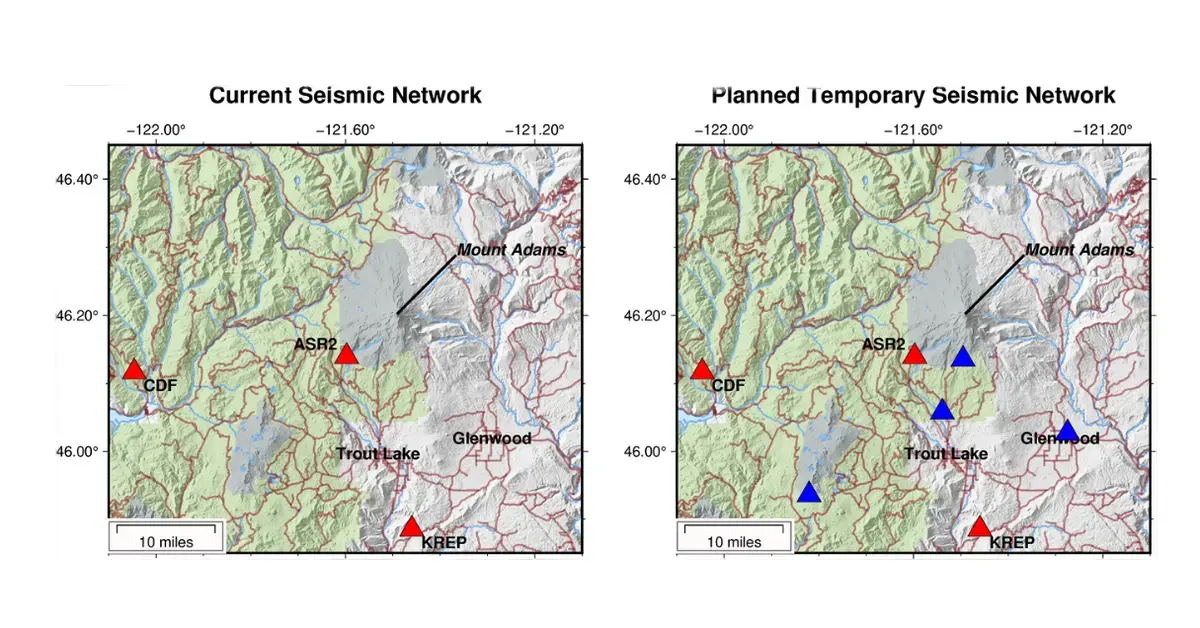
Maps of the currents and proposed seismic network station locations at Mount Adams. Image credit: CVO
- 6 locatable earthquakes (M0.9–2.0) were detected in September on seismic station ASR2, a PNSN-operated station located about 11 km (7 miles) southwest of the summit of Mount Adams, as well as other stations much farther away from the volcano. This represents the most earthquakes located at Mount Adams in a month since monitoring began in 1982.
- New sensors will improve the detection and analysis of seismic events, ensuring a better understanding and assessment of the volcano’s activity.
Following a significant rise in earthquake activity in September, USGS and PNSN scientists installed additional seismic sensors around Mount Adams, Washington’s second-tallest and largest active volcano.
Mount Adams averages one earthquake every two to three years. However, six earthquakes were registered in September alone, the greatest monthly total since seismic monitoring began at the volcano in 1982.
These earthquakes were recorded by seismic station ASR2, which is operated by the Pacific Northwest Seismic Network (PNSN) and situated approximately 11 km (7 miles) southwest of Mount Adams’ summit, along with other more distant stations.
The earthquakes varied from M0.9 to M2.0, and no surface vibrations were reported.
At present, there are no signs that the earthquake activity poses any immediate threat, and the Alert Level and Aviation Color Code for Mount Adams are at Normal and Green.

The increased seismic activity prompted the USGS and PNSN, important organizations involved in geological and seismic monitoring in the United States, to take preventative steps.
The new sensors are expected to increase earthquake detection and offer more detailed data on the locations and depths of seismic events, allowing experts to analyze the activity’s magnitude and identify any potential volcanic hazards.
Mount Adams has only one permanent seismic station, around 10 km (6.5 miles) from the summit. This solitary station hinders scientists’ ability to determine earthquake locations and depths precisely.
By installing more temporary sensors, scientists can collect more detailed and accurate data on seismic activity, allowing for improved research and understanding of the underlying processes.
The data from these stations will be transmitted in real-time to the USGS and PNSN, helping scientists determine whether the recent earthquake swarm is a sign of volcanic unrest or simply background seismicity typical of a dormant volcano.
In addition to enhancing seismic monitoring, scientists are scanning satellite data for any ground deformation that could suggest magma movement beneath the surface.
While no such deformation has been detected, these collaborative efforts provide a more complete picture of Mount Adams’ activity.
Mount Adams is located in south-central Washington State, roughly 80 km (50 miles) west-southwest of Yakima and about 48 km (30 miles) north of the White Salmon-Hood River basin along the Columbia River.
The volcano, part of the Cascade Range, has a conspicuous top surrounded by smaller volcanoes and an ice-capped summit.
According to the USGS, Mount Adams is a “high-threat” volcano with a well-documented potential for significant damage from volcanic hazards such as lahars.
Even though its last documented eruption occurred 3 800 to 7 600 years ago, the volcano is still considered active.
References:
1 Monitoring stations detect small magnitude earthquakes at Mount Adama (September 2024) – USGS – October 3, 2024

Harsha Borah is an experienced content writer with a proven track record in the industry. Harsha has worked with LitSpark Solutions and Whateveryourdose, honing skills in creating engaging content across various platforms. A gold medalist in a state-level writing competition organized by Assam Tourism, Harsha’s travelogue on Tezpur was widely appreciated. Harsha’s article, "The Dark Tale of the Only Judge in India to Be Hanged," ranks second on Google and has garnered over 11 000 views and 8 900 reads on Medium. Outside of writing, Harsha enjoys reading books and solving jigsaw puzzles.

Commenting rules and guidelines
We value the thoughts and opinions of our readers and welcome healthy discussions on our website. In order to maintain a respectful and positive community, we ask that all commenters follow these rules.