
Increased activity at Lewotolo volcano, Indonesia

Image credit: PVMBG
The activity at Lewotolo volcano, located in the Lesser Sunda Islands of Indonesia, intensified over the weekend. The Alert Level remains at 2 (on a scale of 1 – 4), and the public is warned to stay 2 km (1.2 miles) away from the summit crater.
Impressive lava fountains were observed on March 25, 18:03 UTC, rising several hundred meters above the crater. The height of the ash column was ± 700 m (2 297 feet) above the summit, or ± 2 123 m (6 965 feet) above sea level. The ash column appeared gray with moderate to thick intensity, drifting southeast. This eruption was recorded on a seismograph with a maximum amplitude of 18.1 mm and a duration of 56 seconds.1
According to the Darwin VAAC, a moderate gray ash plume reached up to 1 800 m (6 000 feet) above sea level late March 26.
Intense activity continued on March 27, with a vigorous explosion at 01:45 UTC. The height of the ash column was observed at ± 750 m (2 461 feet) above the summit, or ± 2 173 m (7 129 feet) above sea level. The ash column was gray with thick intensity, moving to the west and northwest. This eruption was recorded on a seismograph with a maximum amplitude of 13.1 mm and a duration of 32 seconds.

Another eruption was recorded at 09:04 UTC on March 27, with a maximum amplitude of 8.7 mm and a duration of 52 seconds. The height of the observed ash column was similar to the previous two explosions.
The Aviation Color Code is currently at Orange and the public is advised to stay 2 km (1.2 miles) away from the summit crater.
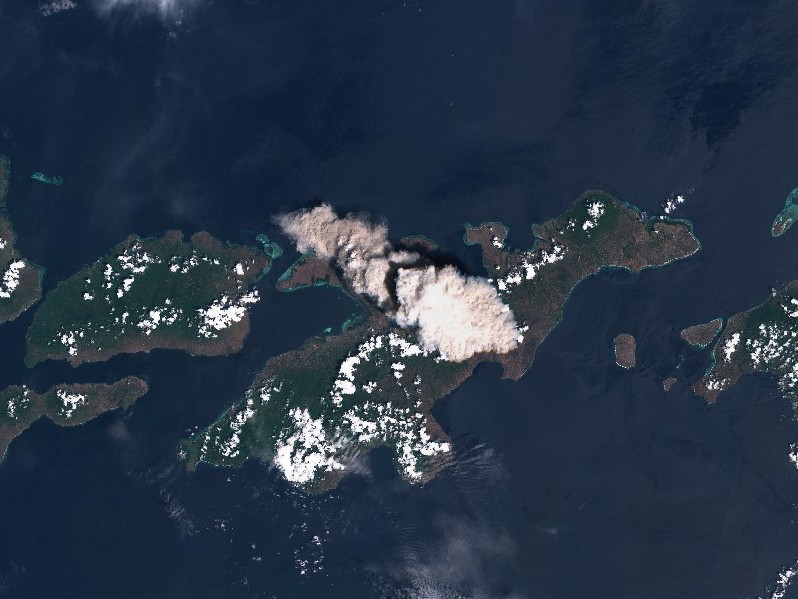
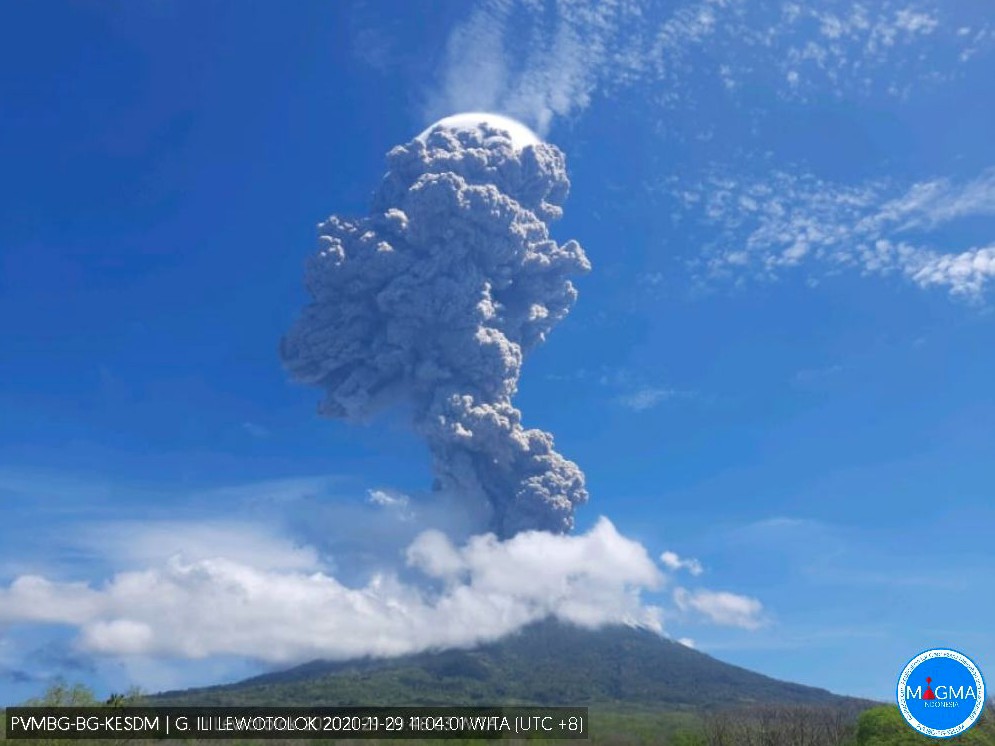
Lewotolo started erupting on November 26, 2020, for the first time since 2012. At 01:50 UTC on November 29, just 3 days later, a major, high-level eruption took place at the volcano.
According to the Darwin VAAC, the volcanic ash cloud was discernible on satellite imagery acquired 03:20 UTC to 15.2 km (50 000 feet) a.s.l. moving southeast and to 5.5 km (18 000 feet) a.s.l. moving northwest.
The eruption was recorded on a seismograph with a maximum amplitude of 35 mm and a duration of 600 seconds.
There were no reports of injuries or damage after this major eruption but authorities confirmed nearly 2 800 people from 28 villages on the slopes of the volcano were evacuated and nearby Wunopitu airport was temporarily closed after ashfall was reported in many areas on the island.
On April 4, 2021 — 5 months later — heavy rains dumped by Tropical Storm “Seroja” produced deadly lahars on the slopes of the volcano in which at least 67 people died. The lahars hit two villages — Lamawolo and Jontona.
Based on the information provided by the Lewotolo monitoring post, volcanologists have warned villagers that they were prone to lahar flows and asked to evacuate.3

Geological summary
The Lewotolok (or Lewotolo) stratovolcano occupies the eastern end of an elongated peninsula extending north into the Flores Sea, connected to Lembata (formerly Lomblen) Island by a narrow isthmus. It is symmetrical when viewed from the north and east.
A small cone with a 130 m (426 feet) wide crater constructed at the SE side of a larger crater forms the volcano’s high point. Many lava flows have reached the coastline.
Eruptions recorded since 1660 have consisted of explosive activity from the summit crater.4
References:
1 Lewwotolo volcano updates – MAGMA Indonesia – March 20 – 27, 2023
2 Major eruption at Lewotolo volcano, ash to 15.2 km (50 000 feet) a.s.l., Indonesia – The Watchers – November 29, 2020
3 More than 67 killed after lahar from Mount Lewotolo hits two villages, Indonesia – The Watchers – April 6, 2021
4 Lewotolo – Geological summary – GVP

Teo Blašković founded The Watchers in 2011 and edited it until 2026, covering seismic and volcanic activity, extreme weather, space weather and near-Earth objects. Articles on this page are his archive.
Published in the last 24 hours
- Marine iguanas in the Galápagos got shorter by as much as 6.8 cm (2.7 inches), or a fifth of their length, when El Niño left them short of the seaweed they can digest, and the biggest ones shrank the most and lived the longest Epicenter
- Neptune's moon Triton has the coldest surface ever measured in the solar system, minus 391 degrees Fahrenheit, yet Voyager 2 caught geysers on it blasting dark plumes 5 miles high Epicenter
- An 83-year-old lodge owner named Harry R. Truman refused to leave his home on Spirit Lake below Mount St. Helens in the spring of 1980, insisting the mountain would not get him, and the May 18 eruption buried him along with his 16 cats Epicenter
- When the Sun’s stormy peak dragged NASA's 77-tonne Skylab out of orbit earlier than expected in 1979, debris rained across Western Australia and the town of Esperance fined NASA $400 for littering; a California radio host finally paid it 30 years later Epicenter
