
New strong explosion at Stromboli volcano, Italy
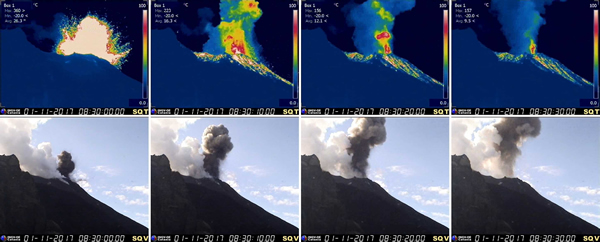
Featured image: Strong explosion at Stromboli volcano, Italy on November 1, 2017. Credit: INGV
A new strong explosion took place at Stromboli volcano, Italy at 20:29 UTC on November 1, 2017, and lasted approximately 3 minutes.
According to INGV Catania, the explosion was similar to that of October 23, 2017. "Surveillance camera image analysis showed that the explosive sequence started with an intense event from the southcentral crater and was followed by several smaller explosions in the following minutes," the observatory said.
The explosion ejected abundant crude pyroclastic material on Sciara del Fuoco viewpoint and in the direction of Pizzo sopra la Fossa as well as dense ash plume which quickly dispersed.
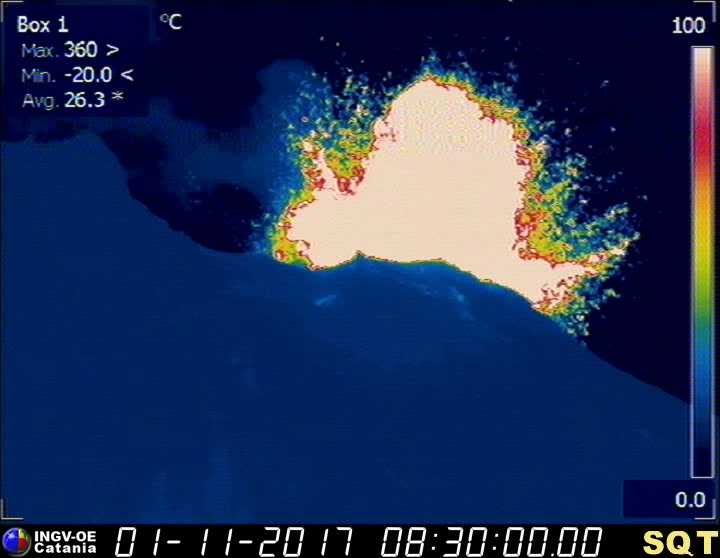
Credit: INGV
"This was a typical explosive sequence, well known in the literature, and is not necessarily linked to the rise of new magma," INGV said.
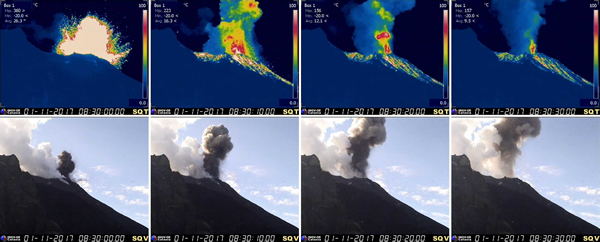
Credit: INGV
An inspection will be performed over the next few days to characterize the event in more detail.
"At present, it can not be ruled out that such events can happen again in the near future," INGV concluded.
Geological summary
Spectacular incandescent nighttime explosions at this volcano have long attracted visitors to the "Lighthouse of the Mediterranean."
Stromboli, the NE-most of the Aeolian Islands, has lent its name to the frequent mild explosive activity that has characterized its eruptions throughout much of historical time. The small, 924-m-high (3 031 feet) island is the emergent summit of a volcano that grew in two main eruptive cycles, the last of which formed the western portion of the island.
The Neostromboli eruptive period from about 13 000 to 5 000 years ago was followed by formation of the modern Stromboli edifice. The active summit vents are located at the head of the Sciara del Fuoco, a prominent horseshoe-shaped scarp formed about 5 000 years ago as a result of the most recent of a series of slope failures that extend to below sea level.
The modern volcano has been constructed within this scarp, which funnels pyroclastic ejecta and lava flows to the NW. Essentially continuous mild strombolian explosions, sometimes accompanied by lava flows, have been recorded for more than a millennium. (GVP)

I'm a dedicated researcher, journalist, and editor at The Watchers. With over 20 years of experience in the media industry, I specialize in hard science news, focusing on extreme weather, seismic and volcanic activity, space weather, and astronomy, including near-Earth objects and planetary defense strategies. You can reach me at teo /at/ watchers.news.

The dragons are rising