
Heavy flooding hits Tanzania
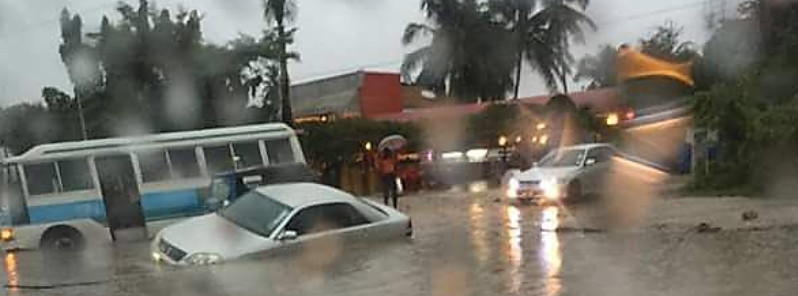
Featured image: Flood in Tanzania, January 20, 2016. Image credit: @moving_sushi
Heavy rainfalls that have been battering Tanzania since January 14, 2016, have caused flooding across a few regions of the country, including Morogoro, Katavi and Dar es Salaam. 6 people died on January 28 alone, in a flood-related incident, while thousands have been left homeless since the rainfalls started.
Torrential downpours in Dar es Salaam lasted for almost two hours, flooded city's roads, especially in Kinondoni district. Luckily, no deaths were reported and no evacuations were necessary. The road connecting the Kilombero and Ulanga districts has been destroyed by the rainstorm, according to Ms Jenista Mhagama, the Minister of State in the Prime Minister's Office.

72-hr accumulated rainfall as observed by GPM Core Observatory. Image credit: Google/NASA/JAXA GPM
The Tanzania Meteorological Agency (TMA) reported 109.9 mm (4.3 inches) of rainfall in Mtwara and 105.1 mm (4.1 inches) in Dar es Salaam on January 28. Tanga measured 141.8 mm (5.6 inches) and Pemba 63.1 mm (2.5 inches) during January 29. The Morogoro city recorded 57.6 mm (2.3 inches) on January 31.
Mahenge reported 59.4 mm (2.3 inches) of rain and 53.6 mm (2.1 inches) fell in Naliendele on February 1 while the city of Mtwara recorded 77 mm (3 inches), Songea 58 mm (2.3 inches) and Kibondo measured 50.5 mm (2 inches) of rainfall on February 2.

30-day average rainfall as observed by GPM Core Observatory. Image credit: Google/NASA/JAXA GPM
Despite the fact that the seasonal rains usually spreading through October, November and December are now over, there is still a likelihood of rainfall outside the normal season in Dar es Salaam, Arusha and Kilimanjaro regions, according to the TMA.
Just when you thought the heatwave in #southafrica was to much, flooding in #tanzania Dar Es Salaam. Hello El Niño pic.twitter.com/8VLaiDejff
— Moving Sushi (@moving_sushi) January 20, 2016
Above average rainfall has been forecast for Ruvuma, Rukwa, Iringa and Mbeya regions until April 2016.
Severe #flooding in #Tanzania has left thousands of citizens homeless: @TheCitizenTZ https://t.co/9SBq256SjH
— Circle of Blue (@circleofblue) January 20, 2016
Another spell of severe weather
The Minister warned the people about another expected spell of severe weather and rains which will likely cause further damage to the infrastructure and local property. Disaster management committees in the local governments have been urged to coordinate with the national disaster management in the Prime Minister's Office in a case of any catastrophe in their areas.
People have been strongly advised to take all the necessary precaution measure in the coming period.

Published in the last 24 hours
- High Risk of excessive rainfall covers Florida’s Space Coast as St. Johns River near Cocoa reaches 5.67 m
- A broad low over southeastern Florida and the northwestern Bahamas has a 30 percent chance of subtropical or tropical development within 48 hours and a 50 percent chance within 7 days, the National Hurricane Center says
- Four small asteroids will pass close to Earth from November 21 to 23
- Cyclone Akvan weakens after landfall near Gopalpur; more than 300 000 evacuated in Odisha, India
