
Famous Egremni Beach in Greece completely wipped away by a series of large landslides

Image credit: My Lefkada
A series of large landslides, triggered by the strong earthquake that hit near the west coast of Greece on November 17, 2015, caused one of the world's most beautiful beaches, on the island of Lefkada, to perish.
In bad geological news, Egremni beach basically disappeared after this week's earthquake. (before & after) pic.twitter.com/MVjEmxhdnL
— Ada (@adatweetsthings) November 19, 2015
ICYMI: Lefkada: dramatic landslides from the earthquake on Nov. 17 https://t.co/9EPzHXnNgk @davepetley #AGUblogs pic.twitter.com/4sbyJyWsis
— AGU's Eos (@AGU_Eos) November 22, 2015
A strong and shallow earthquake of M6.5 with epicenter 14 km (9 miles) WNW of Nidri was registered on November 17 at 07:10 UTC. Not much later, large boulders and a large pile of rubble came tumbling down the mountain, located just above the famous sandy Egremni Beach on the west coast of the island of Lefkada.

Egremni Beach, after devastating landslides, drone footage. Image credit: Geoengineer Website

Egremni Beach, after devastating landslides, drone footage. Image credit: Geoengineer Website
Series of landslides have left huge volumes of debris on the area below. The biggest part of the once, one of the most beautiful beaches of the world, was completely devastated, according to media reports.

Video credit: My Lefkada via YouTube
Large landslide, following the moment of the earthquake, has been captured on video by a local fisherman, who was offshore with his boat at the time.
The earthquake responsible for the event would have been a deadly one, had it occurred during summer when the beach is usually packed with tourists. The worst case scenario has, luckily, been avoided, however the Egremni Beach will never again return to its state prior to the earthquake.
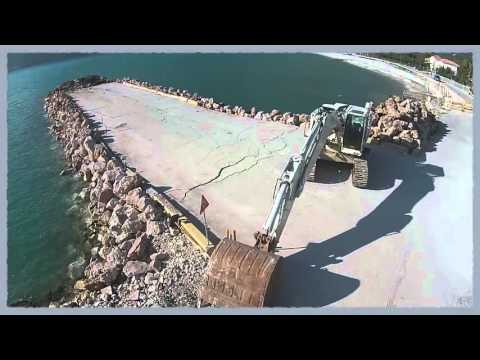
Video credit: Geoengineer Website
Apart from triggering a series of deadly landslides, the earthquake caused significant damage to piers, soil backfill, quay walls and roads. Two victims have been reported.

Published in the last 24 hours
- Male toads abandoned a pond in Italy five days before a deadly 2009 earthquake, while a scientist was counting them Epicenter
- An asteroid was spotted 19 hours before it exploded over Sudan in 2008, and students picked its pieces off the desert Epicenter
- A wave up to 3 m (10 feet) high rose out of Lake Michigan on a sunny June morning in 1954 and swept fishermen off Chicago’s piers, and when a second came 10 days later, warnings had cleared the shore Epicenter
- Just 12 inches of rushing water can carry away most cars, and more than half of US flood drownings happen to people who drive into flood water Epicenter

how many people injure