
Tracking space weather for New Horizons
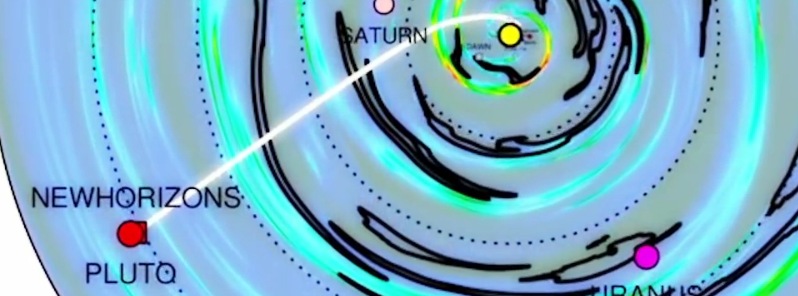
Image credit: TW
A few months before New Horizons was due to reach Pluto, a community of scientists came together to determine just what kind of a environment the mission would experience during its historic flyby.
While the simulations aren't 100% conclusive, this first ever attempt to characterize space weather conditions so far from our own home opens the door to better protecting our spacecraft – and eventually humans – as we continue to explore the solar system and beyond.
To attempt to map what surges of particles are passing by Pluto, the Community Coordinated Modeling Center, or CCMC, at NASA's Goddard Space Flight Center in Greenbelt, Maryland, sought input from space weather scientists around the nation. The CCMC houses numerous software models to help scientists with their research and also to enable improved space weather forecasting.

Video courtesy of NASA/Goddard

The Watchers team and our contributors bring the latest on extreme weather, earthquakes, volcanic eruptions, space weather, and all things science. We're all about making sense of the natural world and keeping you informed on what’s happening. Got a tip or a question? Hit us up using the form at newstips!
Published in the last 24 hours
- High Risk of excessive rainfall covers Florida’s Space Coast as St. Johns River near Cocoa reaches 5.67 m
- Asteroid 2026 WJ to pass Earth at 1.7 lunar distances at 04:20 UTC on November 22, with 2026 WD following at 4.4 lunar distances on November 23
- Cyclone Akvan crossed the north Andhra Pradesh and south Odisha coasts close to Gopalpur on November 20 with 70-80 km/h winds gusting to 90, and has weakened into a deep depression
- A broad low over southeastern Florida and the northwestern Bahamas has a 30 percent chance of subtropical or tropical development within 48 hours and a 50 percent chance within 7 days, the National Hurricane Center says
