
G1-Minor geomagnetic storm in progress
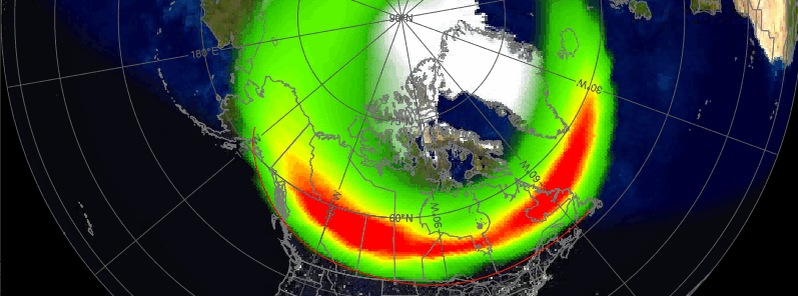
Featured image: Probability of visible aurora on July 13, 2015 at 08:00 UTC. Credit: NOAA/SWPC.
A G1-Minor geomagnetic storm is in progress as a result of coronal hole high speed stream (CH HSS) buffeting Earth's magnetic field.
Effects from the CH HSS are expected to continue disrupting the solar wind environment for the rest of the July 13.
By July 14, nominal conditions are expected to return as the CH HSS influence wanes.

Image credit: NOAA/SWPC.
The geomagnetic field is expected to be at quiet to unsettled levels through July 14.
Quiet conditions are expected on July 15 as CH HSS effects diminish.

Image credit: NOAA/SWPC.
***
Space Weather Message Code: ALTK05
Serial Number: 805
Issue Time: 2015 Jul 13 0741 UTC
ALERT: Geomagnetic K-index of 5
Threshold Reached: 2015 Jul 13 0741 UTC
Synoptic Period: 0600-0900 UTC
Active Warning: Yes
NOAA Scale: G1 – Minor
NOAA Space Weather Scale descriptions can be found at
www.swpc.noaa.gov/NOAAscales
Potential Impacts: Area of impact primarily poleward of 60 degrees Geomagnetic Latitude.
Induced Currents – Weak power grid fluctuations can occur.
Spacecraft – Minor impact on satellite operations possible.
Aurora – Aurora may be visible at high latitudes, i.e., northern tier of the U.S. such as northern Michigan and Maine.
***

Teo Blašković founded The Watchers in 2011 and edited it until 2026, covering seismic and volcanic activity, extreme weather, space weather and near-Earth objects. Articles on this page are his archive.
Published in the last 24 hours
- High Risk of excessive rainfall covers Florida’s Space Coast as St. Johns River near Cocoa reaches 5.67 m
- Asteroid 2026 WJ to pass Earth at 1.7 lunar distances at 04:20 UTC on November 22, with 2026 WD following at 4.4 lunar distances on November 23
- Cyclone Akvan crossed the north Andhra Pradesh and south Odisha coasts close to Gopalpur on November 20 with 70-80 km/h winds gusting to 90, and has weakened into a deep depression
- A broad low over southeastern Florida and the northwestern Bahamas has a 30 percent chance of subtropical or tropical development within 48 hours and a 50 percent chance within 7 days, the National Hurricane Center says
