
Numerous M-class flares and CMEs off the northwestern limb
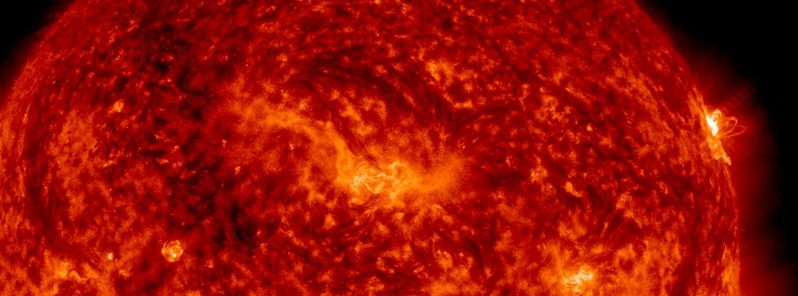
Image credit: NASA SDO/AIA 304 M1.2 at 09:51 UTC on March 2, 2015.
Solar activity reached moderate levels today when Region 2290 (N22W84, Hsx/Alpha) produced a pair of M1 (R1-Minor) flares at 06:39 (M1.0) and 09:48 UTC (M1.1). This region also produced numerous low and mid-level C-class flares over the last 24 hours.
Numerous Coronal Mass Ejections (CMEs) were observed off the northwestern limb associated with flare activity from Region 2290 but initial analysis indicates that none were Earth-directed, SWPC said.
Meanwhile, coronal hole high speed stream (CH HSS) is stirring up geomagnetic storms on our planet.


Updates:
A third M-class solar flare erupted from Region 2290 peaking as M3.7 at 15:28 UTC today. The event started at 15:10 and ended at 15:37 UTC.
At 19:31 UTC, Region 2290 unleashed fourth M-class solar flare of the day. This one measured M4.1; it started at 19:21 and ended at 19:36 UTC.
Sunspots
There are currently 4 numbered sunspot regions on the Earth side of the Sun.
Due to Region 2290's proximity to the western limb sunspot and magnetic classification were difficult to accurately determine. Region 2292 (S08W37, Dai/beta), which reemerged from plage yesterday, exhibited moderate growth in its leader and intermediate spot areas but was largely unproductive in last 24 hours.
Region 2293 (N06W05, Dai-beta) underwent minor decay.

Sunspots on March 2, 2015. Image credit: NASA SDO/HMI
2290 – Alpha
2292 – Beta
2293 – Beta-Gamma
2294 – Beta
Forecast
Solar activity is expected to be low with a chance for M-class (R1-R2/Minor-Moderate) flare activity today as Region 2290 crosses the northwestern limb. The activity is likely to be low on February 3 and 4.
The greater than 2 MeV electron flux is expected to remain at normal levels today and tomorrow with normal to moderate levels likely on March 4 in response to the current coronal hole high speed stream (CH HSS) effects and enhanced solar wind environment.
The greater than 10 MeV proton flux is expected to persist at background levels over the next three days (March 2 – 4).

The solar wind environment is expected to remain enhanced for the remainder of the UTC day until midday on March 3 as CH HSS persists. Solar wind parameters are likely to begin a gradual return to near-background levels midday on March 3 through March 4 as CH HSS influence begins to wane.

The geomagnetic field is expected to be at active to G1 (Minor) levels through midday on March 2 due to continued CH HSS effects. Field activity is likely to decrease to unsettled levels late today with unsettled to active conditions on March 3 as CH HSS influence begins to subside.

Generally quiet to unsettled levels are expected on March 4 with the anticipated return to a nominal solar wind regime.

Teo Blašković founded The Watchers in 2011 and edited it until 2026, covering seismic and volcanic activity, extreme weather, space weather and near-Earth objects. Articles on this page are his archive.
Published in the last 24 hours
- High Risk of excessive rainfall covers Florida’s Space Coast as St. Johns River near Cocoa reaches 5.67 m
- Four small asteroids will pass close to Earth from November 21 to 23
- Cyclone Akvan weakens after landfall near Gopalpur; more than 300 000 evacuated in Odisha, India
- A broad low over southeastern Florida and the northwestern Bahamas has a 30 percent chance of subtropical or tropical development within 48 hours and a 50 percent chance within 7 days, the National Hurricane Center says
