
Newly numbered Region 2268 produced a moderate M1.4 solar flare
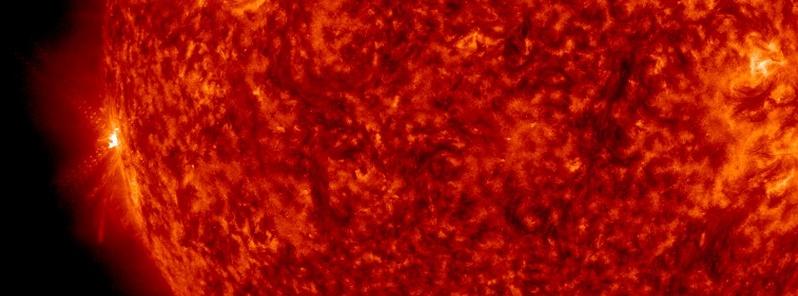
Featured image: M1.4 solar flare from Region 2260 on January 22, 2015. Image credit: NASA SDO/AIA 304
Newly numbered Region 2268 (S10E72, Hax/alpha) produced a moderate M1.4 solar flare on January 22, 2015, just as it began rotating onto the Southeast limb.
The event started at 04:43, peaked at 04:52 and ended at 05:02 UTC.
There were no signatures that would suggest a Coronal Mass Ejection was produced by the event.
This region also produced multiple C-class solar flares during last 48 hours, including a C9.9 at 11:32 UTC on January 21.


Sunspots
There are currently 4 numbered sunspot regions on the solar disk. Newly numbered region 2268 is the only one producing flares at this time.
The remaining spotted regions are relatively quiet and stable.

Sunspots on January 22, 2015. Image credit: NASA SDO/HMI
2265 – Alpha
2266 – Beta
2267 – Alpha
2268 – Alpha
Forecast
Over the next three days (January 22 – 24), solar activity is expected to be low, with increasing chances for M-class (R1-R2, Minor-Moderate) as new Region 2268 continues to rotate onto the visible disk, SWPC said.
Solar wind parameters seemed to reflect the influence of a negative polarity coronal hole high speed stream (CH HSS) during the last 24 hours.
Elevated wind speeds, enhanced total field strength, and periods of isolated negative Bz can be expected over the next three days.
The geomagnetic field saw quiet to unsettled conditions with isolated active periods as CH HSS effects continued.
Quiet to active levels, with a slight chance for minor (G1-minor) storm conditions, are expected from January 22 – 24 due to persistent CH HSS influences.

Teo Blašković founded The Watchers in 2011 and edited it until 2026, covering seismic and volcanic activity, extreme weather, space weather and near-Earth objects. Articles on this page are his archive.
Published in the last 24 hours
- Male toads abandoned a pond in Italy five days before a deadly 2009 earthquake, while a scientist was counting them Epicenter
- An asteroid was spotted 19 hours before it exploded over Sudan in 2008, and students picked its pieces off the desert Epicenter
- A wave up to 3 m (10 feet) high rose out of Lake Michigan on a sunny June morning in 1954 and swept fishermen off Chicago’s piers, and when a second came 10 days later, warnings had cleared the shore Epicenter
- Just 12 inches of rushing water can carry away most cars, and more than half of US flood drownings happen to people who drive into flood water Epicenter
