
Three M-class solar flares erupted from southwest quadrant
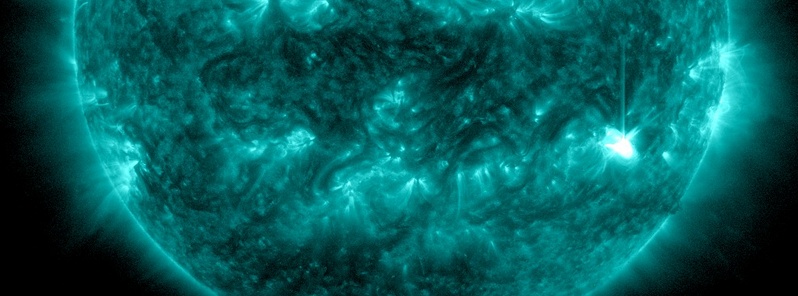
Image credit: NASA SDO/AIA 131 on October 9, 2014 at 01:45 UTC.
Two M-class solar flares erupted from Region 2182 early Thursday, October 9, 2014. The first event started at 01:30, peaked at 01:41 UTC as M1.3 solar flare and ended at 01:47.
The second M-class erupted immediately after the M1.3.
It started at 01:54, peaked at 01:58 as M1.4 and ended at 02:02 UTC.
Region 2182 has 'beta' magnetic configuration and is located in the southwest quadrant. More information about those two events will be available after the analysis is complete.
NOAA SWPC forecasters estimate 5% chance for M-class and 1% chance for X-class solar flares in the next three days.
Update:
A third M-class solar flare erupted from the same region about 5 hours after the M1.4. That event started at 06:48, peaked at 06:59 as M1.2 solar flare and ended at 07:06 UTC.


Sunspots
There are currently 5 numbered sunspot regions on the disk. Region 2186 (S19E60, Cso/beta) exhibited growth as it rotated onto the visible disk yesterday. All other regions were either stable or in decay. None of them currently poses a threat for strong eruptions.

Sunspots on October 9, 2014. Image credit: ESA PROBA2/SWAP
2178 – Alpha
2181 – Alpha
2182 – Beta
2184 – Alpha
2186 – Beta
Geomagnetic field
The geomagnetic field was quiet yesterday with an isolated unsettled period from 09:00 – 12:00 UTC due to extended southward Bz.
It is expected to be quiet to unsettled early on October 9 with a chance for isolated active periods (below G1-Minor) overnight due to enhanced magnetic field and possible nighttime sub-storming.
Predominantly quiet conditions are expected on October 10. Quiet to unsettled conditions are expected on October 11 due to effects from a favorably positioned coronal hole high speed stream.

Teo Blašković founded The Watchers in 2011 and edited it until 2026, covering seismic and volcanic activity, extreme weather, space weather and near-Earth objects. Articles on this page are his archive.
Published in the last 24 hours
- High Risk of excessive rainfall covers Florida’s Space Coast as St. Johns River near Cocoa reaches 5.67 m
- Asteroid 2026 WJ to pass Earth at 1.7 lunar distances at 04:20 UTC on November 22, with 2026 WD following at 4.4 lunar distances on November 23
- Cyclone Akvan crossed the north Andhra Pradesh and south Odisha coasts close to Gopalpur on November 20 with 70-80 km/h winds gusting to 90, and has weakened into a deep depression
- A broad low over southeastern Florida and the northwestern Bahamas has a 30 percent chance of subtropical or tropical development within 48 hours and a 50 percent chance within 7 days, the National Hurricane Center says
