
MAVEN on its way to study what went wrong on Mars
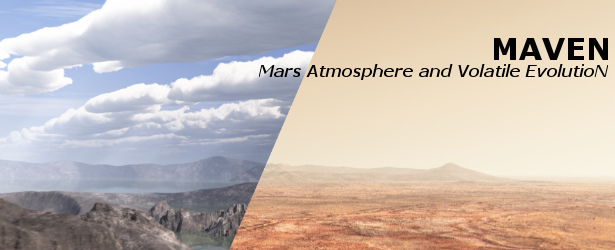
Image credit: "MAVEN mission set for launch" created from 2 images by Michael Lentz/NASA Goddard Conceptual Image Lab. Edit: The Watchers
The Mars Atmosphere and Volatile EvolutioN (MAVEN) mission is scheduled for launch today, November 18, 2013. The two-hour launch window opens at 18:28 UTC. This will be the first mission devoted to understanding the Martian upper atmosphere and what went wrong with it.
Today, Mars is a cold and barren desert world, with no sign of life, at least on the surface. However, billions of years ago when the Red Planet was young, it appears to have had a thick atmosphere that was warm enough to support oceans of liquid water – a critical ingredient for life.
Liquid water cannot exist pervasively on the Martian surface today due to the low atmospheric pressure and surface temperature, although there is evidence for spurts of liquid flow that perhaps consist of a briny solution with reduced freezing temperature, according to Joseph Grebowsky of NASA's Goddard Space Flight Center in Greenbelt, Md. Water under current Martian atmospheric conditions can be ice or sublimate directly into vapor without staying in a liquid phase.
"There are characteristic dendritic structured channels that, like on Earth, are consistent with surface erosion by water flows. The interiors of some impact craters have basins suggesting crater lakes, with many showing connecting channels consistent with water flows into and out of the crater. Small impact craters have been removed with time and larger craters show signs of erosion by water before 3.7 billion years ago. And sedimentary layering is seen on valley walls. Minerals are present on the surface that can only be produced in the presence of liquid water, e.g., hematite and clays," he said.
Mission overview
MAVEN will have four primary scientific objectives:
- Determine the role that loss of volatiles from the Mars atmosphere to space has played through time
- Determine the current state of the upper atmosphere, ionosphere, and interactions with the solar wind
- Determine the current rates of escape of neutral gases and ions to space and the processes controlling them
- Determine the ratios of stable isotopes in the Martian atmosphere
MAVEN will determine how much of the Martian atmosphere has been lost over time by measuring the current rate of escape to space and gathering enough information about the relevant processes to allow extrapolation backward in time.

Weather forecast remains 60% “Go” for MAVEN to spend its last moments on Earth atop the United Launch Alliance Atlas V rocket. The main concerns are for cumulus clouds, disturbed weather and thick clouds in the launch area.
Image credit: NASA

Video courtesy Science@NASA
Follow MAVEN's launch live
Live commentary and prelaunch coverage starts at 16:00 UTC (11 a.m. EST) on NASA's Launch Blog at http://blogs.nasa.gov/maven and on NASA Television at http://www.nasa.gov/ntv.
Throughout the launch countdown, the NASA LSP Twitter and Facebook accounts will be continuously updated:
Learn more about MAVEN
- MAVEN's homepage
- MAVEN's Mission Page at NASA
- Read more about its mission here
- MAVEN on Twitter
- MAVEN on Facebook

Teo Blašković founded The Watchers in 2011 and edited it until 2026, covering seismic and volcanic activity, extreme weather, space weather and near-Earth objects. Articles on this page are his archive.
Published in the last 24 hours
- Male toads abandoned a pond in Italy five days before a deadly 2009 earthquake, while a scientist was counting them Epicenter
- An asteroid was spotted 19 hours before it exploded over Sudan in 2008, and students picked its pieces off the desert Epicenter
- A wave up to 3 m (10 feet) high rose out of Lake Michigan on a sunny June morning in 1954 and swept fishermen off Chicago’s piers, and when a second came 10 days later, warnings had cleared the shore Epicenter
- Just 12 inches of rushing water can carry away most cars, and more than half of US flood drownings happen to people who drive into flood water Epicenter

Tell Maven to stay home and leave Mars alone. It does not belong to us. Over how much money was spent to send Maven to Mars. I thought we were in dire need of money? Cutting food and other things from the American people and to play with their toys in space. Who cares what Martians are doing or even existed. If the government is going to complain about money then they need put their mouths where is should be.