
Sunspot 1865 produced an M1.1 flare – possible Earth-directed CME
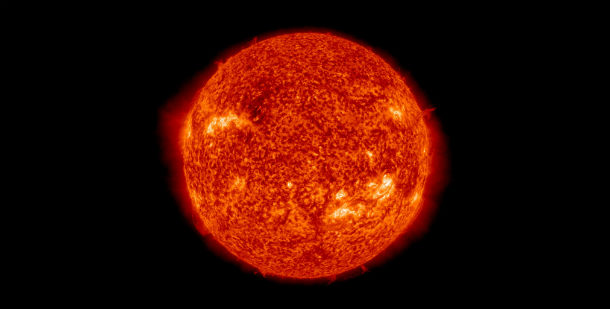
Image credit: NASA SDO AIA 304 - October 15, 2013
In last 24 hours solar activity has been at moderate levels with many C-class flares detected from sunspots 1865, 1861 and from new approaching region behind the east limb. Active Region 1865 produced an M1.1 flare at 09:00 UTC. There are clear dimming as signs of a CME in SWAP and AIA data but no coronograph images yet to confirm. Analysis of any associated Coronal Mass Ejection (CME) will be accomplished as imagery becomes available. Due to the location of this region, an ejection has strong chances of being Earth-directed.

SDO/EVE SAM 1-hour integram and GOES X-Ray flux data show M1.1 solar flare on October 15, 2013 (Credit: SDO/NOAA/SWPC/GOES)
Sunspot AR1865 has decreased in size, however, it still has a 'beta-gamma-delta' magnetic field that harbors energy for X-class solar flares. NOAA/SWPC forecasters estimate 30% chances for an M-class, and 1% chance for an X-class solar flare in the next 24 hours.

SDO AIA with active regions, EVE, X-Ray flux and satellite environment plot data for October 15, 2013 (Credit: NOAA/SWPC/SDO)
There are currently 8 numbered sunspots on the visible solar disk and two new are about to be numbered. Sunspots 1861 and 1865 are capable of producing strong Earth-directed solar flares. Both sunspots are rotating into the western hemisphere of the Sun, so the risk of proton events at Earth has increased. New active region is now about to rotate into view off the eastern limb. A number of coronal mass ejections originating from this region were observed during the past couple of days, including a bright backsided partial halo CME on October 14, 2013 at 22:00 UTC.
Geomagnetic conditions have ranged from unsettled to active due to the fast speed stream from a coronal hole. The possible arrival of the CME from October 13 could raise the geomagnetic conditions up to storm levels late on October 16.

Published in the last 24 hours
- Male toads abandoned a pond in Italy five days before a deadly 2009 earthquake, while a scientist was counting them Epicenter
- An asteroid was spotted 19 hours before it exploded over Sudan in 2008, and students picked its pieces off the desert Epicenter
- A wave up to 3 m (10 feet) high rose out of Lake Michigan on a sunny June morning in 1954 and swept fishermen off Chicago’s piers, and when a second came 10 days later, warnings had cleared the shore Epicenter
- Just 12 inches of rushing water can carry away most cars, and more than half of US flood drownings happen to people who drive into flood water Epicenter
