
M1.4 solar flare with Earth directed CME erupted from Region 1618 – G1 geomagnetic storm predicted
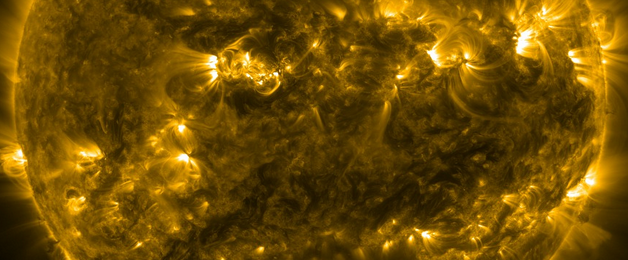
Image credit: Courtesy of NASA/SDO and the AIA, EVE, and HMI science teams.
Another moderate solar flare erupted from Active Region 1618. The event started at 06:45 UTC, peaked at 06:56 UTC at M1.4, November 21, 2012 and ended at 07:08 UTC. Region 1618 still has Beta-Gamma classification, harbors energy for strong solar flares and is Earth directed. Two eruption filaments were observed, both were Earth facing. A Coronal Mass Ejection (CME) is expected to impact the Earth sometime November 23 and may spark a G1 or G2 class Geomagnetic Storm.

A Type II and Type IV Radio Emissions were reported indicating a strong Coronal Mass Ejection (CME):
Space Weather Message Code: ALTTP2
Serial Number: 830
Issue Time: 2012 Nov 21 0728 UTC
ALERT: Type II Radio Emission
Begin Time: 2012 Nov 21 0654 UTC
Estimated Velocity: 720 km/s
Description: Type II emissions occur in association with eruptions on the sun and typically indicate a coronal mass ejection is associated with a flare event.
***
Space Weather Message Code: ALTTP4
Serial Number: 397
Issue Time: 2012 Nov 21 0729 UTC
ALERT: Type IV Radio Emission
Begin Time: 2012 Nov 21 0703 UTC
Description: Type IV emissions occur in association with major eruptions on the sun and are typically associated with strong coronal mass ejections and solar radiation storms.
***


 Image courtesy of NASA/SDO and the AIA, EVE, and HMI science teams.
At 07:36 UTC, November 21, 2012 SWPC issued a prediction for geomagnetic storm category G1:
Space Weather Message Code: WATA20
Serial Number: 504
Issue Time: 2012 Nov 21 0636 UTC
WATCH: Geomagnetic Storm Category G1 Predicted
Highest Storm Level Predicted by Day:
Nov 22: None (Below G1) Nov 23: None (Below G1) Nov 24: G1 (Minor)
THIS SUPERSEDES ANY/ALL PRIOR WATCHES IN EFFECT
Potential Impacts: Area of impact primarily poleward of 60 degrees Geomagnetic Latitude.
Induced Currents – Weak power grid fluctuations can occur.
Spacecraft – Minor impact on satellite operations possible.
Aurora – Aurora may be visible at high latitudes, i.e., northern tier of the U.S. such as northern Michigan and Maine.


Teo Blašković founded The Watchers in 2011 and edited it until 2026, covering seismic and volcanic activity, extreme weather, space weather and near-Earth objects. Articles on this page are his archive.
Published in the last 24 hours
- High Risk of excessive rainfall covers Florida’s Space Coast as St. Johns River near Cocoa reaches 5.67 m
- Asteroid 2026 WJ to pass Earth at 1.7 lunar distances at 04:20 UTC on November 22, with 2026 WD following at 4.4 lunar distances on November 23
- Cyclone Akvan crossed the north Andhra Pradesh and south Odisha coasts close to Gopalpur on November 20 with 70-80 km/h winds gusting to 90, and has weakened into a deep depression
- A broad low over southeastern Florida and the northwestern Bahamas has a 30 percent chance of subtropical or tropical development within 48 hours and a 50 percent chance within 7 days, the National Hurricane Center says
