
Impulsive M2.4 solar flare peaked at 13:19 UTC
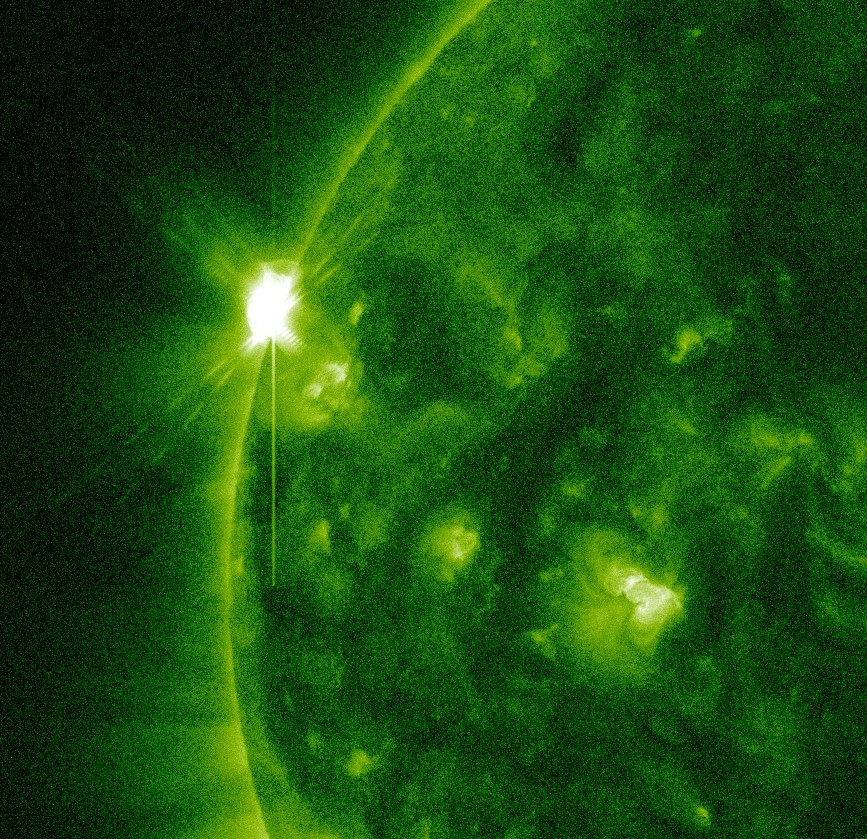
Image credit: TW
Impulsive M2.4 solar flare peaked at 13:19 UTC on August 17, 2012. The event started at 13:12 (B2.8) and ended at 13:23 (M1.0). The flare was centered around a new active region off the northeastern limb. This region is turning into view today.


| Beg | 17/1312 | B2.8 | |
| Max | 17/1319 | M2.4 | Int 6.9e-03 J m-2 |
| End | 17/1323 | M1.0 |
Minor ionization waves are rippling through our planet’s upper atmosphere. NOAA/SWPC issued Minor R1 Radio Blackout Alert. Weak or minor degradation of HF radio communication on sunlit side is possible, with occasional loss of radio contact as well as Low-frequency navigation signals could degraded for brief intervals.

Sunspot 1543 is turning away from Earth and is still crackling with impulsive C- and M-class solar flares. Geomagnetic field was at unsettled levels at short period reaching Geomagnetic K-index of 4.

The geomagnetic field is expected to be at quiet to unsettled levels for the next three days, with a chance for active levels. The disturbed conditions on August 17-18 are expected with the arrival of the CME from August 14. On August 19 a positive coronal hole high-speed stream should arrive and disturbed geomagnetic field again.
There is still 05% chance for another M-class, and 01% chance for X-class solar flare.
CURRENT CONDITIONS
Solar wind
speed: 385.9 km/sec
density: 0.1 protons/cm3
The Radio Sun
10.7 cm flux: 98 sfu
Planetary K-index
Now: Kp= 2 quiet
24-hr max: Kp= 4 unsettled
Interplanetary Mag. Field
Btotal: 2.6 nT
Bz: 0.3 nT south


Teo Blašković founded The Watchers in 2011 and edited it until 2026, covering seismic and volcanic activity, extreme weather, space weather and near-Earth objects. Articles on this page are his archive.
Published in the last 24 hours
- Male toads abandoned a pond in Italy five days before a deadly 2009 earthquake, while a scientist was counting them Epicenter
- An asteroid was spotted 19 hours before it exploded over Sudan in 2008, and students picked its pieces off the desert Epicenter
- A wave up to 3 m (10 feet) high rose out of Lake Michigan on a sunny June morning in 1954 and swept fishermen off Chicago’s piers, and when a second came 10 days later, warnings had cleared the shore Epicenter
- Just 12 inches of rushing water can carry away most cars, and more than half of US flood drownings happen to people who drive into flood water Epicenter

[…] The Watchers – Impulsive M2.4 solar flare peaked at 13:19 UTC […]