
Sun ain’t giving us a rest – after series of M-class events an M6.1 peaked at 11:44 UTC
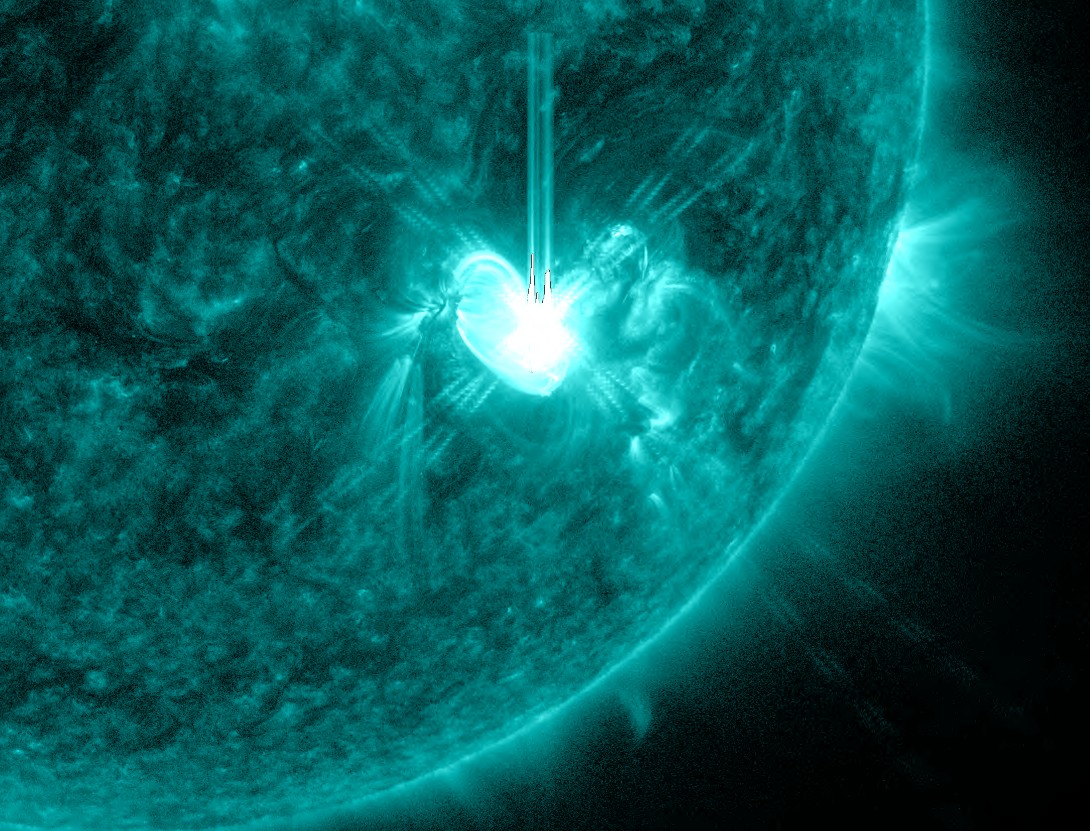
Image credit: TW
The Sun keeps producing M-class flares for second day in a row. We are now bound to get used to M-class same as we did with C-class. Yesterday we saw 5 strong M-class flares – today we reached that number before 8:00 UTC.

The day is still not over and we have already seen 8 M-class solar flares, almost all of them from Region 1515.
At 11:44 UTC on July 5, 2012 notorious Region 1515 peaked with M6.1 solar flare, the stronges so far. The event started at 11:39, peaked at 11:44 and ended at 11:49 UTC. Potential impacts: Area of impact centered primarily on sub-solar point on the sunlit side of Earth. Radio – Limited blackout of HF (high frequency) radio communication for tens of minutes.
Immediately after this eruption a powerful Coronal Mass Ejection (CME) was observed but it’s not Earth directed.

SUMMARY: X-ray Event exceeded M5
Begin Time: 2012 Jul 05 1139 UTC
Maximum Time: 2012 Jul 05 1144 UTC
End Time: 2012 Jul 05 1149 UTC
X-ray Class: M6.1
Optical Class: 1b
Location: S20W32
NOAA Scale: R2 – Moderate
SUMMARY: 10cm Radio Burst
Begin Time: 2012 Jul 05 1142 UTC
Maximum Time: 2012 Jul 05 1144 UTC
End Time: 2012 Jul 05 1145 UTC
Duration: 3 minutes
Peak Flux: 290 sfu
Description: A 10cm radio burst indicates that the electromagnetic burst associated with a solar flare at the 10cm wavelength was double or greater than the initial 10cm radio background. This can be indicative of significant radio noise in association with a solar flare. This noise is generally short-lived but can cause interference for sensitive receivers including radar, GPS, and satellite communications.

Latest solar events: updated at 15:20 UTC, July 5, 2012
| DATE/START | END | PEAK | CLASS | REGION |
| 2012/07/05 01:05:00 | 01:15:00 | 01:10:00 | M2.4 | 1515 |
| 2012/07/05 02:01:00 | 02:32:00 | 02:05:00 | C7.0 | 1515 |
| 2012/07/05 02:35:00 | 02:47:00 | 02:42:00 | M2.2 | 1515 |
| 2012/07/05 03:25:00 | 03:39:00 | 03:36:00 | M4.7 | 1515 |
| 2012/07/05 04:42:00 | 04:49:00 | 04:45:00 | C9.1 | 1515 |
| 2012/07/05 06:49:00 | 07:05:00 | 06:58:00 | M1.1 | 1515 |
| 2012/07/05 07:40:00 | 07:48:00 | 07:45:00 | M1.3 | 1515 |
| 2012/07/05 09:05:00 | 09:11:00 | 09:08:00 | C5.0 | 1515 |
| 2012/07/05 09:17:00 | 09:24:00 | 09:20:00 | C5.8 | 1515 |
| 2012/07/05 10:44:00 | 10:50:00 | 10:48:00 | M1.8 | 1515 |
| 2012/07/05 11:39:00 | 11:49:00 | 11:44:00 | M6.1 | 1515 |
| 2012/07/05 13:05:00 | 13:32:00 | 13:17:00 | M1.2 | 1514 |
There is 80% chance for more M-class flares and 20% chance for X-class.
More updates as they become available.
Follow Sun’s activity in real-time – SWS.

Teo Blašković founded The Watchers in 2011 and edited it until 2026, covering seismic and volcanic activity, extreme weather, space weather and near-Earth objects. Articles on this page are his archive.
Published in the last 24 hours
- High Risk of excessive rainfall covers Florida’s Space Coast as St. Johns River near Cocoa reaches 5.67 m
- Four small asteroids will pass close to Earth from November 21 to 23
- Cyclone Akvan weakens after landfall near Gopalpur; more than 300 000 evacuated in Odisha, India
- A broad low over southeastern Florida and the northwestern Bahamas has a 30 percent chance of subtropical or tropical development within 48 hours and a 50 percent chance within 7 days, the National Hurricane Center says

[…] 1514 )At 11:44 UTC on July 5, 2012 furious Sunspot AR1515 peaked with M6.1 solar flare, the strongest flare so far. Today’s M6.1 eruption is a little over half the size of the […]